

By The Numbers
$1.3 trillion — Market cap erased from the AI chip ecosystem in the space of two days after Broadcom's (AVGO) earnings last week
10.86% / 11.28% — AMD and Intel's (INTC) single-day drops on June 5, among the sharpest moves for either stock this year
$10.8 billion — Broadcom's custom AI chip revenue in Q2 2026, a 143% increase year-over-year, the number the selloff somehow ignored
$56 billion — Broadcom's full-year 2026 AI chip revenue target, representing 180% growth over fiscal 2025
$100 billion+ — Broadcom's fiscal 2027 AI chip target, which would be more than the entire chip industry earned five years ago
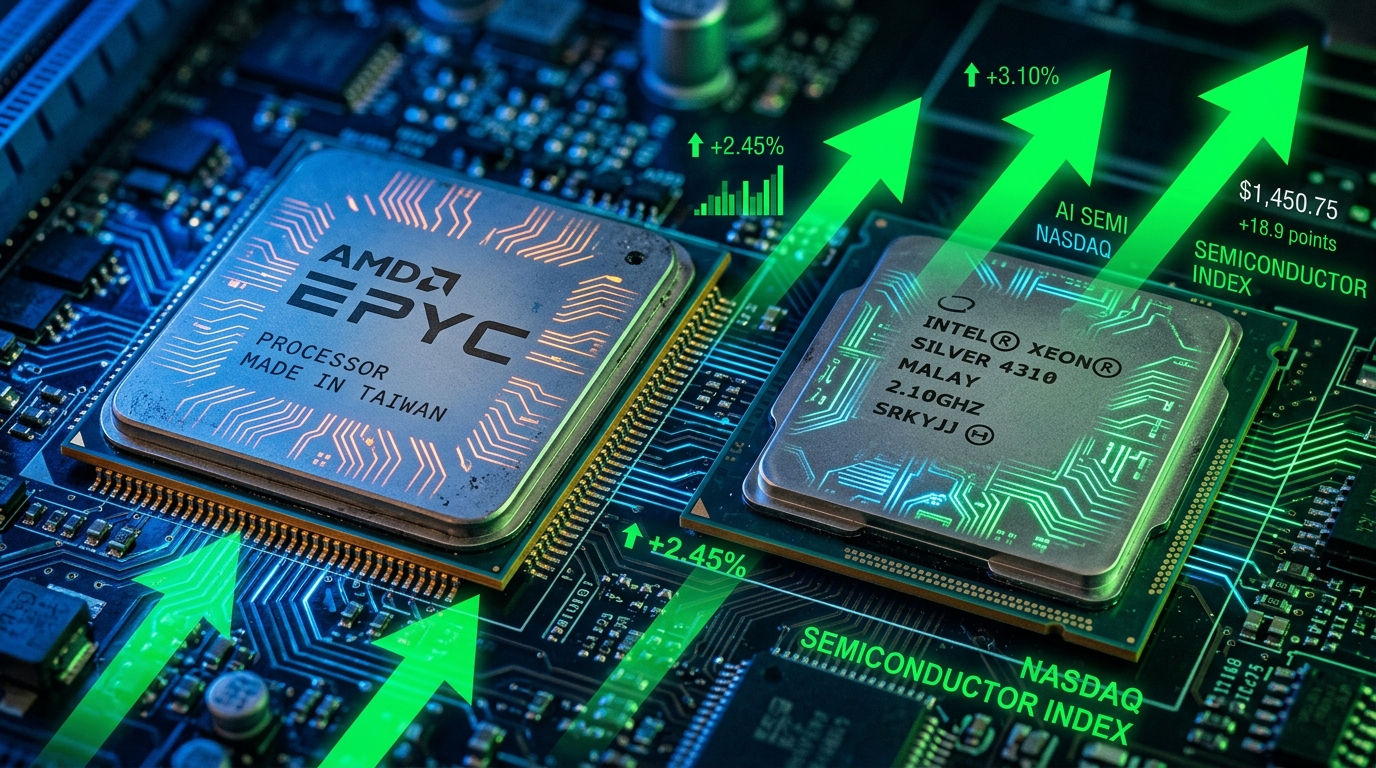
Last week, Wall Street decided the AI chip party was over. Semiconductor stocks crashed. AMD fell 11%. Intel fell 11%. The Philadelphia Semiconductor Index dropped 10%. Headlines screamed about the death of the AI trade. Then, three days later, Intel surged 8.5% in a single session on a new Alphabet (GOOGL) contract. Micron (MU) jumped 9%. The Nasdaq reversed course.
The investors who sold during the panic are now watching the recovery from the sidelines. This story has happened before. It will happen again. Here's what actually drove the selloff and why the underlying thesis never changed.
The "Bad News" That Wasn't
Broadcom reported earnings on June 4. The company's AI chip revenue hit $10.8 billion, up 143% from the same quarter a year ago. Broadcom projected $56 billion in AI chip revenue for the full fiscal year. It set a 2027 target north of $100 billion.
Those are extraordinary numbers. The market erased $286 billion of Broadcom's market cap the same day they were released.
Why? Because Broadcom reiterated its guidance instead of raising it. Wall Street had been expecting an upgrade. When the upgrade didn't come, traders who had positioned for a beat reacted the way traders always do when they're wrong. They sold. Fast.
Hold on. Let me stop here. Reiterating $56 billion in AI chip revenue for a single year is not bad news. That number didn't exist two years ago. The entire global semiconductor market was around $530 billion last year. Broadcom alone is targeting $56 billion in AI chips in 2026.
AMD, Intel, and the Real Story
AMD and Intel got dragged down in the broad chip panic, but neither had anything to do with Broadcom's guidance. AMD is building data center AI chips that compete directly with Nvidia (NVDA). Its MI300X accelerator is gaining ground in hyperscaler deployments. The sell-off on June 5 had nothing to do with AMD's fundamentals.
Intel's situation is different. The company has been in a multi-year turnaround and the road hasn't been smooth. But on June 8, Alphabet announced it selected Intel for chip manufacturing. That contract is validation that Intel's foundry ambitions are real, not just PR. The stock jumped 8.5% on the news. That's what the market looks like when it corrects a mistake.
"The AI chip supercycle doesn't end because Broadcom didn't raise guidance one quarter. It ends when companies stop building data centers. That hasn't happened."
The Trillion-Dollar Destination
The global semiconductor market is on a path toward $1 trillion in annual revenue. AI chips are projected to approach $500 billion of that total, which would mark the first time in history that AI-related chips account for more than half of all chip industry revenue. That milestone, whenever it arrives, will be one of the most significant in technology history.
It's kinda like being an investor in oil in 1905. Everyone knew cars were coming. The question wasn't whether oil demand would grow. The question was which companies would capture the value. The ones who panicked and sold in 1908 missed the next 80 years of the most important industry in the world.
You don't have to trust me. Trust the math. Microsoft (MSFT), Google, Amazon (AMZN), and Meta have all committed to combined AI infrastructure spending north of $300 billion in 2026 alone. That money flows through chip companies. AMD, Intel, Micron, and Broadcom are all in the path of it.
The panic was real. The recovery was faster. The next dip will probably look like another opportunity, not a warning sign.
P.S. Micron reports earnings later this month. After gaining 9% in the recovery, any guidance commentary on AI memory demand will be the next inflection point for the sector. Mark it on your calendar.



Comments
Log in or sign up to join the conversation.