

The year so far has been marked by uncertainty in the stock market - and, yesterday, following developments in eastern Europe – the equity markets were plagued by volatility once again.
After ending Wednesday’s sessions with losses, the main Wall Street indices all sank at the opening bell yesterday. The Dow Jones, S&P 500, and Nasdaq were seemingly in sell-off mode, all falling between 1% and 2% at the start of the session.
However, remarkably, all three indices turned it around, as investors rediscovered their appetite for risk during the session, and all three ended the day with gains of 0.28%, 1.5%, and 3.34% respectively.
As increased uncertainty grips global markets, traders and investors should remain braced for an increase in volatility and, with it, risk. Illustrating this recent uptick in volatility is the CBOE Volatility Index (VIX), sometimes referred to as the ‘Fear Index’, which measures expected volatility based on the S&P 500 options market.
Volatility is considered high when the VIX is higher than 20. Yesterday, the index closed the day just above 30.
Oil and USD Rise
As uncertainty fuelled an increase in volatility in the equity markets - oil and the USD both rose.
The US dollar has long been a safe-haven favorite of investors during periods of market turbulence and, yesterday, it moved higher. The US dollar index, which tracks the performance of the greenback against its rival currencies, closed the day with a gain of 0.93% - having been up as much as 1.6% intraday.
Yesterday’s performance of gold, another popular safe-haven asset, typified the uncertainty and indecision which is currently rife within the markets. Despite the price almost hitting $1,975 intraday, a gain of 3.5% from the previous day’s closing price, it ended the session around $1,903, representing a small loss, although remains up almost 6% for the month.
Crude oil has been following a bullish trajectory ever since its price crashed at the outset of the coronavirus pandemic in March 2020. In December, we speculated that the price of Brent crude may soon break above $80 a barrel, it did. Then it broke $90 and, yesterday, the price of Brent crude shot above $100 a barrel for the first time since 2014, almost touching $105 intraday.
However, the price eventually settled and closed the session at $98.26, a gain of 1.12% for the session, and has risen again this morning.
Oil prices have been supported by increasing demand, due to economies reopening after Covid-19 restrictions were eased and particularly bitter winter in the northern hemisphere. On the supply side, OPEC+ members have continuously kept production suppressed, whilst the global supply chain remains disrupted by the pandemic.
This combination of factors has led to crude oil going from strength to strength in recent months. The latest surge in price, however, arrived as tensions in eastern Europe appeared to reach boiling point.
According to BP’s Statistical Review of World Energy 2021, in 2020, Russia accounted for more than 12% of global oil production, meaning any disruption, or threat of disruption, to their supply is likely to have serious implications on global oil prices.
This increase in uncertainty at a time when oil supply already exceeds demand is likely to leave prices high and volatile.
Remember that during periods of high volatility the associated risks of trading are significantly higher. It is crucial that any traders entering the market in the current circumstances exercise proper risk management techniques, such as ensuring the use of a stop loss.
(Click on image to enlarge)
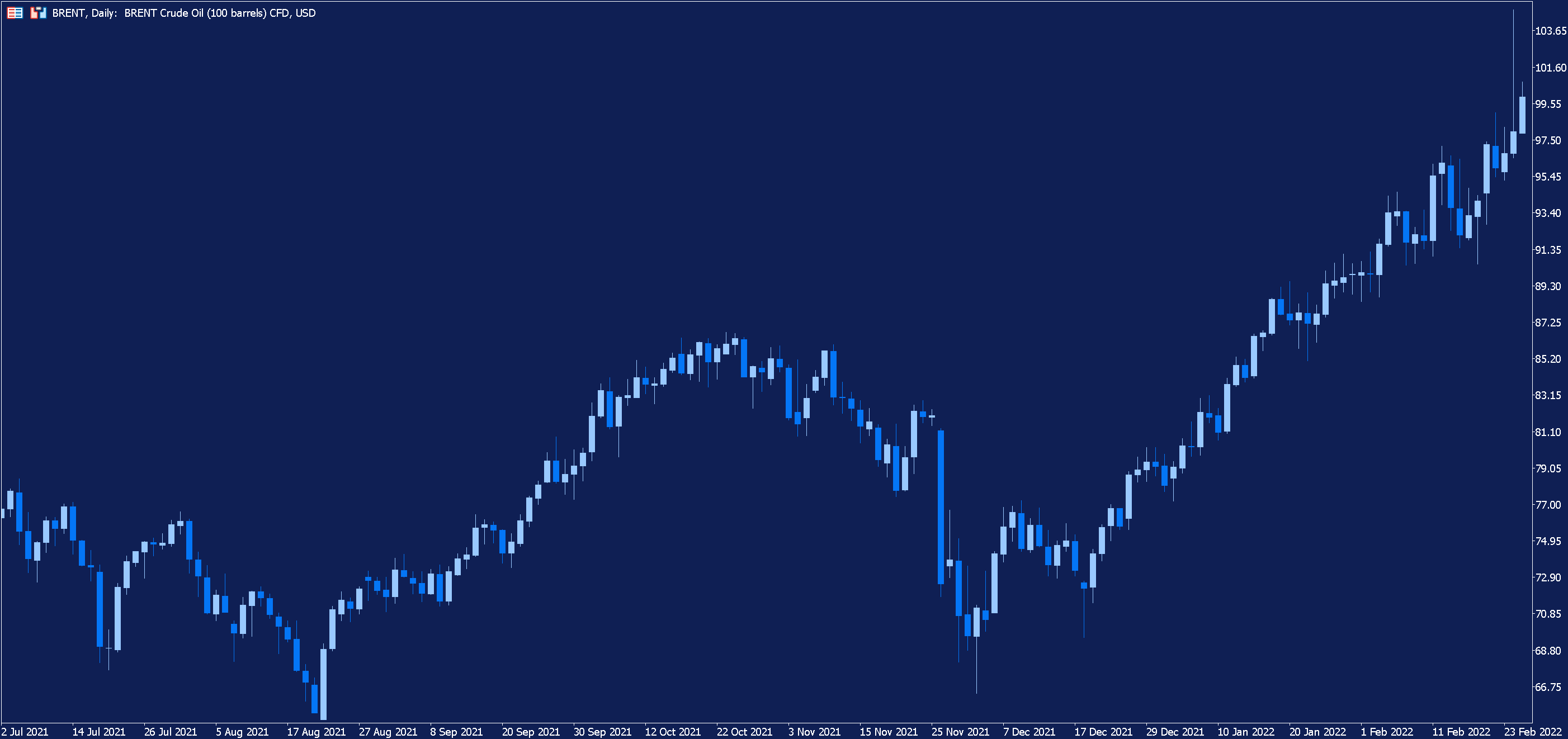
Depicted: Admirals MetaTrader 5 – Brent Daily Chart. Date Range: 2 July 2021 – 25 February 2022. Date Captured: 24 February 2022. Past performance is not a reliable indicator of future results.
(Click on image to enlarge)
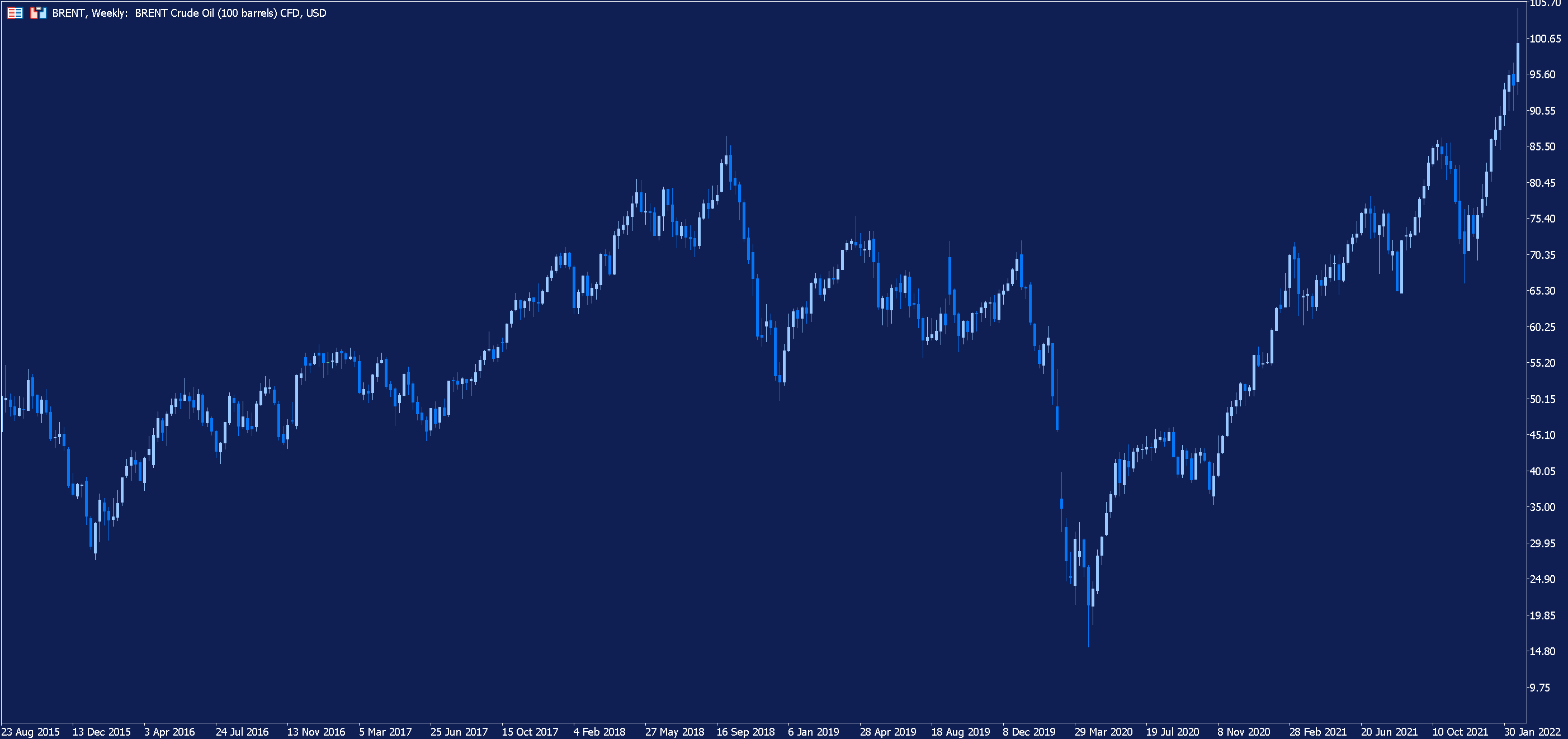
Depicted: Admirals MetaTrader 5 – Brent Weekly Chart. Date Range: 23 August 2015 – 25 February 2022. Date Captured: 24 February 2022. Past performance is not a reliable indicator of future results.

Comments
Log in or sign up to join the conversation.