


Bloomberg has a long read-up about what AQR is doing in tax-aware long-short. It's interesting, but there was one line that ties in with some of what we do here. "Wait 10 years while the money triples." Bloomberg attributed the line to a presentation that AQR gives in promoting the strategy. We'll get back to that in a minute.
Torsten Slok wrote that the 60/40 Portfolio is no longer working. That's not a new thought, but he added a little nuance, citing that the concentration in equities is or will be a contributing factor to that outcome. The concentration is, of course, in tech and tech-adjacent stocks, which, depending on how you count, is about 50% of the index.
Have you heard about the large wave of debt issuance from hyperscalers and the like? Early on Monday, I was looking at bonds for a new account, and Fidelity's inventory was heavy in tech sector bonds. Gemini thinks that the LQD ETF is now 13.2% in tech company bonds, with 7.7% of the fund in hyperscalers alone. Five years ago, LQD was 7-9% tech and 2-3% in hyperscalers. The term hyperscaler existed five years ago but was not used commonly.
The second paragraph of this potentially threatens the equity portion of 60/40, and while we've long talked about interest rate risk threatening the fixed income portion, the tech sector buildup in funds like LQD is another one.
If any of that is plausible to you, what are you going to do? The context of these sorts of comments tends to be in terms of lost decades. The most recent one of those was the 2000's and while markets had a bumpy round trip to nowhere, there were ways to grow portfolios. The way that fund sophistication has evolved, there are now many more alternative ways to grow portfolios than 20 years ago in case a "lost decade" actually happens.
There are several ways to go. One is just staying old school stocks and bonds in a 60/40 allocation or some other split, going all alternatives that can do decently independent of whatever is happening in markets like catastrophe bonds or combining the two, or in our case, dialing up the alt exposure some while maintaining some basic exposures too.
Everyone might come to agree we're going to have a lost decade, but what if that is wrong? If it is wrong, and to be clear I have no idea what will happen, then equities will be the thing that consistently does the best, and having no exposure would turn out to be a terrible mistake.
Even if it is a lost decade, there will still be plenty of pockets that do just fine or maybe a little better than just fine.
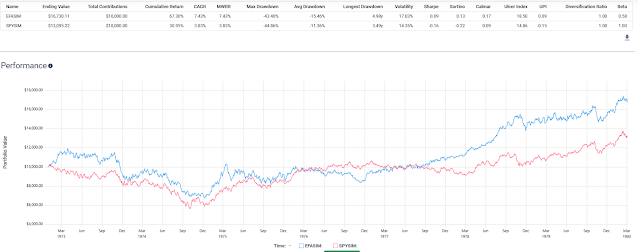
Here's a stretch where foreign had close to "normal" returns in a lost decade for domestic.
Materials did noticeably better than market cap weighted in the 2000's even if not really a normal sort of return.
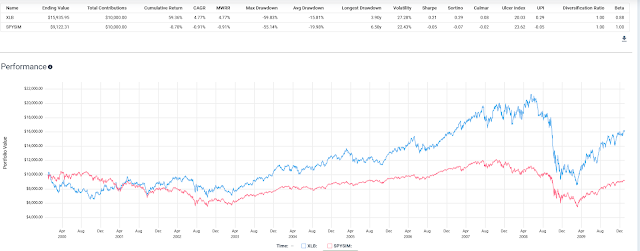
Compounding at 4.77% is obviously a whole lot better than negative 0.91%. We talk frequently about the Merger Fund (MERFX), which I've owned for clients for ages; in the above period it compounded at 4.66%, which is not too exciting during the good times but is pretty strong for a negative period for equities. Gold compounded better than 14% in the 2000's and simulated DBMF for managed futures annualized at 8.44%.
The list of things that can do better in a lost decade is much longer than it used to be, repeated for emphasis. Yes, more choice is better, of course, but a longer list means not having to load up on just one or two things. What if we do have a lost decade for stocks but gold does even worse than stocks in the scenario? It could happen, and having 25% in gold if it did would be very regretful.
When anyone talks about all-weather, this is what they are talking about. A portfolio that is able to adapt to whatever comes along. We have a lot of fun; I have fun anyway, building portfolios that might appear to be robust but really are not. They are templates for robustness, yes, but 25% in cat bonds or 30% in managed futures is loading up on risk.
There is something intellectually satisfying about thinking you could defeat all macro obstacles with just three funds, but you can't. Maybe the combo of momentum, managed futures and cat bonds will never face the consequences of loading up that way, but you'd still be taking a lot of risk. A 5-8% weighting (a little bigger than I usually go) not working when it should is much more of a nuisance than a calamity.
Back to waiting 10 years for your money to triple. At a compounding rate of about 11.5%, your money would triple. Maybe that can happen, or maybe it will take 15 years at 7.6%, which doesn't seem so bad, or maybe it will compound just under six percent and take 20 years to triple. But it will happen; the tripling in ten years comment is about just letting the portfolio/strategy work. Another Munger quote was that the first rule of compounding is to never interrupt it unnecessarily.
Putting 40% into one fund (other than the broadest index fund) and the rest into two or three alternatives is compounding interruption waiting to happen.

Comments
Log in or sign up to join the conversation.