

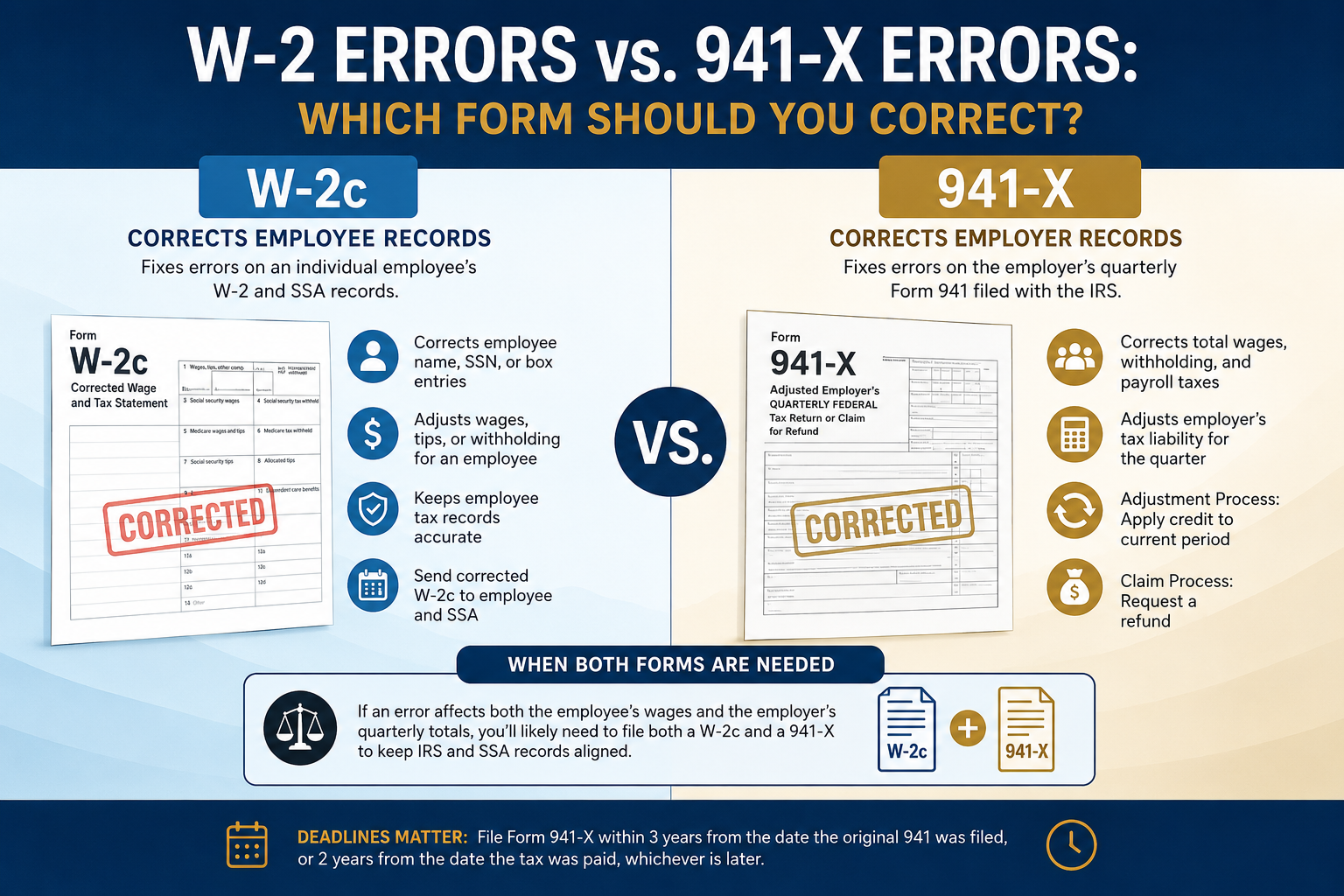
Payroll professionals discover reporting mistakes all the time, whether it's a wage misclassification, a missed tax withholding, or an incorrect Social Security number. But once an error is found, the real question is which correction form applies. Should you file a W-2c, submit a 941 X form, or do both? Understanding the difference between these two correction paths is essential for staying compliant, avoiding IRS notices, and keeping payroll records accurate.
Two Forms, Two Different Purposes
Form W-2 reports wages, tips, and withheld taxes to an individual employee and to the Social Security Administration. Its correction counterpart, Form W-2c, fixes employee-level reporting errors such as an incorrect name, Social Security number, wage amount, or box entry.
The 941 X form, by contrast, corrects the employer's quarterly Form 941, Employer's Quarterly Federal Tax Return. It adjusts aggregate payroll tax figures reported to the IRS, including total wages, federal income tax withheld, and Social Security and Medicare taxes for the entire quarter. Rather than fixing one employee's record, it corrects the employer's overall filing.
Many payroll teams assume these two forms are interchangeable or that filing one automatically resolves the other. In reality, some errors require only a W-2c, some require only a 941-X, and others require filing both together to keep employee and employer records aligned.
When a W-2c Alone Is Enough
If the mistake only affects how wages or withholding appear on an employee's annual statement, without changing what was reported on the quarterly 941, a W-2c is typically sufficient. Common examples include correcting a misspelled employee name, fixing an incorrect Social Security number, or adjusting a box entry that doesn't affect the aggregate tax liability reported to the IRS. These are administrative corrections that keep the employee's individual tax record accurate without altering the employer's total quarterly figures.
When a 941-X Is Required
A 941 X form becomes necessary any time the correction changes the total tax liability the employer reported for a quarter. This includes underreported or overreported wages, errors in federal income tax withholding, Social Security or Medicare tax miscalculations, and corrections tied to credits such as the Employee Retention Credit. Because the 941-X reconciles what was actually owed versus what was reported, it directly affects the employer's tax account with the IRS.
It's important to understand that the 941-X process falls into two categories: the adjustment process and the claim process. The adjustment process applies when an employer wants to apply an overpayment as a credit toward a current period, while the claim process is used to request a refund. Choosing the correct path affects processing timelines and documentation requirements, so payroll teams need to identify which situation applies before filing.
When You Need Both Forms
Many payroll errors touch both employee and employer records simultaneously. For example, if wages were underreported for an employee due to a payroll system error, that mistake likely affects both the employee's W-2 and the employer's quarterly 941. In these cases, employers typically need to file a W-2c to correct the employee's annual statement and a 941-X to correct the corresponding quarter's aggregate tax reporting. Filing only one without the other can create a mismatch between IRS records and Social Security Administration records, which increases the risk of notices or audits.
Timing and Statute of Limitations Considerations
Both corrections come with their own deadlines. The 941-X generally must be filed within three years of the date the original 941 was filed, or two years from the date the tax was paid, whichever is later. Missing these windows can limit an employer's ability to claim a credit or refund. Payroll teams should also track W-2c deadlines closely, since late corrections can affect employee tax filings and trigger penalties for the employer.
Getting the Correction Process Right
Determining whether a W-2c, a 941-X, or both are needed comes down to identifying whether the error changes individual employee records, aggregate employer tax liability, or both. Payroll professionals who build a habit of reviewing errors against this framework reduce the risk of incomplete corrections, IRS mismatches, and unnecessary follow-up notices.
For a deeper walkthrough of the 941-X correction process, including step-by-step guidance on completing the form accurately and avoiding common filing mistakes, payroll and finance professionals may find it useful to explore structured training resources covering payroll tax corrections in detail.
Frequently Asked Questions
Q1: What's the main difference between a W-2c and a 941-X?
A W-2c corrects an individual employee's wage and tax statement, while a 941-X corrects the employer's aggregate quarterly payroll tax return. One fixes employee-level records; the other fixes employer-level tax reporting.
Q2: Can I file a 941-X without also filing a W-2c?
Yes, if the error only affects the employer's quarterly tax totals and doesn't change what was reported on an employee's W-2, such as certain Employee Retention Credit adjustments, a standalone 941-X may be sufficient.
Q3: What is the deadline for filing Form 941-X?
Generally, employers must file within three years from the date the original Form 941 was filed, or two years from the date the tax was paid, whichever is later.
Q4: Does the 941-X follow the same process for every correction?
No. Corrections fall under either the adjustment process, used to apply credits to a current period, or the claim process, used to request a refund. The correct path depends on the nature of the error and the desired outcome.
Comments
Log in or sign up to join the conversation.