

Vishwakarma became a household name for engineers, architects and craftsmen across India, he was already carried into pooja rooms as a finely detailed Vishwakarma's Idol bronze, placed beside tools and workbenches as a mark of respect for skilled work itself. Known as the divine architect of the gods, Vishwakarma occupies a category all his own in Hindu tradition — not a warrior deity, not a household protector, but the very principle of creation through skill, measurement and design.
His name combines vishwa (universe) and karma (action or making), and together they describe exactly what he represents: the one who builds the universe through disciplined, purposeful action. For anyone who works with their hands or their mind to create something lasting, Vishwakarma is the deity who sanctifies that effort. This article traces his origins, his symbolism and his continuing place in home worship, drawn from the same devotional tradition that Gold Plating Art Studio serves through its handcrafted bronze and brass idols.
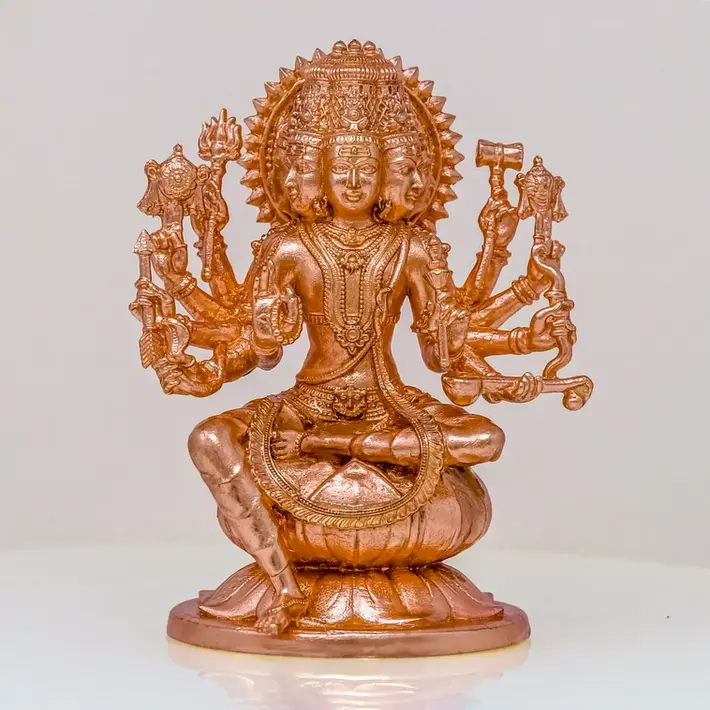
Who Is Vishwakarma?
Vishwakarma is revered as the architect and craftsman of the gods, credited across the Mahabharata, the Ramayana and the Puranas with building the celestial cities, weapons, chariots and palaces that the devas rely on. Whenever a god or hero in these epics needs something constructed, tradition sends them to Vishwakarma. He is described as the son of Prabhasa, one of the eight Vasus, though the Puranas offer other lineages too, including one that names him a mind-born son of Brahma through the sage Vastu.
Vishwakarma's Family — Consort and Children
Vishwakarma's wife is generally named Gritachi (or Ghritachi), and their offspring form an unusually functional divine family. His sons are traditionally listed as Manu, Maya, Tvashta, Shilpi and Vishwajna — figures later regarded by artisan communities as the forebears of blacksmiths, carpenters, bronze-casters, stonemasons and goldsmiths. His daughter Sanjna is closely tied to another well-known story: she is married to the sun god Surya, and when his radiance grows too intense for her, it is Vishwakarma who tempers Surya's brilliance, using the shavings to forge new divine weapons.
Vishwakarma Compared to Brahma and Tvashtar
Because his name was originally used as an epithet for "any powerful, all-making god," Vishwakarma's identity overlaps with a few other figures. In the earliest Vedic hymns, much of what is now attributed to Vishwakarma belonged to Tvashtar, a divine smith and shaper of forms. Over time, later Puranic literature separated the two, keeping Tvashtar as a craftsman-deity in his own right while elevating Vishwakarma to the role of universal architect. He is also sometimes compared to Brahma, since both are linked to the origin of the cosmos — but where Brahma is the creator of consciousness and beings, Vishwakarma is the one who gives that creation physical form and structure.
The Philosophical Symbolism of Vishwakarma
Beyond mythology, Vishwakarma carries a deep philosophical weight in the Rigveda, where two hymns (Mandala 10, Suktas 81–82) describe him not as a craftsman among many gods, but as the ultimate reality itself — an abstract creative force comparable to what later Upanishadic thought would call Brahman. From this cosmic figure, all visible elements of the universe are said to emerge, much like the imagery of Hiranyagarbha, the "golden womb," in the Yajurveda's Purusha Sukta.
The Tools as Symbols of Divine Craft
Vishwakarma is typically shown holding a set of instruments rather than weapons: a measuring scale, a kamandalu (water vessel), a sacred text, a hammer and a chisel. Each tool signals a different aspect of disciplined creation — precision, purity of intent, knowledge, force applied with control, and the patient shaping of raw material into something refined. This is part of why Vishwakarma resonates so strongly with anyone whose daily work involves building, measuring or crafting: his iconography is essentially a portrait of skilled labour treated as sacred.
The Legend of Vishwakarma's Creations
Stabilizing the Cosmic Egg
One widely told Puranic account holds that when Brahma began the work of creation, the newly formed cosmos rested unsteadily on the great serpent Sheshnaag, shaking with every movement. Brahma turned to Vishwakarma, who placed Mount Meru into the cosmic waters to anchor and stabilize the developing universe — establishing him, from the very start of creation, as the one who gives the cosmos its physical footing.
Building the Cities of the Gods
Vishwakarma's most celebrated feats are architectural. He is credited with constructing Lanka, the golden city later ruled by Ravana; Dwaraka, Krishna's magnificent capital; and Indraprastha, the city built for the Pandavas in the Mahabharata (often identified with the site of modern Delhi). In some tellings, he worked alongside Maya, another master craftsman, to raise Indraprastha's dazzling hall of illusions.
Crafting the Vajra from Sage Dadhichi's Bones
Perhaps the most dramatic story tied to Vishwakarma is the forging of the Vajra, Indra's thunderbolt weapon. When the devas needed an unstoppable weapon against the asuras, the sage Dadhichi offered his own bones in sacrifice. Vishwakarma is credited with shaping those bones into the Vajra, turning an act of ultimate renunciation into the weapon that restored balance to the heavens. He is also linked to the Pushpaka Vimana, the flying chariot later associated with Ravana and Rama, and to the divine weapons and jewelled ornaments carried by nearly every major deity.
Vishwakarma Temples and Worship
While Vishwakarma is honoured in home shrines and workplaces far more often than in grand temple complexes, a handful of dedicated shrines have become important pilgrimage points for artisan communities. The Vishwakarma Mandir in Mandi, Himachal Pradesh, sits in the town's Mangvayin Road area and draws devotees from across India despite its modest size. In Phagwara, Punjab, the century-old Shri Vishwakarma Mandir was founded by a contractor named Pandit Nathu Ram Dhiman, with local carpenters, blacksmiths and masons each contributing a rupee and their own tools as symbolic offerings during its five years of construction. A well-known Vishwakarma temple also stands in Machilipatnam, Andhra Pradesh, maintained by the state government and visited heavily during the September worship season. In Himachal Pradesh's Shiva temple traditions, Vishwakarma even appears as a builder-figure in local legend, credited with helping the Pandavas begin construction on a temple during their exile.
Spiritual Significance of Vishwakarma
Patron of craftsmen and professionals — Vishwakarma is worshipped not only by carpenters, blacksmiths, goldsmiths and masons, but by engineers, architects, factory workers and anyone whose livelihood depends on skilled, precise work.
Sanctifying tools and workplaces — On his worship day, it is customary for craftsmen to clean and worship their own tools and machines, treating the instruments of daily labour as extensions of the divine.
Dignity of labour as devotion — Vishwakarma's tradition holds that disciplined work is itself a form of worship, and that creation — whether a building, a tool or a piece of art — reflects a spark of his own creative principle.
Prosperity and safety in one's profession — Devotees seek his blessings for smooth-running businesses, safe workplaces and continued growth in their craft or career.
Vishwakarma Jayanti — His birth is observed annually around Kanya Sankranti, typically falling on 16, 17 or 18 September, with rituals conducted in homes, factories and workshops across the country.
Why Is Vishwakarma Different from Other Creator Deities
Hindu tradition holds several figures associated with creation, but each occupies a distinct role. Brahma is the creator of beings and consciousness — the origin of life itself. Vishnu preserves and sustains what has been created. Vishwakarma's domain is narrower but no less essential: he is the one who gives creation its built form — its cities, weapons, chariots and instruments. Where Tvashtar in the earliest Vedic texts is closer to a divine smith shaping raw matter, Vishwakarma in later tradition becomes the master planner behind all technical and architectural achievement — closer to an engineer-in-chief than a metalworker. This is precisely why his following extends so naturally into the modern world, encompassing not just traditional artisans but software engineers, civil engineers and designers who see their own precision and craft reflected in his mythology.
Conclusion
From a cosmic creative force in the Rigveda to the patron deity of every carpenter, engineer and artisan today, Vishwakarma's story is really the story of work treated as something sacred. He stabilized the early universe, built the cities and weapons of the gods, and left behind an enduring message: that skill applied with discipline and integrity is its own form of worship. Honouring him — whether through a temple visit, a workshop ritual, or a bronze idol kept at home — is ultimately a way of honouring the value of good, honest craft.
Comments
Log in or sign up to join the conversation.