

Vijaya Ganapathi is a revered form of Lord Ganesha, worshipped as the remover of obstacles and a symbol of success, victory, wisdom, and positive beginnings. The presence of the Mooshika Vahana, adds special significance to this traditional representation of Lord Ganesha. The Mooshika is traditionally associated with Ganesha’s ability to overcome desires and obstacles, while the deity represents knowledge, prosperity, and divine protection. In this article, we explore the significance of Vijaya Ganapathi, the symbolism of his Mooshika Vahana, and the traditions associated with worshipping this beloved form of Ganesha.
Vijaya Ganapathi belongs to a family of thirty-two classical Ganapati forms, each representing a distinct aspect of Ganesha's grace. His story brings together mythology, iconography and temple tradition into a single, richly symbolic image - one that has been cast in bronze by Swamimalai artisans for generations and is offered today through Idol Bronze.
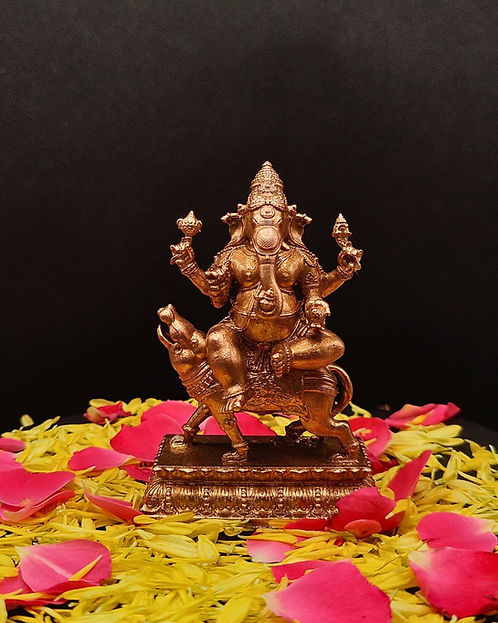
Who Is Vijaya Ganapathi?
Vijaya Ganapathi Among the 32 Forms of Ganapati
The Mudgala Purana, one of the oldest and most authoritative texts on Ganesha worship, describes thirty-two distinct forms of Ganapati, each arising to address a particular cosmic or human need. Vijaya Ganapathi is counted as the fourteenth of these thirty-two forms. His name comes from the Sanskrit word "vijaya," meaning victory, and he is worshipped specifically as the bestower of success - the deity devotees turn to before an important undertaking, examination, journey or venture.
Unlike some Ganapati forms tied to a single myth or a single moment, Vijaya Ganapathi represents an ongoing principle: that triumph follows naturally once obstacles are cleared from the path.
Vinayaka and Vighnesha - Where Vijaya Ganapathi Fits
Ganesha's many forms are traditionally grouped under two broad categories - Vinayaka forms, which express his role as an independent, self-sufficient deity, and Vighnesha forms, which express his role as remover of obstacles. Vijaya Ganapathi sits within the Vighnesha category. His victory is not abstract; it is the direct result of obstacles being cleared, which is why his iconography is built almost entirely around instruments of protection and clearance - the goad, the noose and his own broken tusk.
The Iconography and Symbolism of Vijaya Ganapathi
The Four Hands and Their Meaning
Vijaya Ganapathi is depicted with four arms, each holding an object rich in meaning. One hand holds his own broken tusk - a reminder of the sacrifice he made to complete the writing of the Mahabharata, and a symbol that he asks nothing of his devotees that he has not already given of himself. Another hand carries the ankusha, or elephant goad, used to steer and correct the course of the mind. A third hand holds the pasha, or noose, representing the restraint of desires and distractions that pull a devotee off course. The fourth hand holds a ripe golden mango - in Puranic literature specifically described as a "golden mango" - symbolizing the sweetness of the fruit of effort once obstacles have been overcome.
Together, these four attributes describe a complete philosophy: sacrifice, direction, restraint and reward.
The Mooshika Vahana - Symbolism of the Mouse Mount
Riding beside these four symbols is Mooshika, Ganesha's mouse vahana, and in Vijaya Ganapathi's iconography the mount is shown at full scale rather than as a tiny accessory —-seated in utkatasana, a variant of the relaxed lalitasana pose, with one leg resting on the mouse's back. A mouse may seem an unlikely companion for a god of wisdom and victory, but the symbolism is precise. A mouse gnaws through anything in its path, unseen and persistent - much like desire, ego and distraction gnaw at the human mind. By riding the mouse rather than being ruled by it, Ganesha demonstrates mastery over exactly these forces. The Mooshika Vahana is also associated with fertility and abundance, reinforcing Vijaya Ganapathi's role as a bringer of prosperity alongside victory.
The Legend of Krauncha and the Origin of the Mooshika Vahana
Krauncha's Curse
The story of how Ganesha came to ride a mouse is told across several texts, including the Matsya Purana, the Brahmananda Purana and the Ganesha Purana. According to this legend, a celestial gandharva musician named Krauncha, gifted with a beautiful singing voice, once behaved carelessly in the presence of the sage Vamadeva. In some tellings, he accidentally struck or offended the sage while moving through the heavens; in others, his arrogance about his own gifts caused the offense. Enraged, the sage cursed Krauncha to lose his celestial form entirely and be reborn as a mouse on earth.
Fulfilment of the Boon - Becoming Ganesha's Vahana
Even in delivering the curse, the sage granted Krauncha a boon: that one day, in his diminished form, he would himself be worshipped by the very devotees who had once admired him as a musician. Years later, as the story goes, the mouse-form Krauncha unknowingly disturbed the ashram of the sage Parashara, and Ganesha intervened to tame the creature. Rather than banishing him, Ganesha accepted Krauncha as his vahana - fulfilling the sage's earlier boon and giving the once-proud musician a permanent place beside the god of new beginnings. From that moment, Mooshika has carried Ganesha in nearly every one of his iconographic forms, including Vijaya Ganapathi.
Vijaya Ganapathi Among the Shodasha Ganapati Murtis at Rameshwaram
Vijaya Ganapathi's importance extends beyond the Mudgala Purana into living temple tradition. At the Shri Shankara Mandapam in Rameshwaram, sixteen distinct forms of Ganapati - known collectively as the Shodasha Ganapati Murtis - are enshrined together, each occupying its own dedicated cell. Vijaya Ganapathi holds the fourteenth of these sixteen shrines, depicted exactly as the Puranic description specifies: four arms, the broken tusk, the noose, the goad and the golden mango in hand, seated upon his mouse.
This continued temple presence, alongside the Mudgala Purana's textual description, is part of why Vijaya Ganapathi has remained a popular form for bronze casting through the centuries — sculptors working in the Swamimalai tradition have had both scripture and shrine to draw from when perfecting his proportions and posture.
Spiritual Significance of Vijaya Ganapathi
Devotees turn to Vijaya Ganapathi for several interconnected reasons:
Victory over obstacles - his very name and doctrine hold that where obstacles are absent, failure cannot follow, making him a natural focus before exams, ventures or journeys.
Protection on the path - the broken tusk represents his willingness to give of himself to safeguard his devotees.
Direction and discipline - the elephant goad symbolizes correcting one's course when distraction sets in.
Restraint over desire - the noose, and the tamed mouse beneath him, together represent mastery over the mind's wandering impulses.
Prosperity as reward - the golden mango represents the sweetness that follows sustained, disciplined effort.
Why Is Vijaya Ganapathi Different from Other Ganapati Forms
Many of Ganesha's thirty-two forms are tied to a single episode - a specific battle, a specific boon, a specific devotee's request. Vijaya Ganapathi is different in that he represents a standing principle rather than a one-time event: the assurance that success follows naturally once obstruction is removed. This is sometimes summarized as the "Vijaya Ganapathi doctrine" - where there is no obstacle, there can be no failure. His iconography reflects this generality; rather than commemorating a single myth, his four hands each represent a stage in the process of achieving a goal - sacrifice, guidance, restraint and reward - making him a form devotees return to again and again for any new undertaking, not only a single occasion.
Conclusion
Vijaya Ganapathi brings together scripture, symbolism and centuries of temple worship into a single bronze form. From the Mudgala Purana's account of his place among Ganesha's thirty-two manifestations, to the story of Krauncha's curse and redemption as his Mooshika Vahana, to his enshrinement at Rameshwaram's Shri Shankara Mandapam, every element of his iconography points toward one idea - that victory is the natural outcome of a cleared path. For devotees seeking to invite that same steady progress into their own lives, a handcrafted bronze Vijaya Ganapathi idol remains one of the most meaningful forms of Ganesha to welcome home.
Comments
Log in or sign up to join the conversation.