

According to TechSci Research report, “Vehicle to Infrastructure Communication Market Size– Global Industry Share, Trends, Competition Forecast & Opportunities, 2030”, The Global Vehicle to Infrastructure Communication Market, valued at USD 410.00 Million in 2024, is projected to experience a CAGR of 17.80% to reach USD 1095.61 Million by 2030.
Industry Key Highlights
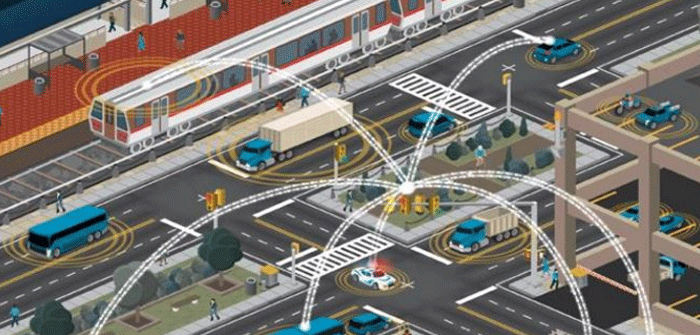
The Global Vehicle-to-Infrastructure (V2I) Communication Market is rapidly emerging as a foundational pillar of the intelligent transportation ecosystem. As governments, automotive manufacturers, urban planners, and technology providers intensify efforts to create safer, smarter, and more connected mobility networks, V2I communication technologies are gaining unprecedented attention worldwide. These systems enable vehicles to communicate directly with road infrastructure such as traffic lights, road signs, toll booths, parking systems, pedestrian crossings, and traffic management centers, facilitating real-time information exchange and enhancing transportation efficiency.
The market is experiencing remarkable growth due to increasing investments in smart city initiatives, advancements in connected vehicle technologies, and rising concerns regarding road safety and traffic congestion. V2I communication serves as a critical component of the broader Vehicle-to-Everything (V2X) ecosystem, enabling seamless interaction between vehicles and surrounding infrastructure to optimize traffic flow, reduce accidents, and improve fuel efficiency.
The deployment of advanced wireless communication technologies, including Dedicated Short-Range Communications (DSRC), Cellular Vehicle-to-Everything (C-V2X), and emerging 5G networks, is significantly enhancing the capabilities of V2I systems. These technologies support low-latency communication, allowing vehicles and infrastructure components to exchange data in milliseconds, which is crucial for safety-critical applications.
Furthermore, the accelerating adoption of electric vehicles (EVs), autonomous driving technologies, and intelligent transportation systems (ITS) is fueling market expansion. Governments worldwide are implementing regulations and funding programs to modernize transportation infrastructure, creating substantial opportunities for V2I technology providers.
As urbanization continues to rise and cities become increasingly congested, V2I communication is expected to play a vital role in shaping the future of mobility by enabling efficient, safe, and sustainable transportation networks.
Request For Sample Copy of Report For More Detailed Market insight: https://www.techsciresearch.com/sample-report.aspx?cid=22026#requestform
Key Market Drivers
Growing Focus on Road Safety Enhancement
Road safety remains one of the most critical concerns for governments and transportation authorities globally. Millions of road accidents occur annually due to human error, poor visibility, traffic congestion, and inadequate communication between road users.
V2I communication addresses these challenges by providing vehicles with real-time information about road conditions, traffic signals, construction zones, accident-prone areas, and hazardous weather situations. These systems help drivers and autonomous vehicles make safer decisions, significantly reducing the risk of collisions.
As road safety regulations become stricter and public awareness increases, demand for V2I communication solutions is expected to accelerate.
Expansion of Smart City Initiatives
Smart city development is emerging as a major catalyst for the V2I communication market. Governments worldwide are investing heavily in intelligent infrastructure projects aimed at improving urban mobility, reducing emissions, and enhancing quality of life.
Connected traffic signals, intelligent intersections, smart parking systems, and integrated transportation management platforms all rely on V2I communication technologies. As cities continue modernizing their infrastructure, the demand for advanced vehicle-infrastructure connectivity solutions will continue to grow.
Rising Traffic Congestion Across Urban Areas
Rapid urbanization and increasing vehicle ownership have intensified traffic congestion in major metropolitan regions worldwide. Congestion not only impacts productivity but also contributes to higher fuel consumption and environmental pollution.
V2I systems enable dynamic traffic management by providing real-time traffic information and adaptive signal control. These capabilities help optimize traffic flow, reduce travel times, and improve overall transportation efficiency.
Advancements in Autonomous Vehicle Technology
Autonomous vehicles require accurate and timely information from their surroundings to operate safely. While onboard sensors play a crucial role, infrastructure-based information significantly enhances situational awareness.
V2I communication enables autonomous vehicles to receive data about traffic signals, road conditions, work zones, and pedestrian activity, improving navigation accuracy and operational safety.
The growing development and deployment of autonomous vehicles are expected to create substantial demand for V2I infrastructure.
Government Regulations and Funding Programs
Many governments are introducing regulations and investment programs to support intelligent transportation systems and connected mobility solutions.
Public sector investments in smart highways, connected corridors, and digital infrastructure are creating favorable market conditions for V2I communication technology providers. Regulatory support is expected to remain a major growth driver throughout the forecast period.
Emerging Trends in the Vehicle-to-Infrastructure Communication Market
Integration of 5G Technology
One of the most transformative trends shaping the market is the deployment of 5G communication networks. 5G offers ultra-low latency, high bandwidth, and enhanced reliability, making it ideal for V2I applications.
With 5G-enabled V2I communication, vehicles can exchange information with infrastructure almost instantaneously. This capability is particularly important for safety-critical functions such as collision avoidance, emergency braking alerts, and autonomous driving systems.
The rollout of 5G infrastructure worldwide is expected to significantly enhance V2I performance and accelerate market growth.
Artificial Intelligence-Powered Traffic Management
Artificial intelligence is revolutionizing transportation management systems by enabling predictive analytics and real-time decision-making.
AI-powered V2I platforms can analyze traffic patterns, forecast congestion, optimize signal timing, and recommend alternative routes. These capabilities improve traffic flow and enhance transportation efficiency.
As AI adoption continues expanding across transportation networks, its integration with V2I communication systems will become increasingly common.
Edge Computing for Real-Time Processing
The need for instant decision-making has driven the adoption of edge computing technologies within V2I ecosystems.
Edge computing processes data closer to its source, reducing latency and enabling faster response times. This is particularly important for applications requiring immediate action, such as collision warnings and traffic signal coordination.
The combination of edge computing and V2I communication is expected to become a defining trend in intelligent transportation systems.
Growth of Connected Electric Vehicle Infrastructure
The global transition toward electric mobility is creating new opportunities for V2I communication technologies.
Connected charging stations, smart energy management systems, and vehicle-grid communication platforms rely heavily on infrastructure connectivity. V2I communication helps electric vehicles identify charging station availability, optimize charging schedules, and improve energy efficiency.
As EV adoption accelerates globally, demand for integrated V2I solutions will continue to increase.
Development of Intelligent Intersections
Intelligent intersections represent a rapidly growing application area within the V2I market.
These intersections utilize sensors, cameras, communication devices, and analytics platforms to monitor traffic conditions and coordinate vehicle movement. Connected intersections enhance safety, reduce delays, and improve traffic efficiency.
Many cities are prioritizing intelligent intersection deployments as part of broader smart transportation initiatives.
Cybersecurity Enhancement Initiatives
As transportation systems become increasingly connected, cybersecurity has emerged as a critical focus area.
Industry stakeholders are investing in advanced encryption technologies, secure communication protocols, and threat detection systems to protect V2I networks from cyber threats.
Enhanced cybersecurity frameworks will play a crucial role in ensuring the reliability and adoption of connected transportation systems.
Market Challenges
High Infrastructure Deployment Costs
One of the primary challenges facing the V2I communication market is the substantial investment required for infrastructure upgrades.
Deploying roadside communication units, sensors, network equipment, and data processing systems can be costly, particularly for developing regions.
Interoperability Issues
Different communication standards and technologies can create interoperability challenges among vehicles and infrastructure components.
Ensuring seamless communication across diverse systems remains a critical challenge for industry stakeholders.
Data Privacy Concerns
V2I communication generates significant volumes of data related to vehicle movement and user behavior.
Protecting sensitive information and ensuring compliance with privacy regulations is essential for maintaining public trust and encouraging adoption.
Network Reliability Requirements
Safety-critical V2I applications require highly reliable communication networks. Any disruptions or delays can compromise system effectiveness and safety outcomes.
Maintaining consistent network performance remains a key challenge for technology providers.
Regional Analysis
North America
North America represents a leading market due to strong investments in intelligent transportation systems, advanced telecommunications infrastructure, and connected vehicle initiatives.
Government programs and collaborations between automotive manufacturers and technology providers continue driving regional growth.
Europe
Europe is witnessing significant adoption of V2I technologies as part of broader efforts to improve road safety and support sustainable mobility objectives.
The region's emphasis on smart transportation infrastructure and autonomous vehicle development contributes to market expansion.
Asia-Pacific
Asia-Pacific is expected to experience the fastest growth due to rapid urbanization, increasing vehicle ownership, and extensive smart city investments.
Countries such as China, Japan, South Korea, and India are actively deploying intelligent transportation systems and connected mobility solutions.
Middle East & Africa
The region is increasingly investing in smart city projects and advanced transportation infrastructure, creating opportunities for V2I deployment.
South America
Growing urban mobility challenges and digital infrastructure development are supporting market growth across the region.
Competitive Analysis:
Qualcomm Technologies, Inc
Robert Bosch GmbH
Continental AG
NXP Semiconductors N.V.
Denso Corporation
Thales Group
Kapsch TrafficCom AG
Harman International
Cohda Wireless
Autotalks Ltd.
Customers can also request for 10% free customization on this report.
10 Benefits of the Research Report
1. Comprehensive Market Insights
Provides a complete understanding of current and future market dynamics.
2. Growth Opportunity Identification
Highlights emerging investment and expansion opportunities.
3. Competitive Benchmarking
Evaluates strategies adopted by major market participants.
4. Trend Analysis
Identifies key technological and industry developments.
5. Strategic Planning Support
Assists organizations in making informed business decisions.
6. Regional Opportunity Assessment
Analyzes growth potential across key geographic markets.
7. Risk Evaluation
Examines market challenges and potential barriers.
8. Segment-Level Intelligence
Provides detailed analysis of market segments and applications.
9. Investment Guidance
Supports investors in identifying profitable opportunities.
10. Future Forecasting
Offers long-term projections and market outlook insights.
Browse latest Related Reports:
Virtual Reality In Therapy Market Report
Wind Turbine Inspection Drones Market Report
Location-based Entertainment Market Report
Comments
Log in or sign up to join the conversation.