

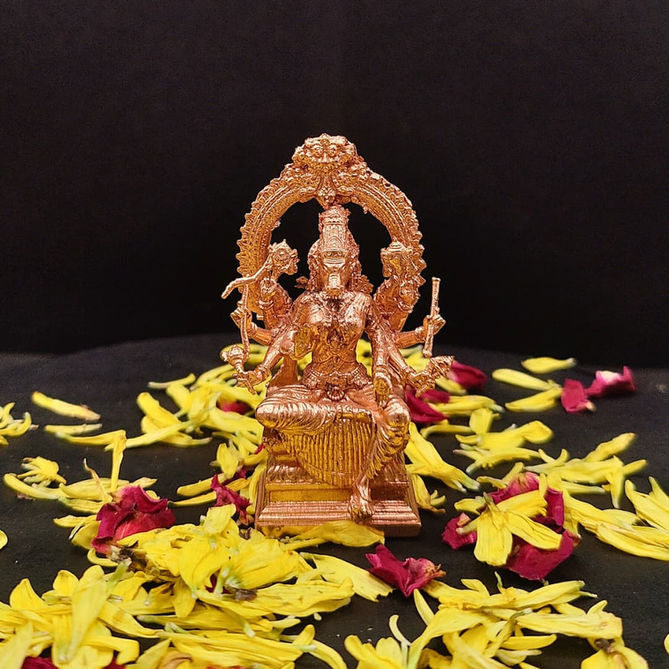
Varahi Amman is one of the fiercest and most disciplined protector deities in Hindu worship, a boar-faced Shakti who doesn't merely bless her devotees but actively stands guard against every obstacle, enemy and hidden threat in their path. A handcrafted Varahi Amman idol brings this formidable energy directly into a home altar.
For centuries, devotees across South India have turned to her when ordinary prayers weren't enough - when the threat was an enemy's ill will, a run of bad luck, or a danger too subtle to name. Kept in quiet corners of home altars and guarded temple sanctums alike, she is invoked less for celebration and more for steady, decisive protection. Gold Plating Art Studio brings this powerful presence within reach, offering a Varahi Amman idol in both bronze and brass so devotees can choose the finish that fits their pooja space.
Who Is Varahi Amman?
Varahi is one of the Sapta Matrikas, the seven mother goddesses of Hindu tradition, each representing the shakti (feminine energy) of a principal god. Varahi is the shakti of Varaha, the boar incarnation of Lord Vishnu, and she carries his boar-headed form combined with the body of a powerful, commanding woman.
Born to Fight Alongside the Matrikas
According to the Devi Mahatmya, the warrior-goddess Durga created the Matrikas from her own being to help destroy the demon army during her cosmic battles, including the fight against the demon Raktabija. The Vamana Purana specifies that Varahi arose specifically from the back of the goddess Chandika, joining her sister Matrikas in the war against evil.
Her Connection to Varaha and the Earth
In the Devi Bhagavata Purana, Lord Varaha is described rescuing the earth goddess Prithvi from the demon Hiranyaksha and setting her afloat upon the cosmic waters. Varahi, as Varaha's shakti, inherits this deep association with the earth itself - making her a goddess not only of protection but of grounding, stability and the strength drawn from the earth.
The Symbolism of the Fierce Protector
Varahi's iconography is built entirely around the idea of disciplined, commanding strength rather than gentle grace, and every element of her form reinforces this role.
The Boar Face and Multiple Arms
Varahi is most often depicted with eight arms, carrying weapons such as a sword, discus, mace, noose, goad and the musala (pestle), signifying her readiness for battle on every front. Her boar face is read as a symbol of the ability to break through obstacles and root out deeply buried karmas, much as a boar tears through the earth.
Dandanatha - The Commander-in-Chief
Within the Sri Vidya tradition, Varahi holds the title Dandanatha, meaning "Commander of the Rod" or "Commander-in-Chief," identifying her as the chief military authority under the supreme goddess Lalita Tripurasundari. She is said to have been born from Lalita's own bow and flowery arrows, and represents the disciplined, corrective force that keeps both external enemies and internal ego in check.
The Legend of Varahi's Battles
Varahi's warrior identity is illustrated most vividly in the stories of her decisive interventions during moments of cosmic crisis.
Emerging in the War Against Raktabija
As one of the Matrikas summoned by Durga, Varahi took her place on the battlefield to help annihilate the seemingly unstoppable demon Raktabija, whose blood spawned new demons with every drop spilled - a battle the Matrikas fought and won collectively through their combined divine force.
The Defeat of Vishukra in the Lalitopakhyana
In the Lalitopakhyana, the scripture recounting the war between Goddess Lalita and the demon Bhandasura, Varahi emerged specifically to defeat Vishukra, Bhandasura's own commander-in-chief - a mirrored battle of generals that cemented her reputation as Lalita's most trusted military strategist.
Her Chariot, the Kiri Chakra
Varahi is said to ride into battle on the Kiri Chakra, a divine chariot drawn by a thousand boars and driven by the goddess Sthambini. Remarkably, this chariot is also said to carry celestial physicians, including the Ashwini Devas and Dhanvantari, linking Varahi's protective ferocity with the power to heal and restore health even amid conflict.
Varahi Amman Temples and Worship
Tamil Nadu is home to several important Varahi Amman shrines, most notably the Sri Maha Varahi Amman Temple in Sholinghur, Vellore district, considered a major pilgrimage destination for devotees seeking her protection. Additional shrines in Velachery and Ambattur, Chennai, along with village temples across the state, reflect her deep-rooted role as a guardian deity of local communities. Varahi is also honored as part of the Sapta Matrika circuit of temples in Varanasi, where each Matrika is believed to govern a distinct subtle energy of the sacred city. In the Sri Chakra of Sri Vidya worship, she holds a defined position as guardian of the sixteenth enclosure, ruling from what is described as an emerald palace within Sri Nagara.
Spiritual Significance of Varahi Amman
Devotees turn to Varahi Amman for a distinct kind of divine support, one centered on protection and discipline rather than material abundance alone:
Protection from the evil eye and negativity - Varahi is widely invoked to shield devotees from drishti (the evil eye) and malicious intent directed at them.
Stambhana, the power to paralyze harm - she is believed to freeze or neutralize threats before they can take effect, including gossip, legal disputes and hidden enemies.
Ego dissolution and inner discipline - as Dandanatha, she corrects and keeps devotees aligned with their spiritual path, tempering excessive pride.
Grounded strength drawn from the earth - her connection to Varaha and Prithvi links her worship to stability, courage and resilience in difficult times.
Why Is Varahi Amman Different from Other Goddess Forms
While many South Indian Amman goddesses are approached for grace, fertility or abundance, Varahi occupies a distinctly military and strategic role. She is not merely fierce in appearance like some protector deities - she holds a formal command position within the Sri Vidya hierarchy as Commander-in-Chief, complete with her own chariot, driver and army of boars. This structured, martial identity, paired with her association with night worship and understated, private ritual (rather than large public festivals), sets her apart as a goddess approached with focus and seriousness rather than celebration alone.
Conclusion
Varahi Amman stands apart as one of Hindu tradition's most disciplined and commanding protector goddesses - a boar-faced Matrika who leads her own celestial forces and stands as an impenetrable guard against every form of harm. From her origins in the Devi Mahatmya to her role as Commander-in-Chief within Sri Vidya worship, she continues to be sought by devotees who value quiet, unwavering strength above all else.
Comments
Log in or sign up to join the conversation.