

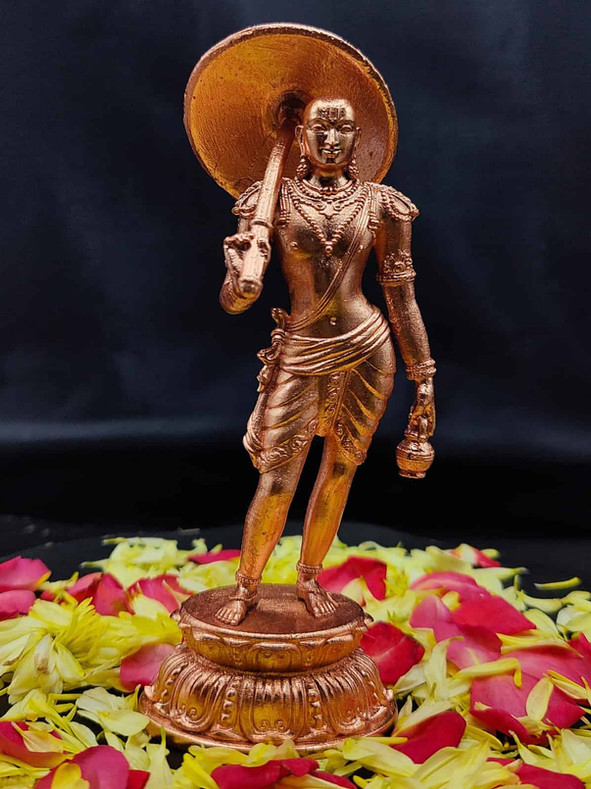
Vamana Avatar, the diminutive brahmin form of Lord Vishnu, is celebrated as the fifth of the ten Dashavataras, an avatar in which the smallest of appearances conceals the vastest of powers. This exquisite Vamana idol, available in both bronze and brass from Gold Plating Art Studio's collection, brings this profound story of humility and cosmic transformation into a piece crafted for devoted worship at home.
Vamana's tale begins not with a display of might, but with a simple request - three steps of land - and unfolds into one of the most philosophically rich episodes in Vishnu's ten incarnations. For devotees who cherish stories of quiet strength triumphing over unchecked pride, Vamana's legend, and the idols crafted in his honour by Gold Plating Art Studio, offer a lasting reminder that true power often arrives in the humblest of forms.
Who Is Vamana?
Position as the Fifth Dashavatara
Vamana is revered as the fifth incarnation of Vishnu, appearing at the very start of the Treta Yuga, following the fierce Narasimha avatar. Where Narasimha's purpose was to destroy through overwhelming force, Vamana's purpose was to restore cosmic balance through wisdom and humility, marking a distinct shift in tone among the avataras.
Birth as Son of Kashyapa and Aditi
Vamana was born as the son of the sage Kashyapa and his wife Aditi, making him one of the Adityas, the celestial beings descended from Aditi. His birth came at a time when the Devas, overwhelmed by the growing dominance of the Asura king Mahabali, sought Vishnu's intervention to restore the cosmic order.
The Aditya Lineage
As an Aditya, Vamana shares his lineage with other radiant celestial figures, including Surya, the Sun God, reinforcing his identity as a being of light and order sent to counter the excesses of Mahabali's rule.
Iconography and Symbolism of Vamana
The Dwarf-Brahmin Form
Vamana is depicted as a short-statured brahmin boy, carrying a wooden staff, an umbrella and a water pot — the simple accessories of a humble ascetic rather than the ornate weapons associated with Vishnu's other forms. This deliberate plainness is central to the story that follows.
Symbolism of Humility Before Transformation
Vamana's unassuming appearance is not incidental but essential to his purpose. By approaching as the smallest and most modest of figures, he was able to draw close to Mahabali without arousing suspicion, embodying the idea that true strength often conceals itself behind humility until the moment it is needed.
The Legend of Vamana and King Mahabali
A King's Generosity, and Its Excess
King Mahabali, grandson of the devoted Prahlada, ruled the three worlds with such generosity and might that even the Devas found themselves eclipsed and powerless. Though a just and virtuous king, his growing dominance threatened to overturn the cosmic balance between the Devas and Asuras.
Vamana's Request for Three Steps of Land
Disguised as a young brahmin, Vamana approached Mahabali during a grand yagna the king was performing, and asked for nothing more than land measuring three of his own steps. Confident in his own power and generosity, Mahabali agreed without hesitation.
Shukracharya's Warning
Mahabali's guru, Shukracharya, recognised the disguised Vishnu at once and warned the king against granting the request, sensing that this humble figure was far more than he appeared to be. Yet Mahabali, having already given his word, refused to go back on his promise, choosing his honour over caution.
Trivikrama: The Cosmic Transformation
The moment Mahabali granted his consent, Vamana began to grow, expanding to a colossal, cosmic form known as Trivikrama. With his first step, he covered the entire earth; with his second, he spanned the heavens. There remained nowhere left for the third step to fall.
Bali's Surrender and the Boon of Sutala
Recognising the divine being before him, Mahabali offered his own head for Vishnu's third step, an act of complete surrender rather than defeat. Moved by this devotion, Vishnu placed his foot upon Bali's head, sending him not to destruction but to Sutala, a realm of the netherworld, where he was granted eternal sovereignty and a promise to return to the mortal world once each year.
Vamana and the Ulagalantha Perumal Temple
The Ulagalantha Perumal Temple in Kanchipuram, Tamil Nadu, stands as one of the most significant shrines dedicated to Vishnu's Trivikrama form. The temple takes its very name from this legend — "Ulagalantha Perumal" translates to "the Lord who measured the world" — and enshrines Vishnu in his towering, world-spanning posture, a powerful visual reminder of the moment his stride encompassed all of creation.
Spiritual Significance of Vamana
Humility as Divine Strategy
Vamana's story teaches that humility is not weakness but often the most effective form of strength, allowing one to approach even the mightiest obstacles without resistance or fear.
Cosmic Sovereignty Revealed
The transformation into Trivikrama reveals a central truth of Vishnu's nature: that the entire universe exists within his stride, and that apparent smallness can conceal boundless, all-encompassing power.
Connection to the Onam Festival
In Kerala, the Vamana legend is inseparable from the beloved festival of Onam, celebrated annually to welcome King Mahabali back to his former kingdom, as Vishnu promised. Far from portraying Mahabali as a villain, the festival honours him as a righteous king whose devotion earned him an enduring bond with the divine.
Why Is Vamana Different from Other Dashavatara Forms?
Scale of appearance: While avatars like Narasimha and Varaha arrive in imposing, powerful forms, Vamana begins as the smallest and most modest of figures.
Method of resolution: Where other avatars rely on direct confrontation or combat, Vamana achieves his purpose through a simple request and the recipient's own word of honour.
Nature of the adversary: Unlike demons defeated through battle, Mahabali is not portrayed as evil, but as a virtuous king whose excess needed correction rather than destruction — reflected in his generous, rather than punitive, fate.
The transformation itself: Vamana is unique among the avatars for his mid-story metamorphosis, growing from the humblest form into the cosmic Trivikrama within a single episode.
Conclusion
Vamana's story stands apart among the Dashavataras for its quiet, deliberate unfolding — a humble request that reveals the vastness of the universe within a single stride. It is a tale that honours both the generosity of a king and the wisdom of restraint, reminding devotees that true greatness need not announce itself loudly to alter the course of destiny. For those seeking a symbol of humility paired with boundless strength, Vamana remains one of the most quietly powerful figures in the Vishnu tradition, crafted with care by the artisans of Ambattur, Chennai, at Gold Plating Art Studio.
Comments
Log in or sign up to join the conversation.