

Super Bowl Squares is a game of pure luck as usually played. Players buy boxes on a 10x10 grid for a fixed price (I use $50 squares, meaning a $5,000 pool, for my calculations, but stakes run from a penny to thousands of dollars). Players indicate ownership by writing their names in the box, but all boxes have the same chance of winning.
After all 100 boxes are sold, the person running the pool randomly assigns the numbers 0 through 9 to the rows, and then again to the columns. The rows represent the last digit of the Eagles' score, the columns represent the last digit of the Patriots' score. In a typical game, 1/8 of the pool is awarded based on the first quarter score, 1/4 on the halftime score, 1/8 on the third quarter score and 1/2 on the final score.
For example, suppose you wrote your name in the upper left box and the digit selected for the first row was 3, and the digit selected for the first column was 1. You will win something if the score at the end of any of the first three quarters or the end of the game (this may not be the end of the fourth quarter score due to the possibility of overtime) has a final digit of 3 for the Eagles and 1 for the Patriots, for example Eagles 13, Patriots 21. The rows by convention represent the NFC team, while the columns represent the AFC team. Eagles 3, Patriots 1 is the most average square this year, with an expected value of $48.65 for a $50 contribution. Eagles 1, Patriots 3 is slightly better with an expectation of $54.73. The table below shows all the results.
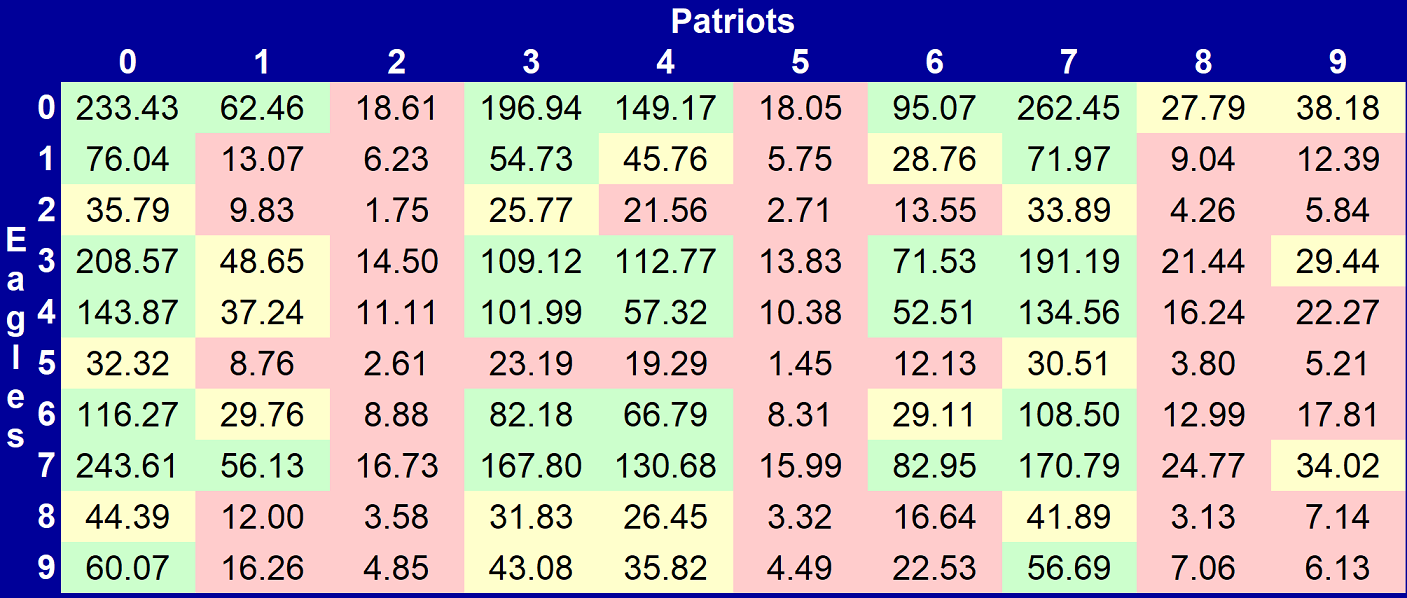
The best square this year is Eagles 0, Patriots 7 with an expectation of $262.45, more than five times the contribution. 0's, 3's and 7's are always good and if both your numbers are among those, you have a very good square. The worst square is 5,5. Not only are 5's unlikely final digits of a score, but they only come up much on high scores, like 35 or 45. These mostly occur at the ends of games, and if both teams have a 5 it could easily be the same score (35-35 or 45-45) meaning the game will go into overtime and the score will change. 2's, 5's and 8's are bad. 1's, 4's, 6's and 9's are in between, good if you pair them with a 0, 3 or 7; bad if you pair them with a 2, 5 and 8.
You can see other valuations posted on the Internet, but most of them simply use data from past NFL games. This is problematic. If you only use a season or two of data, you don't get enough scores to value the less valuable squares. If you use more data, you are factoring in games played under different conditions, such as where extra points are kicked from or how overtime works. Moreover different teams have different scoring propensities.
You could try to simulate the game from first principles, but this is very hard, and not necessary to value the squares. The important parameters are how high scoring the game is likely to be, and the extent to which each team relies on field goals versus touchdowns. Fortunately, we can use the point spreads to figure out the first one. The Patriots are favored by 4.5 points and the over/under is 48. Thus Las Vegas thinks the Patriots are likely to score around 26.25 points and the Eagles 21.75.
For touchdown to field goal ratio, I look at both teams offensive and defensive statistics over the season. The 2017 NFL average is 1.41 touchdowns per field goal. The Eagles are near average (1.43) but the Patriots do a better job of getting to the end zone. Their ratio is 1.69. Both teams allow above ratios on defense, the Eagles at 1.70 and the Patriots at 1.50. Given these statistics, I give the Eagles a Super Bowl expected ratio of 1.46--averaging their offensive ratio to the Patriots defensive--and the Patriots 1.69. There are an average of 24 drives (12 per team) in the NFL.
Combining these two analyses tells me that an Eagles drive has a 20% chance of a touchdown, 14% of a field goal and 66% chance of no score (punt or turnover or end of half or game). A Patriots drive has a 25% chance of a touchdown, 15% chance of a field goal and a 60% chance of no score. This is almost everything I need to simulate games. I also need to put in chances for safeties, missed extra points and two point conversions; and also assumptions about timing. These are especially important late in the game where coaches are more likely to go for two point conversions in order to get to a more favorable score position. I also have to worry about overtime. But all these are pretty straightforward to incorporate using league average values and standard coaching strategies.


Comments
Log in or sign up to join the conversation.