

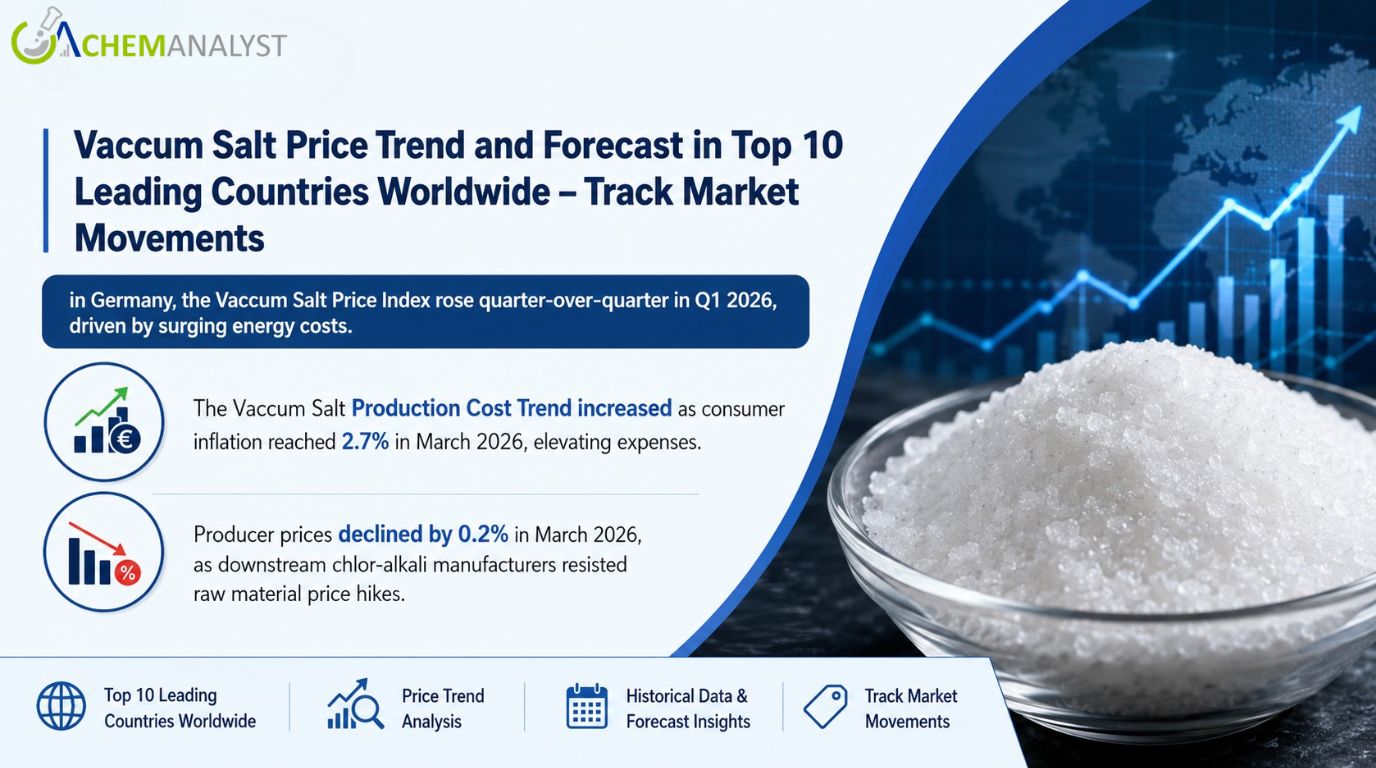
The global Vaccum Salt Price market witnessed notable growth during Q1 2026 as energy inflation, industrial expansion, and rising downstream demand reshaped regional pricing dynamics. Across major economies including the United States, China, and Germany, the Vaccum Salt Price Index moved upward quarter-over-quarter due to higher manufacturing expenses, stronger chlor-alkali demand, and broader industrial recovery.
According to ChemAnalyst Vaccum Salt Price: - https://www.chemanalyst.com/Pricing-data/vaccum-salt-2350
Vacuum salt remains a critical industrial raw material used extensively in chlor-alkali processing, food manufacturing, water treatment, pharmaceuticals, detergents, and chemical production. As industrial activities accelerated globally in early 2026, suppliers faced increasing pressure from energy-intensive production operations and transportation costs, resulting in elevated pricing trends.
The Vaccum Salt Production Cost Trend also reflected persistent inflationary pressures in several regions. Rising electricity tariffs, fuel costs, labor expenses, and logistics disruptions collectively contributed to higher operational expenditures for manufacturers.
What is Vacuum Salt?
Vacuum salt is a highly purified form of salt produced through vacuum evaporation technology. The process involves evaporating brine under controlled pressure and temperature conditions to obtain fine, high-purity sodium chloride crystals.
Compared to solar salt or rock salt, vacuum salt offers superior purity and consistency, making it ideal for industrial applications that require stringent quality standards.
Major applications of vacuum salt include:
Chlor-alkali manufacturing
Food processing
Pharmaceutical formulations
Water softening
Textile processing
Detergent manufacturing
Chemical synthesis
As industrial production increases globally, demand for vacuum salt continues to expand, influencing global pricing structures.
North America Vaccum Salt Price Trend
United States Vaccum Salt Price Analysis
In the United States, the Vaccum Salt Price Index increased quarter-over-quarter during Q1 2026. The upward pricing movement was primarily driven by elevated energy costs and rising manufacturing expenses.
Vacuum salt production is highly energy-intensive because the vacuum evaporation process requires substantial electricity and thermal energy. During March 2026, the Producer Price Index (PPI) in the United States rose 4.0% year-over-year, significantly impacting production economics for chemical and mineral manufacturers.
The Vaccum Salt Production Cost Trend strengthened further as manufacturers experienced:
Higher natural gas prices
Increased electricity tariffs
Rising transportation expenses
Labor cost inflation
Elevated packaging costs
Additionally, robust industrial demand from the chlor-alkali and water treatment sectors supported price growth throughout the quarter.
The United States chemical manufacturing industry remained resilient during early 2026, boosting procurement activity for industrial-grade vacuum salt. Market participants also reported tighter inventories in some regions due to weather-related logistics constraints and increased domestic consumption.
Key Drivers Behind US Vaccum Salt Price Growth
Rising Energy Costs
Energy remains one of the largest cost components in vacuum salt manufacturing. Higher fuel and electricity prices directly raised evaporation and processing costs.
Industrial Expansion
Demand from chemical manufacturing and water treatment industries strengthened procurement activity across North America.
Supply Chain Costs
Freight rates and inland transportation charges increased due to ongoing logistics challenges and fuel inflation.
Inflationary Pressures
Broader economic inflation impacted labor wages, maintenance costs, and industrial operating expenses.
APAC Vaccum Salt Price Trend
China Vaccum Salt Market Performance
China witnessed a quarter-over-quarter rise in the Vaccum Salt Price Index during Q1 2026, supported primarily by strong downstream chlor-alkali demand and expanding industrial production.
China remains one of the world’s largest producers and consumers of vacuum salt. The country's massive chemical manufacturing base heavily depends on high-purity salt for chlor-alkali operations, caustic soda production, and PVC manufacturing.
During March 2026, industrial production in China increased 5.7% year-over-year, indicating stronger manufacturing activity across multiple sectors. This industrial recovery significantly improved the Vaccum Salt Demand Outlook in the region.
Read the LinkedIn Article: - https://www.linkedin.com/pulse/vacuum-salt-price-intelligence-2026-how-energy-costs-impacting-singh-06cqc/
As demand strengthened, vacuum salt suppliers experienced higher order volumes from:
Chlor-alkali producers
Textile manufacturers
Food processing companies
Pharmaceutical industries
Water treatment facilities
The market also benefited from improving export demand and infrastructure investments that supported broader industrial activity.
Factors Supporting China Vaccum Salt Price Increase
Strong Chlor-Alkali Demand
The chlor-alkali industry remains the largest consumer of vacuum salt in China. Rising production of caustic soda and chlorine derivatives fueled procurement demand during Q1 2026.
Industrial Production Growth
Manufacturing expansion across construction chemicals, plastics, and industrial processing industries strengthened consumption patterns.
Stable Domestic Consumption
Steady domestic demand from food and pharmaceutical sectors provided additional market support.
Logistics and Raw Material Costs
Transportation and raw material procurement costs remained elevated despite improvements in supply chain efficiency.
Europe Vaccum Salt Price Trend
Germany Vaccum Salt Price Analysis
Germany recorded a quarter-over-quarter increase in the Vaccum Salt Price Index during Q1 2026 due to surging energy costs and inflationary pressures across industrial sectors.
European manufacturers continued to face elevated electricity and natural gas prices during the first quarter of 2026. Since vacuum evaporation technology relies heavily on thermal and electrical energy, rising utility costs significantly impacted production economics.
In March 2026, Germany’s consumer inflation rate reached 2.7%, increasing operational and logistics expenses for industrial manufacturers.
The Vaccum Salt Production Cost Trend strengthened as companies dealt with:
Higher utility expenses
Rising labor wages
Increased transportation costs
Expensive industrial maintenance
Inflation-driven procurement expenses
The German chemical sector remained a major contributor to vacuum salt demand growth. Water treatment and food manufacturing industries also supported market expansion during the quarter.
Major Factors Influencing Germany Vaccum Salt Prices
Energy Inflation
Europe’s energy market volatility continued to influence industrial manufacturing costs.
Industrial Manufacturing Recovery
Stable activity in chemical processing and industrial manufacturing boosted vacuum salt demand.
Inflationary Environment
Higher consumer inflation translated into increased operational costs for manufacturers.
Environmental Compliance Costs
European sustainability regulations and carbon-related expenses added further financial pressure on industrial producers.
Global Vaccum Salt Market Drivers
Several macroeconomic and industry-specific factors influenced global Vaccum Salt Price movements during Q1 2026.
Energy Cost Volatility
Energy remains the most influential factor impacting vacuum salt production costs globally. Rising electricity and fuel prices directly affect evaporation and processing operations.
Chlor-Alkali Industry Expansion
The chlor-alkali industry continues to drive significant demand for high-purity vacuum salt worldwide.
Industrial Growth
Manufacturing recovery across major economies strengthened industrial mineral consumption.
Logistics and Freight Costs
Transportation expenses continued influencing regional pricing trends due to fuel inflation and supply chain inefficiencies.
Inflationary Pressures
Global inflation impacted wages, maintenance, packaging, and raw material procurement costs.
Vaccum Salt Demand Outlook for 2026
The global Vaccum Salt Demand Outlook remains positive throughout 2026 as industrial production and chemical manufacturing continue expanding.
Several industries are expected to sustain healthy procurement activity, including:
Chlor-alkali manufacturing
Water treatment
Pharmaceuticals
Food processing
Textile production
Chemical manufacturing
Asia-Pacific is expected to remain the fastest-growing regional market due to industrialization and infrastructure development.
North America and Europe are also likely to witness stable demand growth despite ongoing energy-related cost challenges.
Future Vaccum Salt Price Forecast
Industry analysts expect Vaccum Salt Prices to remain firm during the remainder of 2026 due to continued energy market volatility and resilient industrial demand.
However, pricing trends may vary by region depending on:
Natural gas price movements
Industrial production growth
Export-import dynamics
Inflation trends
Environmental regulations
Supply chain stability
If energy prices stabilize in the second half of 2026, manufacturers may experience moderate cost relief. Nevertheless, strong downstream demand from chlor-alkali industries is expected to support overall market pricing.
Challenges Facing the Vaccum Salt Industry
Despite positive market growth, the industry continues to face several operational challenges.
High Energy Dependency
Vacuum evaporation technology consumes substantial energy, making producers vulnerable to utility price fluctuations.
Environmental Regulations
Stricter environmental standards in Europe and North America may increase compliance costs.
Transportation Expenses
Freight market volatility continues affecting supply chain economics globally.
Competitive Pressure
Manufacturers face increasing competition from alternative salt production methods and regional suppliers.
Strategic Industry Opportunities
The global vacuum salt market also presents multiple long-term growth opportunities.
Expansion in Water Treatment
Growing investment in water purification infrastructure is expected to support future demand.
Industrial Automation
Advanced manufacturing technologies can improve operational efficiency and reduce production costs.
Emerging Market Growth
Rapid industrialization in developing economies may create additional demand opportunities.
Sustainable Production Technologies
Energy-efficient evaporation systems may help manufacturers reduce operational costs and environmental impact.
Conclusion
The global Vaccum Salt Price market experienced significant upward momentum during Q1 2026 as rising energy costs, industrial expansion, and robust chlor-alkali demand strengthened regional pricing trends.
In the United States, elevated energy expenses and inflationary pressures increased production costs. China benefited from strong industrial production growth and robust downstream demand, while Germany faced continued energy-driven manufacturing challenges.
Looking ahead, the Vaccum Salt Demand Outlook remains positive as industrial activity, infrastructure development, and chemical manufacturing continue supporting market expansion worldwide.
Although energy volatility and inflation remain major challenges, strong downstream consumption is expected to maintain firm pricing conditions throughout 2026.
Contact US:
Email-Id: - [email protected]
Contact No: - +1 (332) 258-6602
Address: - 420 Lexington Avenue, Suite 300
New York, NY
United States, 10170
Comments
Log in or sign up to join the conversation.