


USD/JPY fell to 159.45 on Tuesday, with the yen strengthening amid growing concerns about currency intervention by the Japanese authorities. The key level for the market remains 160.00, which traders see as a potential area of heightened risk of official intervention.
Japanese Finance Minister Satsuki Katayama stated last week that the authorities were seeing sharp, one-sided moves in the yen and were ready to respond to excessive volatility. Against this backdrop, USD/JPY’s approach to 160.00 significantly raises the risk for yen sellers, as the likelihood of government intervention rises.
The yen is also being supported by deteriorating global risk appetite. The continued sell-off in the AI sector may boost demand for safe-haven assets, including the Japanese currency. At the same time, the fundamental backdrop remains mixed: the Japanese economy unexpectedly recorded zero quarter-on-quarter growth in Q3, versus expectations of 0.1%, while household consumption fell for the second consecutive quarter. These data leave the BoJ room to proceed cautiously with policy normalisation despite inflationary risks.
At the same time, the BoJ’s rhetoric remains fairly hawkish. Hajime Takata pointed to the risks of second-round inflationary effects and stressed the need to bring interest rates closer to neutral. The central bank is therefore signalling its readiness to act flexibly and remain data-dependent. The weak yen is also seen as a factor that could add to inflationary pressures, supporting expectations of further rate hikes.
In the US, the dollar continues to draw support from expectations of tighter Fed monetary policy. Following strong inflation data and hawkish comments from Fed officials, markets estimate the probability of a 25-basis-point rate hike in December at around 95.7%, with the probability of a 50-basis-point move at approximately 4.3%. Attention now shifts to October US retail sales data, which could influence Fed expectations and determine the next move in USD/JPY.
Technical Analysis
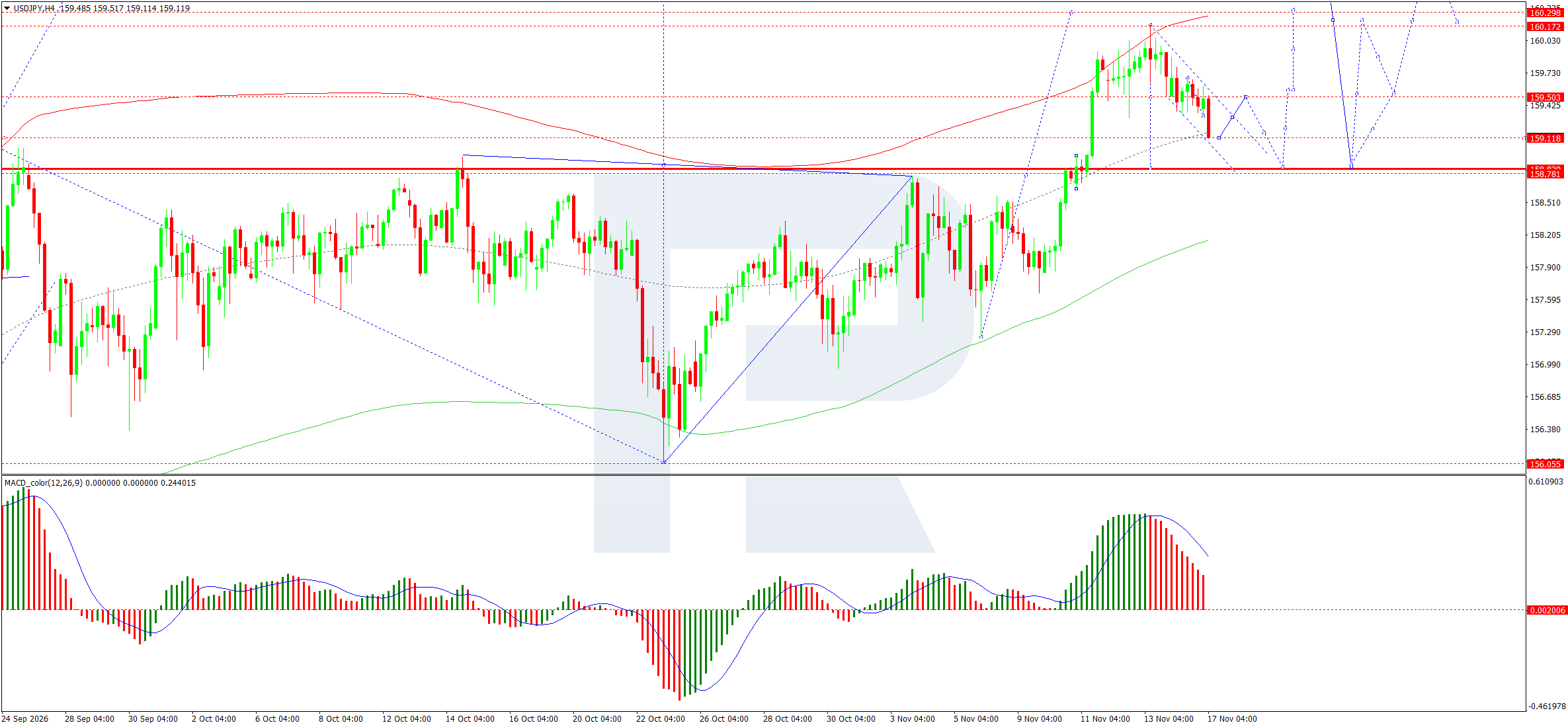
On the H4 USD/JPY chart, a correction is developing following the upward move towards 160.17. The sequence of higher lows preserves the medium-term uptrend, but the immediate move is towards support at 158.80. The pair is trading around 159.11, below intermediate resistance at 159.50. The 158.80 area is a key zone for assessing whether buyers can maintain control following the previous break higher.
The MACD indicator remains above zero, but its signal line is pointing downwards, and the positive histogram bars are contracting. This combination reflects weakening upward momentum and supports a continued correction. The indicator’s position in positive territory does not yet confirm a resumption of the upward move.
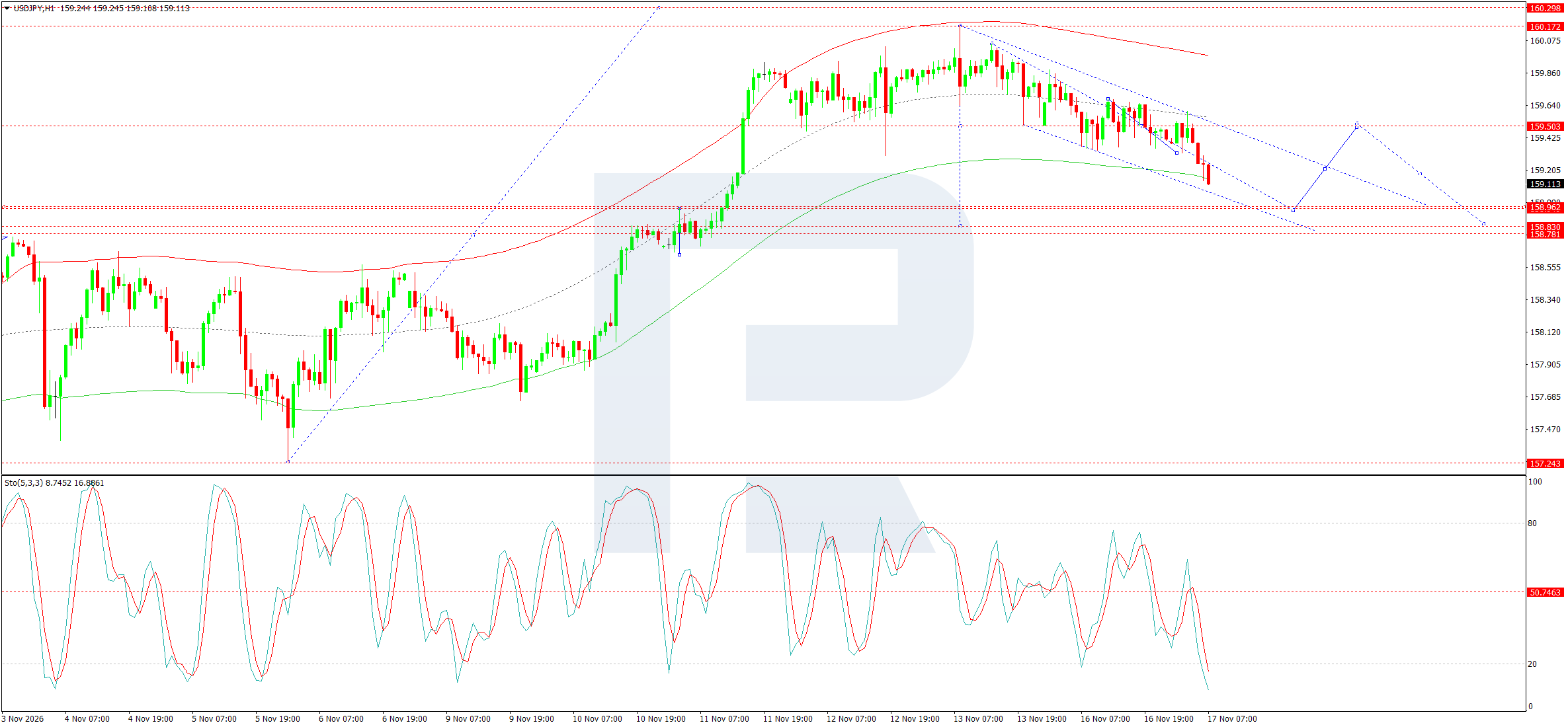
On the H1 USD/JPY chart, a downward structure is forming, with a sequence of lower highs. The nearest downside target is around 158.96, with the next support zone between 158.83 and 158.78. The Stochastic oscillator has fallen below 20, with both lines pointing downwards. Oversold conditions allow for a technical rebound but do not, on their own, signal a reversal.
For 17 November, the baseline scenario remains a test of these support levels followed by consolidation. Holding above the 158.80 area would allow for a recovery towards 159.50. Consolidation above this resistance would increase the likelihood of a move towards 160.17, followed by 160.30. Conversely, a break below support at 158.78 would indicate a deepening correction and require a reassessment of the upward scenario.
Conclusion
USD/JPY remains under pressure near 159.45 as the yen benefits from growing concerns about intervention, with the 160.00 level seen as a potential area of heightened risk of official action. Japanese authorities have warned about sharp, one-sided currency moves, increasing the risks for yen sellers as the pair approaches this level. Deteriorating global risk appetite, particularly amid the sell-off in the AI sector, may also support demand for the yen, while mixed domestic data – zero GDP growth and falling household consumption – leave the BoJ room to proceed cautiously with policy normalisation. Fairly hawkish BoJ rhetoric and expectations of further Fed tightening, with the probability of a 25-basis-point rate hike in December at 95.7%, keep the fundamental backdrop mixed. Technically, the pair is undergoing a correction within a medium-term uptrend, with support at 158.80 and resistance at 159.50. Consolidation above resistance would open the way towards 160.17 and 160.30, while a break below support would deepen the correction. The upcoming US retail sales data will be the key catalyst for the next directional move.



Comments
Log in or sign up to join the conversation.