

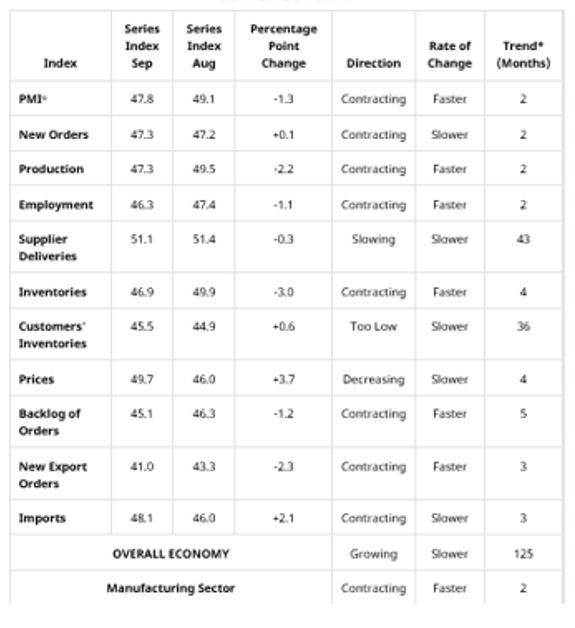
“(US) Manufacturing contracted in September, as the PMI registered 47.8 percent, a decrease of 1.3 percentage points from the August reading of 49.1 percent. This is the lowest reading since June 2009, the last month of the Great Recession, when the index registered 46.3 percent…The PMI contracted for the second straight month. The contraction continues six straight months of softening in manufacturing.” (ISM, October 1, 2019)
In September, the American ISM manufacturing index dropped to 47.8, its lowest measure since June 2009. (A reading above 50 indicates that the manufacturing economy is expanding; below 50 indicates that it is generally contracting.)
Indeed, all the major sub-indices of manufacturing (production, new orders and employment) were also in contraction territory, i.e. below 50. In other words, the September data marks the second consecutive month of manufacturing contraction.
Not surprisingly, the recent low numbers have heightened fears that the US economy will shortly fall into a recession. In fact, a manufacturing recession, even if it is triggered by a trade war, does not necessarily lead into a general economy-wide recession.
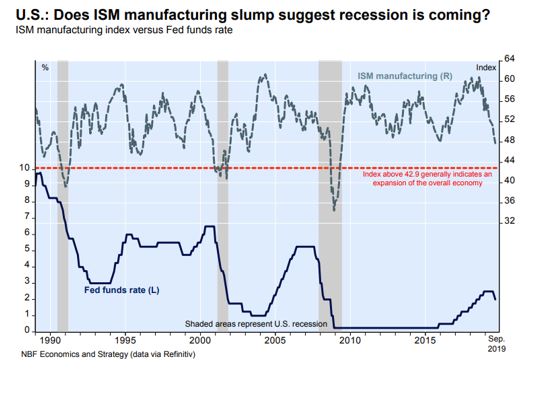
As the accompanying chart illustrates, the last time the ISM manufacturing indicators were this low the American economy was coming out of the 2008-09 recession.
As the National Bank’s October 1st Hot Chart illustrates, even in the face of a weakening manufacturing sector, that the overall economy continues to expand.
In other words, manufacturing woes do not necessarily predict a US recession.
Indeed, the past relationship between the manufacturing PMI and US real GDP growth indicates that the September PMI (47%) corresponds to a 1.5% increase in annual real GDP. That is, a PMI above 42.9 percent generally indicates an expansion of the overall economy. Therefore, the September PMI suggests continued growth for the overall US economy.
President Donald Trump has publicly blamed the Federal Reserve for the latest weakness in manufacturing. He incorrectly argues that high-interest rates and the strong US dollar were the main cause of the industry slump. He ignores the clear evidence that the main perpetrator of manufacturing’s slump is the trade war that he created.
The key conclusion stemming from the recent disappointing data on US manufacturing is that the industrial weakness has deepened and broadened to encompass almost every sub-sector.
As well, manufacturing production is contracting across the industrialized world, with activity clearly worsening everywhere in September. Finally, an additional worry is the fact that it remains somewhat unclear whether and/or when the next bout of tariff escalation between the U.S. and China will occur.
In closing, manufacturing is contracting in all of the industrial countries, and there is little doubt that the trade war is behind the industry’s malaise.
Overview Of US Manufacturing, September 2019


Comments
Log in or sign up to join the conversation.