

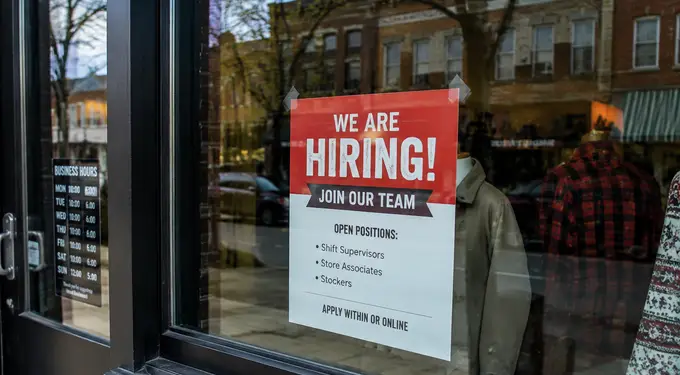
The US labor market showed mixed signals in July, with job openings increasing modestly even as employers pulled back on hiring.
Job openings, a measure of labor demand, rose by 89,000 to 7.271 million on the last day of July, the Labor Department’s Bureau of Labor Statistics said Tuesday in its Job Openings and Labor Turnover Survey, or JOLTS report.
June’s figure was revised lower to 7.182 million from the previously reported 7.359 million.
Economists polled by Reuters had expected 7.3 million unfilled positions in July.
The increase in vacancies was driven in large part by manufacturing, where job openings jumped by 79,000, with nearly all of the increase coming from durable goods industries.
Professional and business services also recorded 65,000 additional openings.
The overall job openings rate increased to 4.4% from 4.3% in June.
But the increase in available jobs did not translate into stronger hiring.
The number of hires fell by 278,000 to 5.054 million, while the hiring rate declined to 3.2% from 3.4%.
Professional and business services accounted for much of the decline, with hiring in the sector falling by 188,000.
Layoffs remain historically low
The JOLTS report also showed that employers continued to avoid large-scale layoffs, providing some support for the view that the labor market is stable rather than rapidly deteriorating.
Layoffs and discharges fell by 119,000 to 1.666 million in July. The layoff rate declined to 1% from 1.1% in June.
Historically low layoffs have accounted for much of the employment growth seen this year, even as companies have become increasingly reluctant to add workers.
At the same time, fewer workers voluntarily left their jobs in July.
A decline in quits can signal that employees are becoming less confident about finding better opportunities elsewhere.
Taken together, the figures suggest a labor market that is neither collapsing nor showing the strength associated with a robust expansion.
"The labor market is back in the 'low fire, low hire' mode," said Heather Long, chief economist at Navy Federal Credit Union.
"Companies are growing cautious as the war in Iran drags on and borrowing costs have spiked.''
Fed faces inflation and employment trade-off
The latest labor data arrives as the Federal Reserve weighs competing risks from inflation and employment.
A relatively stable labor market gives policymakers more room to focus on inflation, which remains above the central bank’s 2% target.
Fed Chairman Kevin Warsh said Friday that the central bank will "have work to do" if policymakers fail to gain sufficient confidence that inflation is moving toward the 2% goal.
Financial markets are currently pricing in about a 66% probability of a 25-basis-point Fed rate increase at the September 15-16 meeting, according to CME Group’s FedWatch tool.
The federal funds rate currently stands at 3.50%-3.75%.
Higher energy prices could complicate the outlook.
The fighting with Iran has created an energy shock that is putting additional pressure on household budgets and could keep inflation elevated.
That leaves the Fed facing a difficult policy environment: hiring is weakening, but price pressures may limit its ability to respond with easier monetary policy.
Friday's jobs report takes center stage
Investors will now turn to Friday’s closely watched nonfarm payrolls report for a clearer picture of the labor market.
A Reuters survey of economists expects payroll growth to rebound in August after employment unexpectedly declined in July.
The broader trend so far this year points to a significant slowdown in job creation.
US employers, including companies, nonprofits and government agencies, have added an average of 61,000 net jobs per month in 2026, AP reported.
While that pace is weak by historical standards, it represents an improvement from 2025, when monthly job growth averaged fewer than 10,000 positions.
That was the weakest hiring pace outside a recession since 2002, as high interest rates and uncertainty surrounding President Donald Trump’s tariffs discouraged companies from expanding their workforces.
The July JOLTS data therefore offers little evidence of either a major labor-market breakdown or a renewed hiring boom.
Instead, employers appear to be maintaining a cautious balance: keeping layoffs low while limiting new hiring.
That dynamic could remain important for the Fed.
If employment continues to weaken without a sharp rise in layoffs, policymakers may have more time to assess whether inflation is moving sustainably lower before changing interest rates.
For now, the US labor market appears to be moving sideways, with Friday’s employment report likely to determine whether that holding pattern is beginning to break.



Comments
Log in or sign up to join the conversation.