

“U.S. infrastructure is aging, underperforming, and harming the economy. Businesses and individuals are bearing the economic costs of our failing infrastructure. They are losing time, productivity, and opportunities due to excessive traffic, delayed shipments, disruptions in energy supplies, or connectivity issues. According to the American Society of Civil Engineers’ 2017 Infrastructure Report Card, America’s overall infrastructure grade is a D+ (poor and at risk), reflecting challenges faced by transportation, water, energy, and other infrastructure systems across criteria such as condition, capacity, and safety.” (House Committee on The Budget, Sept. 24, 2019)
It is generally understood that the US infrastructure industry lags far behind many of its global competitors. Unfortunately, new infrastructure investment has historically been held back by a lack of federal government commitment.
This is unfortunate since infrastructure spending is a critical determinant of the health of the US economy in both the short and long term. Infrastructure spending is crucial since it supports production, employment, productivity, and international trade.
Indeed, a commitment to increased infrastructure spending was one of the few sensible economic planks that the Trump Administration ran on in 2016. However, despite a massive increase in the budget deficit and in military spending, nothing effective resulted from the infrastructure promise. In fact, the United States has not experienced a major federal led infrastructure package since the days of the Eisenhower administration.
A recent NBER report (The Digest, Sept. 2020) indicates that real net investment per capita has drifted downward since the financial crisis and currently stands near its lowest level since 1983. (The NBER Digest, Sept. 2020).
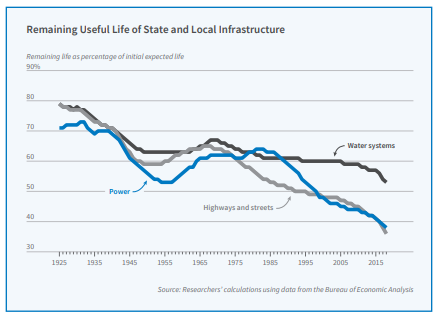
The same study indicates that the average age of most types of infrastructure in the US has been rising, and the remaining service life has been falling. Much of US infrastructure, from highways to waste treatment facilities and energy grids, has approached the end of its useful life and is in desperate need of upgrading.
It is useful to distinguish infrastructure into two broad categories - transportation and utilities. The former includes mass transit and rail, streets and highways, seaports, airports, and even new transportation systems will be needed for driverless vehicles. The latter utility group includes key services such as power, water, waste and broadband or fiber.
When money is actually allocated there will be the vexing challenge of distinguishing between major infrastructure upgrades, which count as investment, and maintenance spending, which does not. For example, in the case of highways maintenance spending represents about 15% of gross investment.
The fiscal spending multipliers are attractive when it comes to infrastructure spending.
In the short term, every $1 of infrastructure spending should boost economic output by $1.50 or more. Moreover, the multiplier effect related to infrastructure spending is likely strongest when the economy is weak and recovering. This should fit the early years of a Biden Presidency.
Even though infrastructure investments are extremely attractive to the public there are unfortunately long political time lags before shovels are in the ground. The political lag occurs because these kinds of large investments typically involve three levels of government.
Thus, the potential positive economic gains could be held up by political jockeying in Congress and between the new Administration and State and local governments.
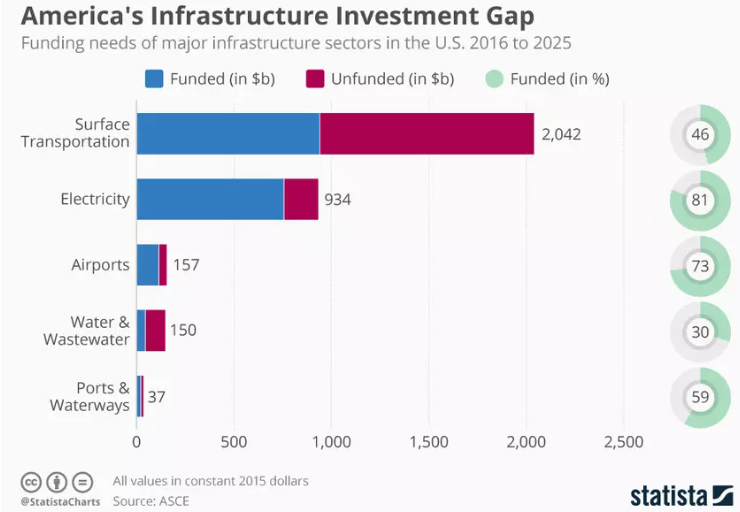
Nonetheless, a Biden Administration could potentially realize strong medium-term gains for the economy in terms of employment, incomes and output if, unlike Republicans, it seriously addresses the large infrastructure spending gap.
(Click on image to enlarge)
(Click on image to enlarge)


Comments
Log in or sign up to join the conversation.