
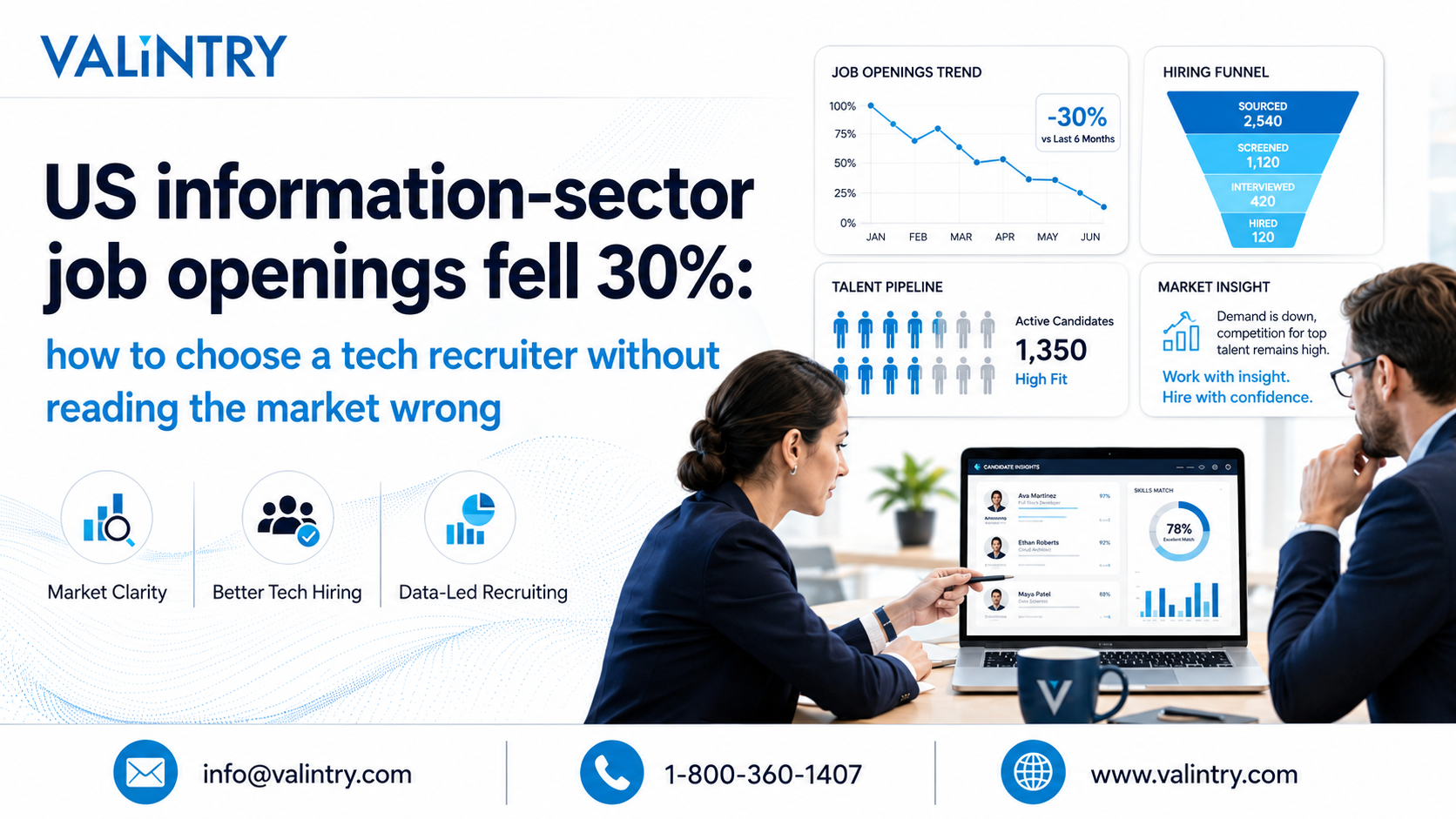
The US technology hiring market can look weak or strong depending on which number gets quoted. The Bureau of Labor Statistics JOLTS table shows that job openings in the broad information sector fell from 109,000 in May 2025 to 76,000 in May 2026, a drop of about 30%. That figure can support a cautious hiring view, but it doesn’t describe every technology occupation or every employer’s search difficulty.
The conflicting signal appears when occupational demand is examined instead of one industry category. Employers still compete for specific skills in cloud infrastructure, cybersecurity, software engineering, data work, and technical leadership. A company that treats a broad sector decline as proof that every IT role is easy to fill may underinvest in search quality and lose time on weak candidate pools.
What deserves attention first: demand is uneven
The strongest evidence separates industry activity from occupational demand. The BLS outlook for computer and information technology occupations projects about 317,700 openings each year from 2024 to 2034. It also reports a May 2024 median annual wage of $105,990 for these occupations, compared with $49,500 across all occupations. Those figures show why a lower headline opening count can coexist with persistent competition for specialized workers.
Hiring leaders should judge an agency by the roles it can fill and the evidence behind its candidate pool. A buyer comparing a Best Tech Recruiting Agency should expect a clear explanation of which skills remain scarce within the required location and salary range. The agency should also show how candidate availability changes when a brief requires a certain cloud platform, security clearance, industry background, or work arrangement.
What needs context: speed and database claims
Large candidate counts sound persuasive, but a database total says little about current reach. Useful questions include how recently profiles were checked and how many candidates match the actual brief. A list containing millions of records can still produce a small usable pool after location, compensation, work authorization, and technical depth are applied.
Speed claims need the same treatment. VALiNTRY states that its process can present qualified candidates within 48 hours and that its V-FiTT system covers more than 6 million profiles. A buyer considering a Tech Recruitment Company should ask what “qualified” means, which roles meet that timing, and how often the target is achieved. Client-reported figures become useful when the agency can define the measurement and provide comparable search examples.
What can be ignored: rankings without a method
Labels such as “top agency” or “leading recruiter” carry little weight on their own. A ranking deserves attention only when the publisher names its method, comparison group, data period, and commercial relationships. Testimonials can add context, but anonymous praise can’t replace placement records, retention figures, reference checks, or role-specific outcomes.
The same caution applies to broad “talent shortage” claims. Shortages often vary by skill, seniority, pay, location, and employer requirements. A specialist agency should narrow the claim to the buyer’s vacancy and explain which requirement is reducing the available pool. That explanation is more useful than repeating a national shortage headline that may combine unrelated occupations.
Which sources are strongest
Official labor data provides the best starting point for market size, wages, openings, and hiring movement. Agency records can then answer narrower questions about response rates, interview conversion, offer acceptance, and retention. Both source types matter because government data describes the market while search records show how a specific hiring brief performs inside it.
Technology claims also need operational evidence. The NIST AI Risk Management Framework asks organizations to govern, map, measure, and manage AI risk across a system’s use. Applied to recruiting, that means a buyer should ask what the matching tool measures and how humans review its output. An AI label has little value without a documented process for testing accuracy and correcting weak matches.
How readers should apply the evidence
Start with one live vacancy rather than an agency’s general sales claims. Give each firm the same role brief, salary range, location rules, and required skills, then compare the first candidate group on relevance. The test should record how many candidates meet the requirements and where the search breaks down.
Screening methods deserve close review because automated tools can create legal and practical risk. The EEOC and Department of Justice guidance on AI in hiring warns that algorithmic tools may screen out people with disabilities and may require accommodation processes. Buyers should ask how an agency checks assessment tools and handles accommodation requests. Human review should remain part of the decision path.
The final choice should rest on evidence tied to the actual vacancy. A buyer assessing a Best Tech Recruitment Agency should expect clear search assumptions and a documented screening process. Results should be reported against measures agreed before the search begins. VALiNTRY also describes contract, temp-to-perm, and permanent hiring support through its IT staffing agency services, which gives buyers a practical route when the hiring model is still part of the decision.
A short evidence filter for the final decision
Ask 4 questions before signing. Is the claim tied to a defined role and date? Can the agency show how the figure was measured? Does an official or original source support the market claim? Can the recruiter explain what the evidence changes in the hiring plan? Those questions remove much of the noise and leave the information that can support a sound decision.
Frequently asked questions
Why do current tech hiring figures appear to conflict?
Different datasets measure different parts of the market. An industry series may include publishing, telecommunications, and other information businesses, while an occupational series follows workers such as developers or security analysts across many industries. The period, geography, and seasonal adjustment can also change the result. A reliable interpretation checks the definition before using the number.
Does a large candidate database prove an agency is effective?
A large database proves reach only when the records are current and relevant to the role. Buyers should ask how many profiles match the full brief and how many candidates have shown recent interest. Response rate and interview conversion usually reveal more than the headline total. The agency should be able to explain the age and source of its records.
How should a company test a recruiter before a large engagement?
Use one representative vacancy with written success measures. Compare the relevance of submitted candidates and the time required to produce the first qualified profile. Review communication quality during the search and ask for a final report on what the market showed. This creates evidence that can support a wider agreement.
What proof matters for technical screening?
The recruiter should explain who conducts the screen and what the assessment covers. For technical roles, the process should connect directly to the work rather than rely on keyword matches. Buyers should review sample scorecards and ask how borderline results receive human review. Reference checks and later job performance can help test whether the screen predicts success.
Should employers prefer a specialist over a general recruiter?
A specialist may offer better role knowledge when the vacancy requires uncommon tools or senior technical judgment. The useful test is the recruiter’s ability to explain the role and challenge unclear requirements. A general firm may still perform well when it has a proven team for that skill area. Evidence from comparable searches should decide the choice.
For more details, Click Here
Get In Touch
Phone: 1-800-360-1407
Mail: [email protected]
Comments
Log in or sign up to join the conversation.