

There are several compelling reasons for expecting price inflation to increase in the year ahead, particularly because the economy has been so strong, and the labor market seems incredibly tight (i.e. a 3.9% unemployment rate).
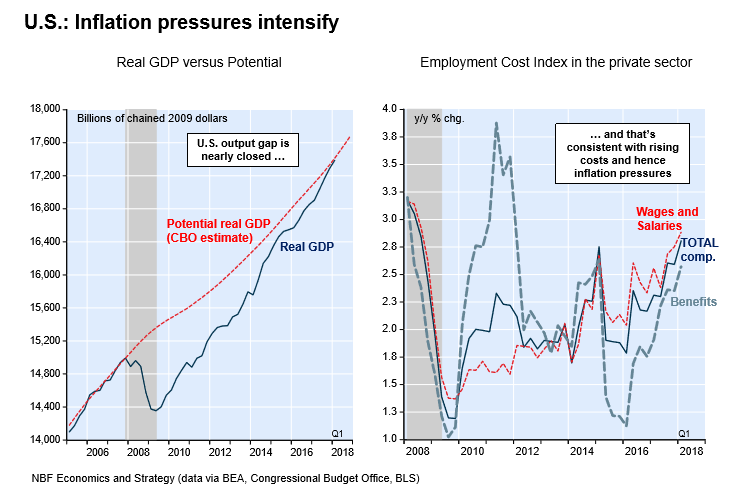
The Congressional Budget Office provides estimates of full capacity GDP, which can then be compared to actual GDP levels.
According to the CBO’s figures, the U.S. output gap (or the difference between potential and actual real GDP) was virtually eliminated at the end of 2017. The U.S. economy expanded at real annual growth rate of 2.3% in Q1, even though the output gap may actually be closed.
In other words, the elimination of the output gap suggests that the economy is outperforming and close to a situation where actual GDP could be higher than the economy's recognized maximum capacity output.
In theory, the elimination of the output gap suggests that wage and price pressures will intensify.
In fact, while the data are not necessarily perfectly clear, inflationary pressures have been building. The Fed’s preferred measure of inflation, the core PCE deflator, which excludes food and energy, rose 1.9% year-over-year in March.
There is little doubt that as the output gap becomes even more negative, the Fed will more consistently hit its 2% inflation target.
Other related data indicate that the private sector’s employment cost index, which includes wages, salaries, and benefits, rose again in Q1 and is now growing at its fastest pace since 2008.


Comments
Log in or sign up to join the conversation.