

The gross domestic product in the U.S. rose at an annual rate of 2.6% in the three months ending June, data from the U.S. commerce department showed on Friday. The second quarter data posted a rebound after the economy was seen rising just 1.2% in the three months ending March 2017.
Attributing to the growth in the GDP, consumer spending and businesses as well helped to propel growth higher.
(Click on image to enlarge)
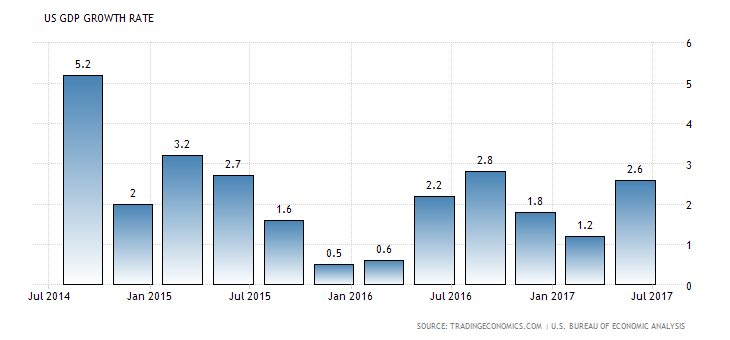
U.S. GDP Q2 2017 – 2.6%
According to the data, household outlays rose at a pace of 2.8%, accelerating from the 1.9% growth in the first quarter. Consumer spending was seen rising across goods and services sectors.
In July, the Conference Board consumer confidence index surged to the second highest levels since 16 years.
On the business front, data was also upbeat. Nonresidential fixed investment rose at a pace of 5.2%. This was slightly lower from the first quarter growth of 7.2% but was still one of the best on record since 2014.
Government outlays also increased with a push from the federal defense spending. Home building and improvements, however, posted a drag during the second quarter. Residential fixed investment fell 6.8%.
The commerce department also made some annual revisions to the GDP data going back to 2014. Overall there was little change with GDP growth averaging 2.2% a year since 2013 through 2016. This was slightly higher from 2.1% growth estimated during the same period.
GDP numbers for 2014 and 2015 were revised higher but growth for 2016 was revised down due to a wider trade deficit data.
U.S. trade deficit falls, durable goods orders rise on transportation
On Thursday, the U.S. trade deficit data was released. Official data showed that the deficit in goods was down 3.7% in June on a month over month basis to a seasonally adjusted $63.86 billion.
Exports rose 1.4% on the month while imports fell 0.4%, helping to reduce the deficit. Export of food, feeds and beverages showed a modest rebound from May.
The commerce department also said that net international trade helped to boost the overall economy. Trade alone amounted to 0.18% to the overall GDP figures.
The durable goods orders data also helped to improve the sentiment in the U.S. dollar. Data showed that orders for durable goods rose 6.5% in June.
Most of the gains came from transportation orders which rose 19% and marked two consecutive monthly increases. Excluding transportation orders, durable goods orders rose just 0.2%.
Core PCE rises 0.3% on the month
The Fed's preferred gauge of inflation, the PCE price index rose 0.3% on a month over month basis. This was in line with economists' expectations. Excluding food and energy prices, core PCE rose 0.9%. Inflation continues to run below the Fed's 2% target rate.
The fact that inflation pressures staying subdued alongside lower wage growth continue to weigh on traders’ minds.
Next week, fresh economic reports will be released. The data will offer further clues into how the U.S. economy has performed in July. The ISM’s manufacturing and non-manufacturing PMIs are expected to slip back following a strong increase in June.
The U.S. unemployment data is also due to come out on Friday. The unemployment rate is projected to slip to 4.3% with wages seen accelerating. Some better than expected data could help the U.S. dollar to recover some of the losses from the past few weeks.
Still, traders are unlikely to buy into any single event considering that the markets’ expectations of a rate hike continue to fall significantly, while the Fed projects another rate hike by December 2017.



Comments
Log in or sign up to join the conversation.