

I look at hundreds of charts a week and the most useful tend to teach multiple lessons or elegantly illustrate an important macro factor. The chart below, which depicts relative equity valuations since 1985, is an example.
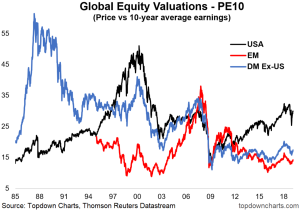
Interestingly, U.S. equities traded at steeply discounted price/earnings multiples, compared to non-U.S. developed markets, for the period 1985-1997/8. The dot.com bubble drove capital into U.S. markets which produced a period produced in which the United States had the most highly valued equities.
American equities entered another period in in 2012 in which they traded at premium price/earnings multiples to other markets. The trend persists to this day.
We do a lot of work at the Global Investment Letter on monitoring capital flows because we believe it is the single most important driver of investment returns over time. The two periods on the chart in which U.S. markets traded at premiums reflects foreign capital moving into U.S. dollar-denominated assets. The U.S. dollar remains the best of a motley group of currency alternatives and the U.S. economy continues to demonstrate unmatched resilience. The downward slope of the non-U.S. developed markets.
The period that began in the late '90s was clearly driven by the dot.com bubble. The United States was ground zero for investment in this theme. It is interesting to note that the valuation gap between the U.S. and non-U.S. developed markets began to narrow as the Japanese market collapsed starting in 1989. Capital was moving from Japanese to American equities and the trend accelerated with the advent of the internet.
The second period which began in 2012 is being driven by different considerations which I touched on in 2015 (The Best Investment Over the Next Five Years?). I believe the key driver of the persistent valuation premium of U.S. stocks are geopolitical in nature, most notably driving capital from Europe. It has long been my contention that the euro is ultimately doomed (Will the Euro Ultimately Collapse? also from 2015) and that the European Union may not exist in its present form in 10 years.
The downward slope of the non-U.S. developed markets line on the chart is a testament to the declining relative importance of Europe and Japan. The array of economic and political issues facing the European Union and the generally deteriorating global geopolitical situation suggests that the United States will be the recipient of foreign capital for some time.


Comments
Log in or sign up to join the conversation.