

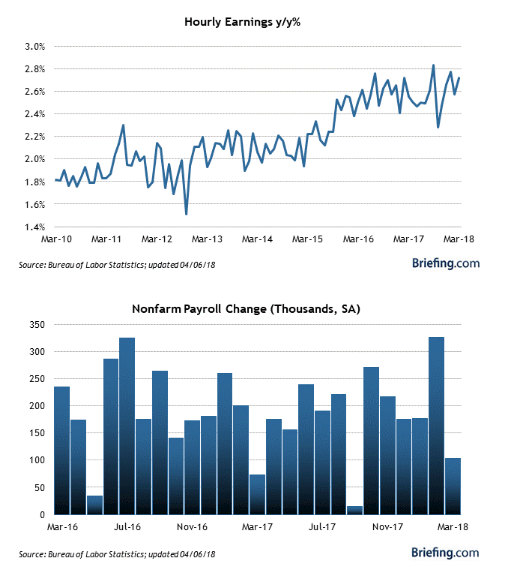
Non-farm payrolls increased by only 103,000 in March, sharply lower than the 326,000 gain in February. Nonetheless, job growth in the first quarter of 2018 was stronger than it was in the same quarter last year.
Indeed, the household survey data suggest that there still is some scope for increasing employment from those who are formally out of the labor market, such as stay-at-home parents.
There was a sharp 0.3% increase in average hourly earnings in March, which raised the year-over-year rate up to 2.7%. The 12-month wage gain was still slightly below the 2.8% in January that worried the markets about inflation heating up.
The unemployment rate remained at 4.1% in the latest survey, its lowest level since December of 2000. The U-6 measure of unemployment, which includes discouraged workers and people working part-time jobs who would prefer full-time work, fell to an 11-year low of 8%.
As for the various sectors, there was solid employment gains in March in manufacturing, health care, and mining, but unusually weak growth in the service sector.
The construction and retail trade sectors engaged in major hiring in February, but then let many of these people go in March. The recent pullback in job growth can also partly be traced to the wintry weather in March and the unusually strong 326,000 jobs surge in February.
In other words, it is not unusual for job growth to slow after a surge the month before.
While it may be premature to assume that U.S. job growth is genuinely slowing, nonetheless, the March figures could affect the Fed’s decision on whether to raise interest rates three or four times this year.


Comments
Log in or sign up to join the conversation.