

The US Dollar was unable to hold onto gains on Monday, which may have had more to do with an unwind of USDBRL short positions than value buyers seeing the USD as oversold. Either way, the DXY is working on its lowest weekly close since October 31, and if you look at the bond market or listen to St. Louis Federal Reserve President James Bullard, who is a non-voter, you can see why. On Friday morning, Mr. Bullard said that “FOMC’s contemplated policy rate path is overly aggressive relative to actual incoming data on U.S. macroeconomic performance.” The bond market seems to agree as the spread of short-dated maturities that are sold compared to longer dated maturities that are bid are flattening. It's also worth noting that fear is not compounding despite the pullback in US economic growth. When looking at the options market, 1-month 25 delta risk reversals showing traders are not paying a premium for protecting against the JPY appreciating that many would expect after Wednesday's miniture sell-off. This tends to show that markets remain stable, which could help risk in the coming days.
What’s important to note is that the front end is being supported by the Federal Reserve, whom Bullard said could be hiking too aggressively relative to economic data, and the back end is said to be market driven. As of Friday, the 2/10 Year Treasury Yield Spread was at 0.94%. This is lower than the 20-day average of 1.02653%. This bear flattening of the 2/10 spread helps to show if the trend of lower/ flattening continues that future growth in the US is not being priced in by the bond market and that the Fed may, in fact, be setting up for unwarranted aggressive tightening. On the other side of the most popular FX pair, EUR/USD, the EUR has been shining and looks set to have the central bank headed by Mario Draghi confirming to markets that their form of tightening is working its way into the limelight. On Friday, EUR/USD traded above 1.12 for the first time since November 9 and is working on its highest weekly close since September.
While the week was fraught with FX events, looking forward, all eyes will be on Vienna, and specifically, the Organization of Petroleum Exporting Countries or OPEC in Vienna when they meet on Thursday, May 25. Crude Oil traded above $50/bbl on Friday in anticipation that OPEC would extend production curbs through March 2018, a 9-month extension. In an ideal scenario (which rarely plays out in markets or life), US production would slow down, inventories draws in the US would continue, China demand would remain near record highs, and an increasingly weak US Dollar would align with OPEC’s agenda to bring their own stockpiles below the five-year average. Should all, or some of this come to pass, it’s fair to say that we could soon hear a revival of traders clamoring for $60+ per barrel of WTI Crude Oil .
Closing Bell’s Top Chart: May 19, 2017, WTI Crude Oil makes a break for the top of the price range
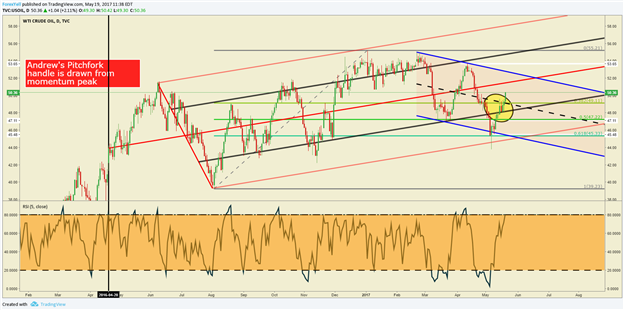
Next Week's Main Event:Thursday, May 25: OPEC meeting in Vienna, expected extension of production cuts
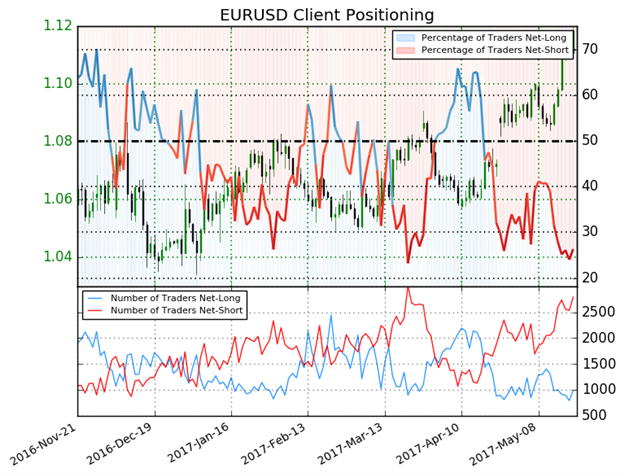
EUR/USD: As of Friday, May 18, IG retail trader data shows 22.8% of traders are net-long with the ratio of traders short to long at 3.39 to 1. In fact, traders have remained net-short since Apr 18 when EUR/USD traded near 1.06101; the price has moved 5.5% higher since then. The number of traders net-long is 7.1% lower than yesterday and 35.4% lower from last week, while the number of traders net-short is 9.4% higher than yesterday and 46.8% higher from last week.
We typically take a contrarian view to crowd sentiment, and the fact traders are net-short suggests EUR/USD prices may continue to rise. Traders are further net-short than yesterday and last week, and the combination of current sentiment and recent changes gives us a stronger EUR/USD-bullish contrarian trading bias.


Comments
Log in or sign up to join the conversation.