

US DOLLAR BOUNCES FROM SHORT-TERM SUPPORT
The US Dollar is showing a mild bounce from support this morning after Retail Sales figures for the month of February printed in a rather disappointing manner. The expectation was for a .3% gain, and the actual print was for a -.1% contraction. This comes on the heels of last month’s -.1% contraction (this was revised up from a prior release of -.3%) and December’s .1% gain. All in all, this continues to show a bit of weakness in the segment of the American economy that’s continued to drive in the post-Financial Collapse environment.
In the US Dollar, yesterday’s sell-off on the back of the inflation report released earlier in the morning continues to loom large, as that move pushed DXY back-below 90.00 and that theme of weakness largely continued throughout the US session and well-into Asia. A bit of support began to show in DXY around an area that has helped to hold the lows over the past few weeks; and this morning’s retail sales report is helping to bring that level back into play after a quick bounce in the European session.
On the data front – Friday brings U of M Consumer Sentiment numbers, and next week brings the Federal Reserve’s March rate decision, currently carrying an 88.8% chance of a 25 basis point hike.
US DOLLAR VIA ‘DXY’ FOUR-HOUR CHART
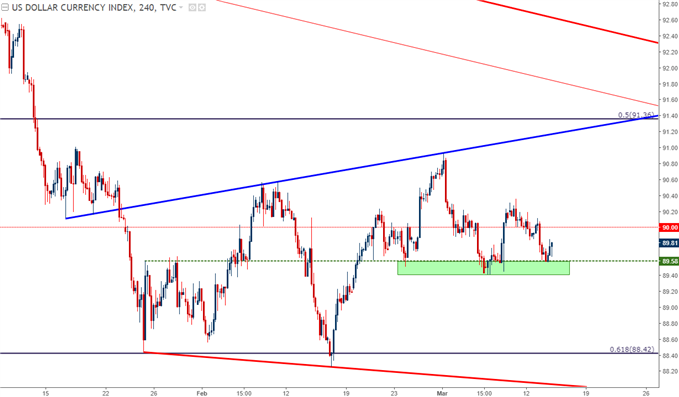
Chart prepared by James Stanley
EUR/USD IN AN AWKWARD SPOT AFTER RALLY FROM SUPPORT
The Euro is lower on the morning after a speech from ECB President, Mario Draghi, in which he said that the ECB needs to see more evidence that inflation is rising. A dovish tilt from the ECB and the head of the bank has become rather commonplace of recent. At the ECB’s rate decision earlier in the month, a hawkish clue in the statement was offset by a dovish Draghi during the presser, leading to a rip and dip scenario in the single currency around last week’s rate decision.
Shortly after that rate decision last week, we looked at EUR/USD approaching a key area of prior supportaround 1.2281. That support has held up thus far, and prices have made a quick approach towards the prior group of swing highs around the 1.2400-1.2445 area; making for a difficult setup at the moment as prices are rather stretched from prior resistance for bullish plays while also not showing the tendencies of a bearish reversal.
The support structure that we’ve been following has continued to hold through February and thus far into March, and a revisit to the zone that runs between 1.2335-1.2350 could open the door for bullish strategies.
EUR/USD FOUR-HOUR CHART: RANGE REMAINS, BUT DIVORCED FROM NEARBY SUPPORT/RESISTANCE POINTS
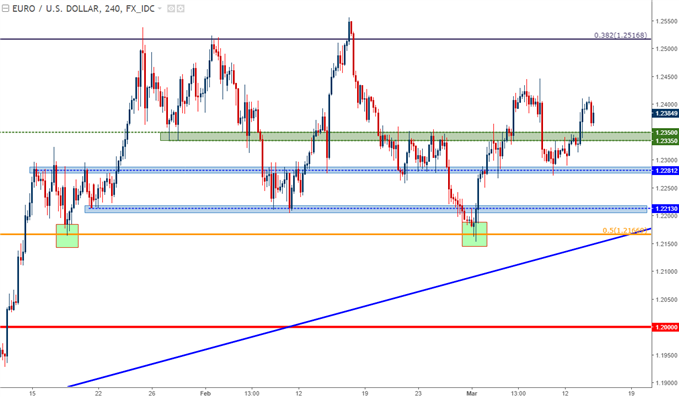
Chart prepared by James Stanley
GBP/USD CLINGS TO GAINS AFTER YESTERDAY’S BULLISH BREAKOUT
The British Pound saw a topside breakout yesterday after the reveal of the UK’s Spring Statement, in which growth forecasts for 2018 were upgraded. This was seen as another sign that the British economy continues to grow in the post-Brexit backdrop, and this has helped GBP/USD make another approach towards the 1.4000 psychological level.
At this point, buyers haven’t yet been able to re-eclipse that value, but price action remains within a bullish channel and buyers have responded to a visit to short-term support at 1.3950 earlier in the session. A break above 1.4000 should be approached cautiously, as there are multiple areas for resistance to play out just-above that level.
GBP/USD FOUR-HOUR CHART: RE-APPROACHING 1.4000 AFTER YESTERDAY’S BULLISH BREAKOUT
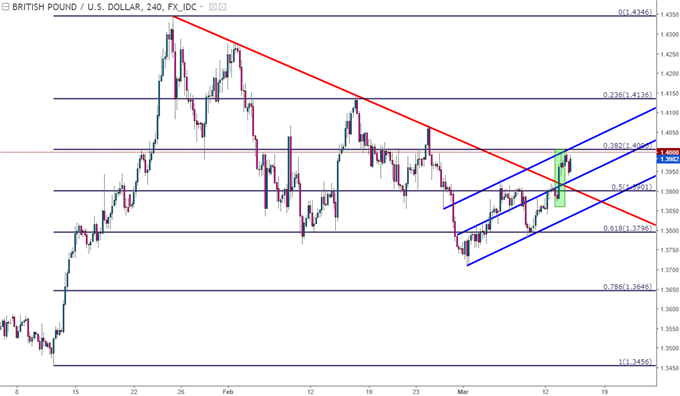
Chart prepared by James Stanley
USD/JPY BACK TO SHORT-TERM SUPPORT AFTER BOJ MINUTES: LONG-TERM SUPPORT REMAINS
Last night brought the release of Bank of Japan meeting minutes from last week’s rate decision. The big item of interest as we approached that event was the fact that the Yen started to show some rather pronounced weakness about 24 hours ahead of the release. That weakness could not hold, however, and prices have quickly moved back to an area of prior short-term support.
USD/JPY FOUR-HOUR CHART: BACK TO SHORT-TERM SUPPORT FOLLOWING BOJ MEETING MINUTES
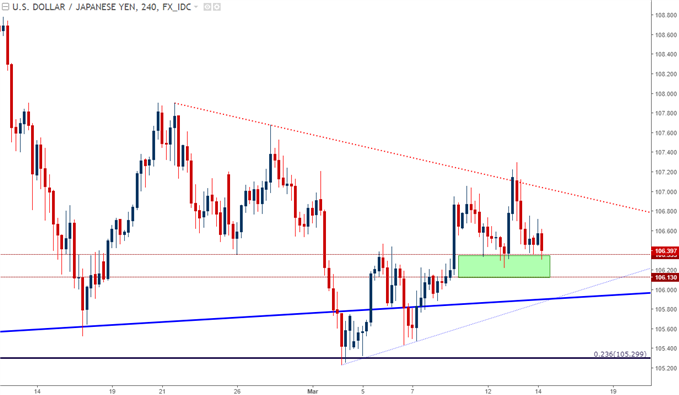
Chart prepared by James Stanley
The bigger area of concern around the Japanese Yen is the longer-term support that’s been in-play over the past month in USD/JPY as Yen-strength has become a bit more notable. This long-term support is coming from a couple of different areas, as the support side of a symmetrical wedge formation along with the 23.6% Fibonacci retracement of the 2015-2016 major move in the pair.
USD/JPY WEEKLY CHART: LONGER-TERM CONFLUENT SUPPORT REMAINS
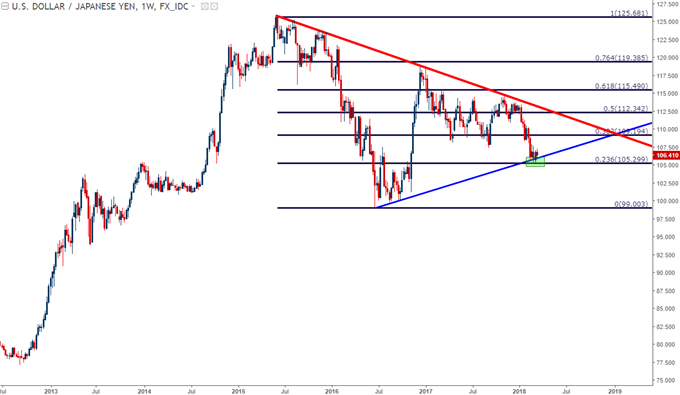
Chart prepared by James Stanley


Comments
Log in or sign up to join the conversation.