

Two weeks ago, with US CDS surging ever since the arrival of "helicopter money"...
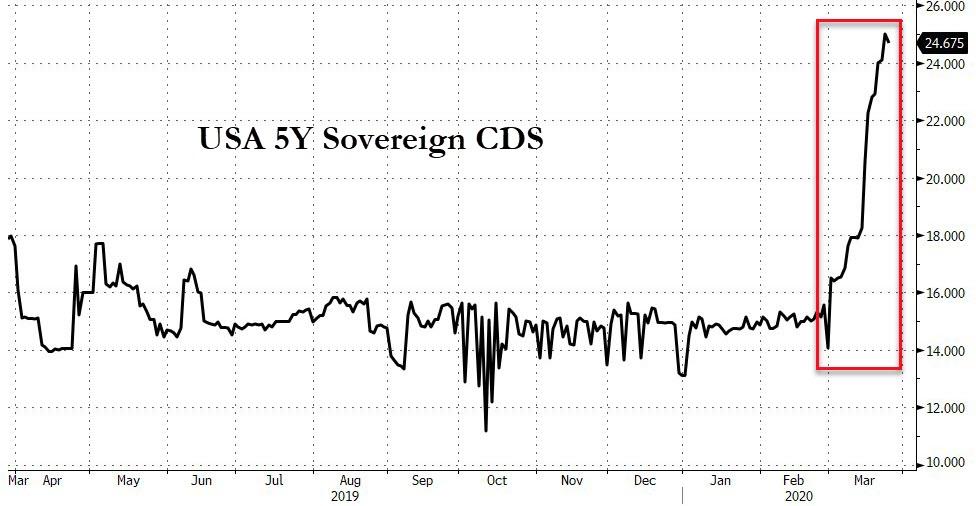
...Fitch became the first rating agency to warn that the US AAA rating was at "risk of a near-term negative action" due to a damning set of reasons including soaring debt, shrinking GDP, and the "helicopter-money" anti-virus actions.
Moments ago, the Committee for a Responsible Federal Budget (CRFB) issued a report which is sure to pour gasoline on that particular dumpster fire, when it projected that the US budget deficits will total more than $3.8 trillion this year, another $2.1 trillion in 2021, and will total just over $11 trillion by the end of 2025.
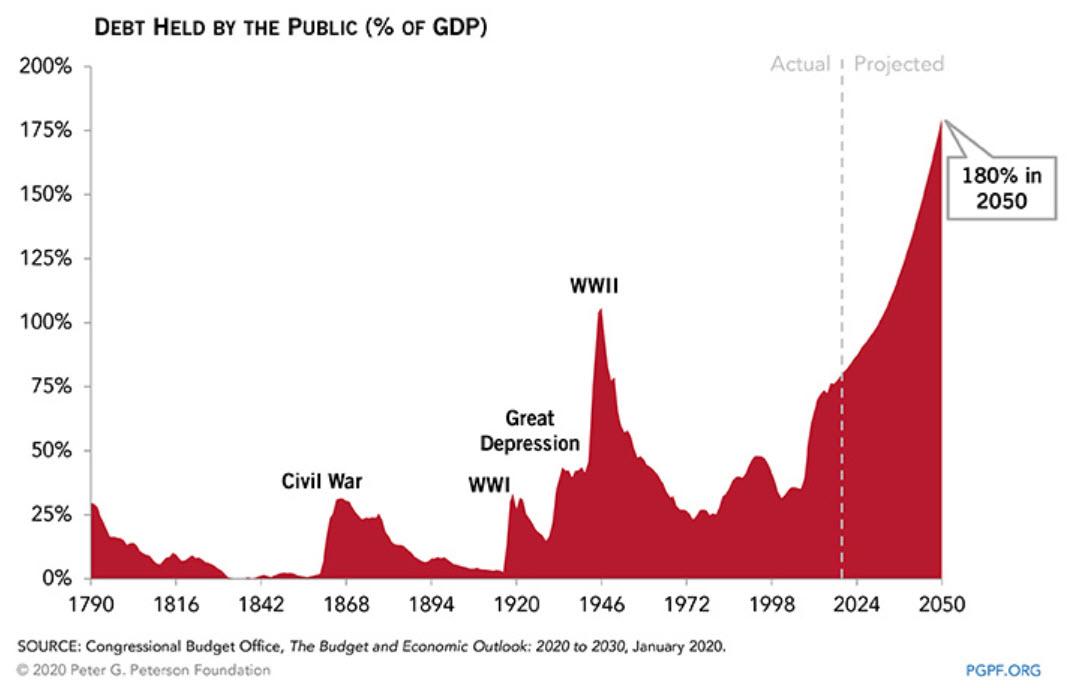
And, as we pointed out a few days ago, the CRFB now projects total debt held by the public will exceed the size of the economy, or 100% of GDP, by the end of the year, and will eclipse the record set after World War II by 2023.
* * *
In its report, the CRFB writes that the United States entered the current public health and economic crisis facing high levels of debt and trillion-dollar deficits. Due to the effects of the crisis and legislation enacted to combat it, debt and deficits will now grow much higher, to never-before-seen levels both in dollars and as a share of Gross Domestic Product (GDP).
The CRFB's latest projections find that under current law, budget deficits will total more than $3.8 trillion (18.7 percent of GDP) this year and $2.1 trillion (9.7 percent of GDP) in 2021. Meanwhile, debt held by the public will exceed the size of the economy by the end of Fiscal Year 2020 and eclipse the prior record set after World War II by 2023.
The final result will likely be even worse. As the CRFB admits, "These projections almost certainly underestimate deficits, since they assume no further legislation is enacted to address the crisis and that policymakers stick to current law when it comes to other tax and spending policies. The projections also assume the economy experiences a strong recovery in 2021 and fully returns to its pre-crisis trajectory by 2025. Assuming a slower and weaker recovery (but no changes in law), we estimate debt would grow to 117 percent of GDP by 2025."
Parroting the Fed, every politician and every recipient of bailout funds, the CRFB writes that like the record levels of borrowing undertaken during World War II, "a large share of today's massive deficits are both inevitable and necessary in light of the current pandemic crisis." As CRFB president Maya MacGuineas explained recently, "combating this public health crisis and preventing the economy from falling into a depression will require a tremendous amount of resources – and if ever there were a time to borrow those resources from the future, it is now." But just as World War II was followed by years of fiscal responsibility to restore debt to historic levels, it will be important after the crisis and recovery to ensure that debt and deficits return to more sustainable levels.
Some more from the report:
If that wasn't bad enough, the CRFB warns that "Debt and Deficits are Likely to Be Far Higher than We Project"
Our updated debt and deficit projections are based on current law and assume a robust and ultimately full economic recovery. In theory, our projections could be too high or too low, but in reality, deficits and debt are likely to be much higher than we project.
On the economic side, we project that a faster recovery (and a full recovery of price levels) could result in deficits of $10.3 trillion through 2025 as opposed to $11.3 trillion, holding debt levels to 102 percent of GDP by 2025. On the other hand, a deeper contraction and a much slower economic recovery could result in deficits of $12.7 trillion through 2025 and debt as high as 117 percent of GDP.
Neither of these scenarios account for the (extremely likely) possibility that further legislation will be enacted to combat the current public health and economic crisis. Policymakers are already considering proposals to extend various parts of the CARES Act and pass further measures to support states, hospitals, businesses, and households. They may also enact more traditional stimulus measures once lockdowns end in an effort to jumpstart the economy.
These policies would further increase deficit and debt levels. For example, if policymakers end up spending another $1 trillion per year over the next three years on additional stimulus measures, debt as a percentage of GDP would be about 12 percentage points higher by 2025. If policymakers use the current crisis as an excuse to enact a number of permanent and unrelated policies, debt could grow even higher and larger deficits would persist in perpetuity.
At some point, such high and rising deficits and debt levels will prove unsustainable, and corrective action will be needed. Putting long-term deficit reduction measures in place sooner rather than later would allow policymakers to phase in changes more gradually and give those affected more warning and ability to prepare.
At this point, someone should inform the beancounters at the CRFB about the wondrous thing called the Magic Money Tree (MMT) why explains why becoming the next Weimar Republic/Zimbabwe/Venezuela does miracles for one's fiscal outlook and confidence in the world's reserve currency.
And now we look forward to the Congressional Budget Office updating its long-term debt chart which before the Coronavirus pandemic looked like this...
(Click on image to enlarge)



Comments
Log in or sign up to join the conversation.