

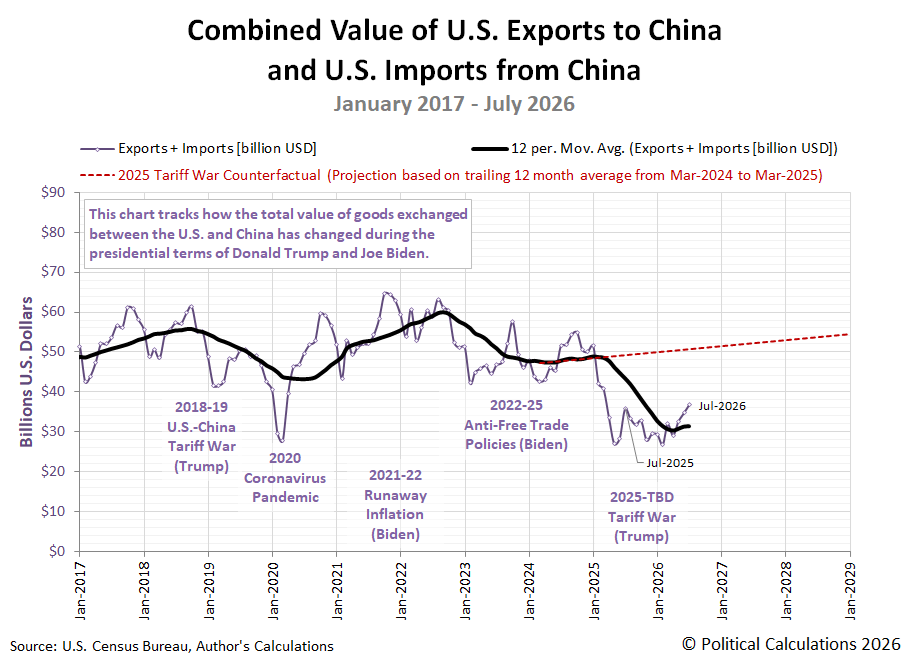
The total value of goods exchanged between the U.S. and China recorded by the U.S. Census Bureau increased for a third consecutive month in July 2026, the first such sustained rise since June-October 2024. Even so, the total level of trade between the two nations remains far below its pre-2025 tariff war levels.
Between June and October 2024, the combined value of U.S. imports from China and exports to China rose $3.2 billion to reach $55 billion. U.S.-China trade has risen $6.5 billion since April 2026 to total $36.8 billion in July. The value of trade between the U.S. and China during July 2026 is 33% less than it was in October 2024.
These figures are based on the Census Bureau's monthly trade data, which doesn't take any seasonality in the data into account. Applying a trailing twelve month average to the monthly data however confirms the large drop that has occurred in trade between China and the U.S., dropping from $48.4 billion in October 2024 to $31.4 billion in July 2026, a 35% decline.
The following chart reveals how the flow of trade between the U.S. and China has developed from January 2017 through July 2026.
The increase from April through July 2026 comes as U.S. President Donald Trump and Chinese Premier Xi Jinpeng are set to meet to discuss trade and other issues in the U.S. in September 2026. Curiously, the New York Times has chosen to focus on China's dominant trade position with the rest of the world ahead of that summit.
When President Trump and China’s leader, Xi Jinping, meet this month to talk about a fragile trade truce, one issue is sure to dominate: China’s seemingly unstoppable export engine.
Chinese customs data released on Tuesday showed that in August, China sold $119.09 billion more in goods to the world than it bought — the fourth month in a row that the trade surplus topped $100 billion. Exports rose by 25 percent in U.S. dollar terms, while imports climbed 28 percent.
So far this year, the trade gap is already over $800 billion, and economists say it is on track to surpass last year’s $1.2 trillion, a milestone no other country has reached.
According to U.S. data, China's year-to-date trade gap with the U.S. is over $91.2 billion through July 2026, which as the data demonstrates, is much lower than it would have been without 2025's tariff war.
Why then has China's trade position strengthened so much everywhere else? China's domestic economy has struggled to grow during the past year, in part because of its tariff war with the U.S. With domestic demand not able to absorb their production surpluses, Chinese producers have redoubled their exporting efforts to virtually everywhere else in the world. The New York Times recently emphasized the role that China's economic weakness has played in contributing to China's global trade dominance:
The widening trade gap is also a symptom of lackluster demand at home. Consumer spending has been weak, while youth unemployment remains high. In August, China’s imports slowed, even as the country imported more high-tech goods like automatic data processing machines and semiconductors. Foreign car shipments have fallen around 20 percent so far this year as domestic brands dominate the market.
Looking forward, the article also references China's official trade data for August 2026, which is reported about a month before the U.S. data for the same month becomes available. That data indicates China's exports to the U.S. increased, which in turn, suggests the total value of U.S.-China trade increased for a fourth consecutive month.
Comments
Log in or sign up to join the conversation.