

Substantial attention has been devoted to the disasterous effects of implementing a Donald Trump agenda of imposing 45% tariffs on imports of goods from China. To gain some perspective, consider the implications for prices of goods imported from China if such a tariff were imposed (and a large country assumption used, so that only half of the tariff increase manifested in increased prices).
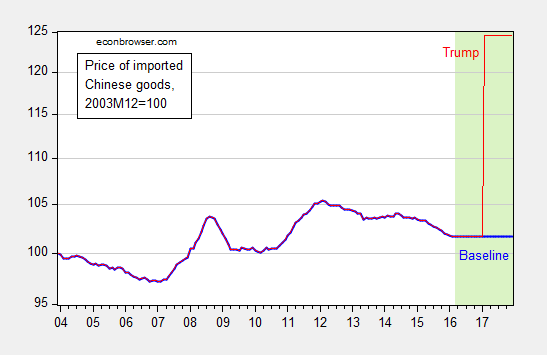
Figure 1: Price of Chinese commodity imports, 2003M12=100, with 2016M03 values at 2016M02 values (bold blue), and a 22.5% higher price level as of 2017M02 assuming the half of incidence falls on the US (red). Light green shaded area denotes projection period. Vertical axis is logarithmic. Source: BLS, and author’s calculations.
Obviously, drop the large country assumption, and the resulting price increase can be up to 45%.
From WaPo yesterday:
An economic model of Trump’s proposals, prepared by Moody’s Analytics at the request of The Washington Post, suggests Trump is half-right about his plans. They would, in fact, sock it to China and Mexico. Both would fall into recession, the model suggests, if Trump levied his proposed tariffs and those countries retaliated with tariffs of their own.
Unfortunately, the United States would fall into recession, too. Up to 4 million American workers would lose their jobs. Another 3 million jobs would not be created that otherwise would have been, had the country not fallen into a trade-induced downturn.
The job losses would be halved if China and Mexico chose not to retaliate to the tariffs of 45 percent and 35 percent, respectively. In which case U.S. growth would flatline, but the country would not fall into recession.
Here is the key graph from the article, depicting the baseline, and the alternative under Trump:
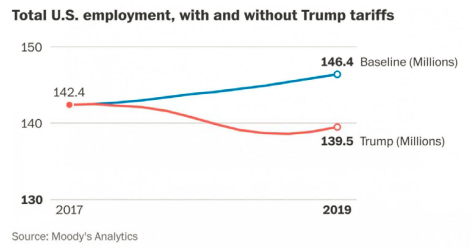
I don’t know all the assumptions built into the simulation, and in particular I don’t know if the assumptions regarding imported goods price increases match those I’ve shown in Figure 1. But the trade flow impacts in the Moody’s simulation apparently match those in Peter Petri’s calculations, as recounted in this WSJ article.
Suffice to say, even the “no-retaliation” scenario (which in my personal, but limited, knowledge of Chinese characteristics, seems unlikely) is pretty unappealing.
That’s the Thermonuclear option. What is interesting is to consider what I call the Nuclear option, which is implicit in the position statement on <a href="http://www.sanders.senate.gov/agenda/">Senator Sanders' website (Agenda Item 7).
We must end our disastrous trade policies (NAFTA, CAFTA, PNTR with China, etc.) which enable corporate America to shut down plants in this country and move to China and other low-wage countries.
Ending PNTR (I interpret the statement thus, as does Vox) with China sounds rather arcane, and even innocuous. After all, the acronym stands for “Permanent Normal Trading Relations”. It’s not clear what part of PNTR Senator Sanders wishes to do away with; if it’s the “P” in PNTR, then NTR will have to be renewed by Congress year after year, as it was from 1980 until 2000. How easy will that be in these times?
If NTR is not renewed, then what happens? Et voila, tariffs revert to levels applied before Most Favored Nation status was granted to China: to 44%. This figure is suspiciously close to the 45% value Donald Trump has cited.
So, what’s the difference between a Trump strike and a Sanders strike? Apparently, the only difference is that Donald Trump has promised to raise tariffs “on day one”, while Senator Sanders has not laid out a timeline. (An alternative interpretation is that Senator Sanders will only move to revoke PNTR if currency manipulation is proved, while Donald Trump won’t wait for a determination.)
More on the trade positions of both candidates here, and the likelihood each one can make a case that the Chinese currency is undervalued, here.

Comments
Log in or sign up to join the conversation.