

“The budget deficit has now soared back roughly to where it was in 2012, when the unemployment rate was more than twice its current level, and the economy desperately needed deficit spending to sustain demand.” (Paul Krugman, NYT, October 29, 2019)
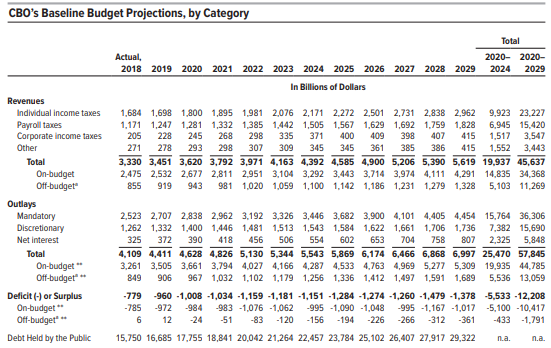
The US budget deficit surged 26% over the last twelve months to $984.4 billion — its highest level in seven years.
The massive increase in the 2019 budget deficit despite the extremely strong economy is widely attributed to Trump and Republican fiscal decisions, including reduced tax revenues due to the 2017 Trump tax cut and the related budget deal that added billions in spending for military and domestic programs.
Two recent projections by the Trump Administration and the Congressional Budget Office (CBO) project that the deficit will top $1 trillion in the 2020 budget year, which began Oct. 1.
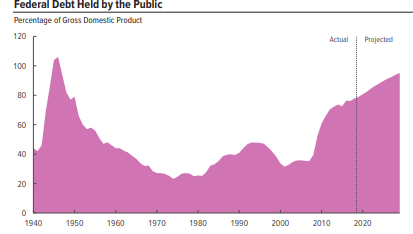
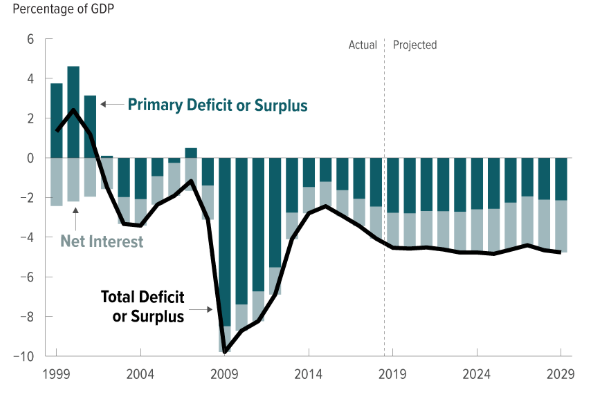
As the following table and charts illustrate, the CBO baseline estimates also indicate that the budget deficit will stay above $1 trillion over the next decade. As a result of the continuing deficit path, the federal debt that is directly held by the public is projected to grow steadily, from 79% of GDP in 2019 to 95% in 2029—its highest level since just after World War II.
Applying such a massive fiscal stimulus to a fully employed economy has never made any sense. Nonetheless, in an environment of strong equity prices, extremely low inflation, and low-interest costs of servicing the debt, the markets appear quite blasé.
As Paul Krugman seems to imply in a recent article, the American economy certainly did not require significantly higher budget deficits to sustain demand.
Nonetheless, it is generally accepted that the US has a serious public sector infrastructure gap. The gap in roads, sewers, bridges, pollution controls, etc. is huge and requires attention, but there is too much turmoil in US politics currently to even see a consensus emerge on directing future spending in the needed infrastructure direction.
The traditional worry of economists that unnecessarily large budget deficits would crowd out needed capital investment does not seem to apply at present, even though capital investment is quite weak.
In the current tense international environment, the weakening of investment spending seems more related to the US trade war with China, and the related concern that the global economy may be slipping into a slower growth phase, or even possibly into a recession. Budget concerns and crowding out arguments are simply not relevant to this issue.
However, at some point in the future, a day of reckoning on irresponsible fiscal policy will emerge. However, in this economist’s view, that day of reckoning is far off in the future.
When the political and financial reckoning arrives, it will probably focus both on the fact that tax revenues were cut too deeply in 2017, as well as on the allocation priorities on the side on the increased government spending.
When at some time in the future inflation and higher interest rates both emerge, then the government's interest payments on the debt will truly crowd out useful program spending.
In fact, the costs of servicing the debt rose 16% in 2019 to $375.6 billion and is already one of the fastest-growing items in the US budget.
In summary, the CBO’s projections over the next ten years suggest that there is no budgetary relief in sight based on present programs priorities and a soft-landing economic scenario.
Deficits as a % of GDP should remain roughly stable at current levels over the next ten years, though the ratio will still be substantially higher than the 50-year average.
As well, the federal debt projections would increase from 79% of GDP in 2019 to 95% in 2029. Assuming the baseline projections are accurate, the US government debt will be the largest since 1946 and more than twice the 50-year average.
The following table and two charts are extracted from the recent CBO budget projections.
(Click on image to enlarge)
The CBO Federal Debt Projections As % Of GDP To 2029
(Click on image to enlarge)
The CBO Budget Projections As % Of GDP: 2019-2029
(Click on image to enlarge)


Comments
Log in or sign up to join the conversation.