

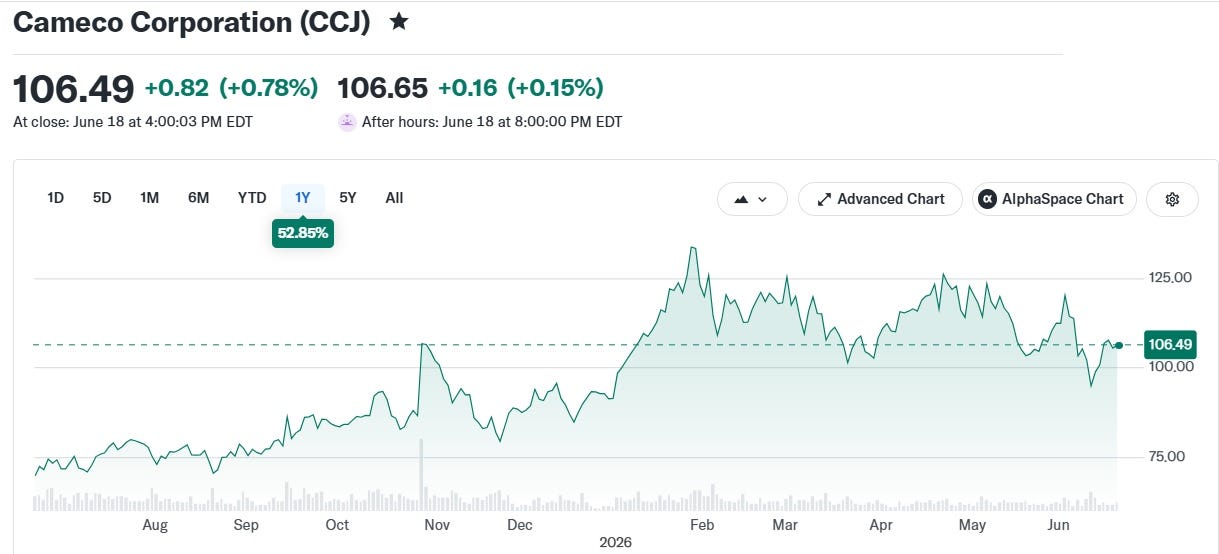
The uranium miners had a nice run in early 2026 but have been rangebound—and quiet—since then. Here’s sector bellwether Cameco’s 12-month price action:
But Big Things Are Happening Under the Surface
While the uranium stocks consolidate, two potentially positive trends have gained traction:
“Hyperscalers” have embraced nuclear
A hyperscaler is a Big Tech firm that designs, builds, and operates data centers, for both its own cloud service division and for offering AI services to customers. Among the main players are Alphabet (GOOGL) (Google), Amazon (AMZN), Meta (META) (Facebook), and Microsoft (MSFT).
The bigger the data center, the more power it requires, and local communities are increasingly resistant to having their power bills skyrocket because of soaring data center demand. So the hyperscalers are building power plants next to their data centers to ensure their own power supply. Nuclear, because of its small footprint and 24/7 baseline capability, is in the mix. Uranium Insider newsletter reports:
Hyperscalers are now actively engaging across the full nuclear fuel cycle — from uranium offtake and project financing all the way through conversion, enrichment, and reactor technology. This is no longer theoretical…that the hyperscalers “might” get more directly involved in both building new nuclear capacity and securing fuel…it is already happening.
Let’s break it down:
NexGen Energy (NXE) has held direct discussions with Big Tech hyperscalers about project finance and long-term uranium offtake for its Rook I project in Saskatchewan – one of the largest high-grade undeveloped uranium assets globally. Importantly, Rook I is a crucial supply element in the early 2030s, a period where nuclear utilities are utterly relying on its supply to “save the day.”
The same companies are communicating with enrichers (Centrus (LEU) and Urenco) while also seeking conversion capacity and UF6 supply.
On the reactor side, hyperscalers are in near-daily communication with major technology providers including GE Vernova (GEV) (BWRX-300) and Westinghouse (AP-300 and AP-1000) on deployment pathways and power delivery.
Crucially, this new and consequential Layer of Demand Is NOT in supply/demand Models.
Most consensus uranium supply/demand forecasts are still built primarily around traditional utility procurement, reactor restarts & life extensions, and announced government or utility-backed builds (primarily in China). The emerging hyperscaler demand – direct project finance conversations, uranium offtake interest, and active engagement across the fuel cycle – is not meaningfully reflected in base-case projections.
This is exactly what can create right-tail upside for the uranium sector.
When a new class of deep-pocketed, long-term buyers begin to enter the market, it adds an incremental layer of demand that sits outside the models the market currently relies on. That’s asymmetric, right-tail upside potential: demand that could push actual requirements meaningfully higher than current consensus forecasts anticipate, especially if even a modest portion of the projected AI-driven data center buildout is powered by new nuclear capacity.
This is great news for uranium. But there’s a problem:
The hyperscalers are rolling out their data centers now, and conventional nuclear power plants take a long time to build. In the meantime, faster-to-market power sources like natural gas are gaining market share:
Chevron to fuel massive Microsoft data center in Texas using natural gas
(CNBC) - Chevron will fuel a massive Microsoft data center in West Texas with natural gas under a 20-year agreement, the oil major announced Monday.
The data center, called Project Kilby, is expected to consume nearly 2.7 gigawatts of electricity, equivalent to the power needed to run about two million homes.
A majority of the electricity will come from large gas turbines supplied by Chevron (CVX)’s partner, GE Vernova. Caterpillar will also provide turbines. The power infrastructure will be located at the data center site.
Microsoft’s partnership with Chevron comes as it undertakes a massive buildout of data centers to power artificial intelligence applications. It plans $190 billion in capital expenditures this year, 61% more than in 2025.
Microsoft’s embrace of natural gas through a partnership with the oil industry shows a willingness to invest in fossil fuels to meet its electricity needs.
The rapid growth of AI “requires energy infrastructure that can scale quickly and reliably,” Noelle Walsh, Microsoft’s president of cloud operations and innovation, said in a statement Monday.
Enter the SMR
Small modular reactors (SMRs) are about one-third the size of traditional nuclear plants. They’re “modular” because they’re factory assembled from standardized components, making them (so far at least in theory) faster to build and more flexible to site.
China and Russia have reportedly built and are operating SMRs, and the US has made catching up a national security priority. From OilPrice.com:
Modern military operations are increasingly energy intensive. Defense installations, logistics hubs, shipyards, semiconductor fabrication plants, weapons production facilities, and command and control infrastructure all depend on uninterrupted electricity. Yet many of these facilities remain dependent on centralized transmission systems vulnerable to disruption.
One of the most strategically important developments in the SMR sector is the growing focus on “behind-the-meter” deployment capability — the ability to place reactors adjacent to mission-critical facilities rather than relying exclusively on long-distance transmission infrastructure.
This approach could fundamentally reshape military and industrial resilience in the United States.
Distributed advanced nuclear generation could provide secure dedicated power to defense installations, industrial corridors, AI campuses, and manufacturing hubs while reducing dependence on vulnerable grid infrastructure without competing for electric power with civilian communities. It could also improve survivability during cyberattacks, physical sabotage, or grid instability scenarios.
In response, the US is actively encouraging the SMR sector:
Department of Energy Celebrates Second Advanced Reactor Achieving Criticality
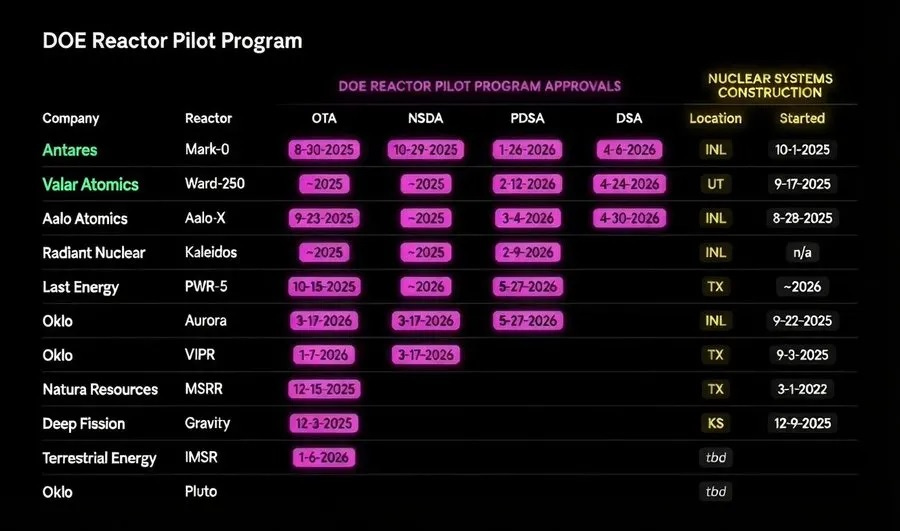
(Energy.gov) - The DOE marked a second major milestone this past week as Valar Atomics’ Ward 250 reactor achieved zero-power criticality at the Utah San Rafael Energy Lab. The demonstration makes Valar the second company to reach this threshold under the DOE Reactor Pilot Program (RPP), following Antares Nuclear by just two weeks.
This helium-cooled high-temperature gas reactor moved from groundbreaking on an empty Utah site last September to a self-sustaining chain reaction in roughly nine months. It is the first DOE-authorized advanced reactor built and operated entirely outside the national laboratory system. The 100 kWt test unit serves as a stepping stone toward scalable 5 MWe modules intended for data centers, remote sites, and industrial heat.
Both achievements flow directly from President Trump’s May 2025 executive order, which instructed the DOE to authorize at least three test reactors and bring them to criticality by July 4, 2026. The RPP’s streamlined authorization pathway is producing results, showing that private developers can advance advanced reactor concepts from site work to controlled fission much faster than traditional regulatory routes have historically permitted.
Aalo Atomics is likely to deliver the third milestone. Having assembled its Critical Test Reactor and secured a DSA approval, the company is positioned to achieve zero-power criticality very soon.
Two Investment Implications
Hyperscaler demand makes an already tight uranium market even tighter. The obvious result is higher prices and widening margins for the uranium miners.
The emergence of SMRs will further increase uranium demand while giving investors a new category of stocks to consider. I’m looking forward to adding a couple of the breakout SMR companies to our Portfolio.
In the meantime, continue adding opportunistically to uranium miners and related ETFs. Nuclear power is just getting started.



Comments
Log in or sign up to join the conversation.