


Today, Amazon Inc. (AMZN) put options at a $220 strike expiring in 45 days (Oct. 30) have had unusually heavy volume. That strike is 11.5% below today's trading price, and investors collect a 1.45% short-put yield, a bullish play.
AMZN is trading at $248.77 in midday trading on Tuesday, Sept. 15. That's well off its recent peak of $284.02 on Aug. 3, just after its July 30 Q2 earnings release.
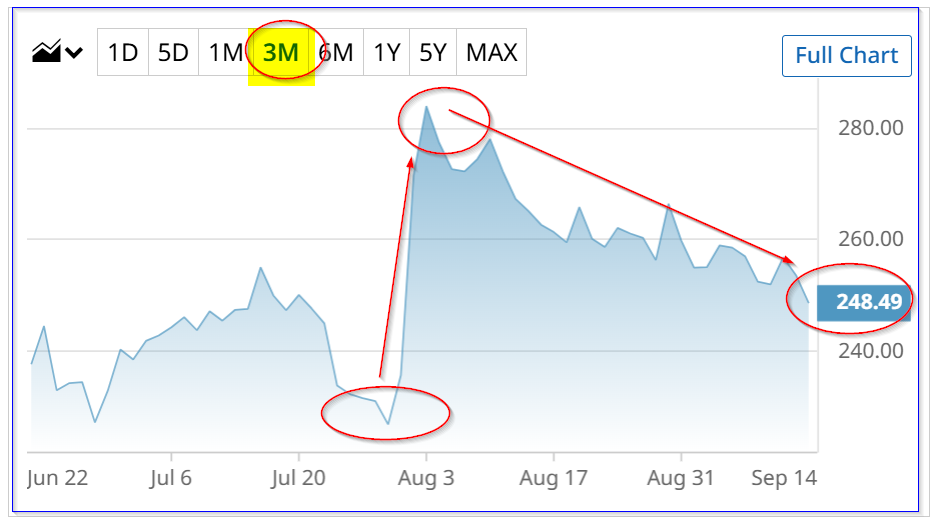
AMZN - last 3 months - Barchart - Sept. 15
AMZN - a Value Play
I analyzed these results and AMZN's updated price targets yesterday in a Barchart article, “Amazon's Operating Cash Flow Could Push AMZN Over $314 - What's the Best AMZN Play?" (Sept. 14, Barchart).
I showed that, based on its strong operating cash flow (OCF) and OCF margins, and using a reasonable multiple, AMZN could be worth $314.56 per share over the next year. Other analysts have higher price targets, including $328.17 (Yahoo! Finance survey), $327 (Barchart), and $323.17 (AnaChart).
This shows that the potential upside for holding AMZN shares is between 26% and 32% over the next year.
I also showed that it makes sense for potential long investors in AMZN to sell short out-of-the-money (OTM) puts in one-month or slightly longer expiry periods (as well as vertical put credit spreads).
Today's unusual options volume in AMZN underscores this play.
Heavy Put Options Volume in AMZN
This is shown in today's Barchart Unusual Stock Options Activity Report. It shows that over 3,600 put option contracts traded at the $220 strike price expiring Oct. 30. That volume is over 35x the prior outstanding contract number.
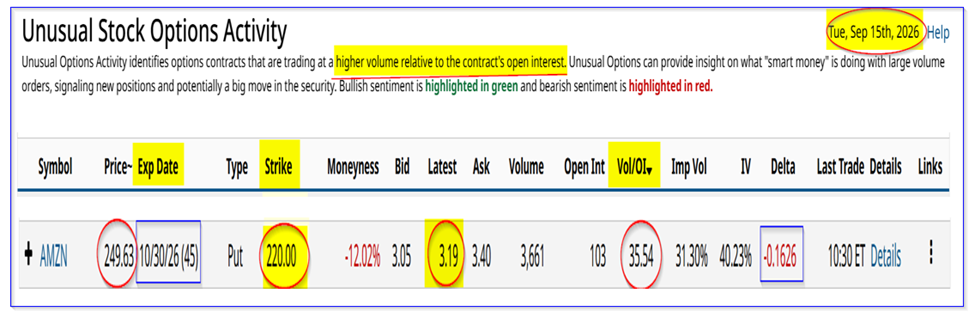
AMZN puts expiring Oct. 30 - Barchart Unusual Stock Options Activity Report - Sept. 15
Moreover, short-sellers collected $3.19 in premium on these puts. That works out to a 1.45% yield (i.e., $3.19/$220.00) for investors who entered an order to “Sell to Open” these puts.
To make this play, an investor must post $22,000 in collateral with their brokerage firm. Their account will then collect $319. As long as AMZN stays over $220, the account collateral won't be assigned to buy 100 shares at $220.
That lowers the potential breakeven point to $220 - $3.19, or $216.81, which is 12.8% below today's trading price. In other words, this is an attractive entry point for long investors.
Moreover, if the 1.45% yield play is executed each month for a year, the investor's expected return is 17.4%. However, that assumes that the account is never assigned to buy shares.
The worst that can happen here is an unrealized loss if AMZN stock falls below the breakeven point. In that case, the investor owns 100 AMZN shares. They can hold on, sell covered calls, or lower their buy-in cost through additional purchases.
Put Credit Spread Play
In my Sept. 14 article, I also discussed a related put credit spread play. For example, if an investor does not have $22K in collateral to do a short-put play in AMZN, they can do a vertical put credit spread.
That lowers the collateral requirement, but also has much higher risk. Let's see how that works.
For example, if the investor shorts the Oct. 30 expiry $220 put, collecting $319, but also buys a $210 put costing $194, the net credit received is $125. However, the collateral required is just $1,000 (i.e., ($220 - $210) x 100.
So, the net return on investment is much higher:
$194/$1,000 = 19.4% over 45 days
As long as AMZN stays over $220.00 during this period, the investor won't have to buy 100 shares to fund the short-put leg of this play. It shows that this is a very attractive way to play AMZN.
For example, if this play is done twice over 90 days, the expected return (ER) is over 38%. That's much better than holding AMZN shares over the next year.
However, the risk of having to fund $22K to buy shares, is much higher for these investors if they don't have the capital. If this happens, despite the low delta ratio, the investor would likely have to roll this play over to the next month.
Nevertheless, AMZN looks cheap here, and investors are piling into short-put and put credit spreads in AMZN to play the upside.

Comments
Log in or sign up to join the conversation.