

Over the past month, oil inventories in the United States continued to rise, putting further pressure on oil prices. On October 16, 2015, the price of West Texas Intermediate closed at $47.26 per barrel. By November 20, 2015, this had declined to $41.46. As can be expected, this continual decline in oil prices is having a ripple effect throughout the American economy, not only hurting those companies directly affected by it such as exploration and production companies but also having a devastating effect on ancillary industries such as manufacturing. Unfortunately, it does not appear likely that this condition will change in anytime in the near future despite Saudi Arabia’s claims that the nation will do “whatever it takes” to stabilize oil prices.
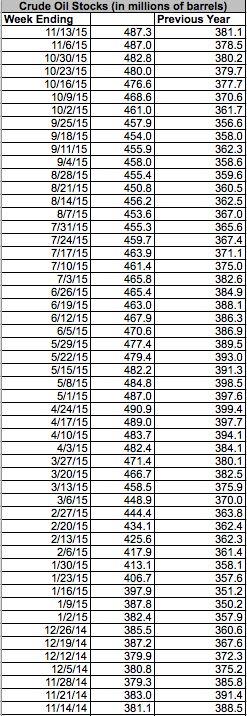
At the end of the week ended November 13, 2015, the nation’s commercial inventories of crude oil contained a total of 487.3 million barrels. Not only is this an increase from the 487.0 million barrels of oil that these same inventories contained at the end of the previous week, but it is also the largest quantity of oil that was contained in these inventories since the end of April. As has been consistently been the case over the past year, this is also a significantly larger quantity of oil than what was contained in the nation’s commercial crude oil inventories at the end of the corresponding week of last year. At the end of the week ended November 14, 2014, these inventories contained a total of 381.1 million barrels of oil. This tells us that the United States continues to be oversupplied with oil and, as this oversupply does not appear to be abating, oil prices will likely be continued to be pressured downward.
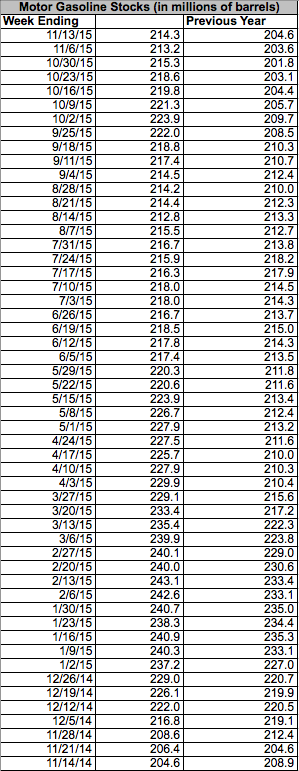
In addition to oil inventories, the nation’s gasoline inventories also increased in size week-over-week. At the end of the week ended November 13, 2015, the nation’s commercial inventories of motor gasoline contained a total of 214.3 million barrels of motor gasoline. This is an increase of 1.1 million barrels from the 213.2 million barrels contained in these same inventories at the end of the week ended November 6, 2015. As has been the case for much of the past year, this is a higher quantity of gasoline than these inventories contained last year. However, it was not as large of a year-over-year increase as what oil inventories experienced. At the end of the week ended November 14, 2014, the nation’s motor gasoline inventories contained a total of 204.6 million barrels of gasoline.
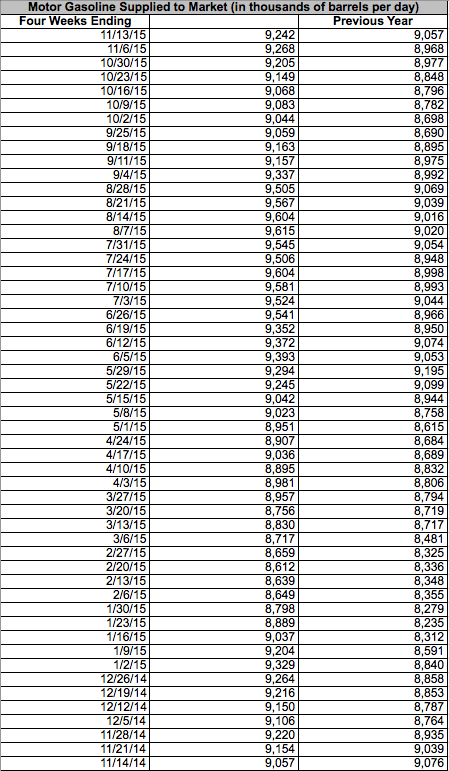
Interestingly, the increase in gasoline inventories comes in spite of the fact that the nation’s oil refineries in aggregate supplied less motor gasoline to the market than during the previous week. During the four-week period ended November 13, 2015, the nation’s oil refineries supplied an average of 9.242 million barrels of motor gasoline per day to the market. This compares to an average of 9.268 million barrels per day during the four-week period ended November 6, 2015. As has been the case for much of the past year, both of these figures are higher than last year’s numbers. At the end of the four-week period ended November 14, 2014, the nation’s oil refineries supplied an average of 9.057 million barrels of gasoline per day to the market. The fact that gasoline inventories increased despite the decrease in gasoline production could be a leading indicator that the economy’s demand for gasoline has decreased, in spite of the decline in gasoline prices. This is to be expected as the summer driving season has now come to a close and colder weather has begun to set in across much of the country.
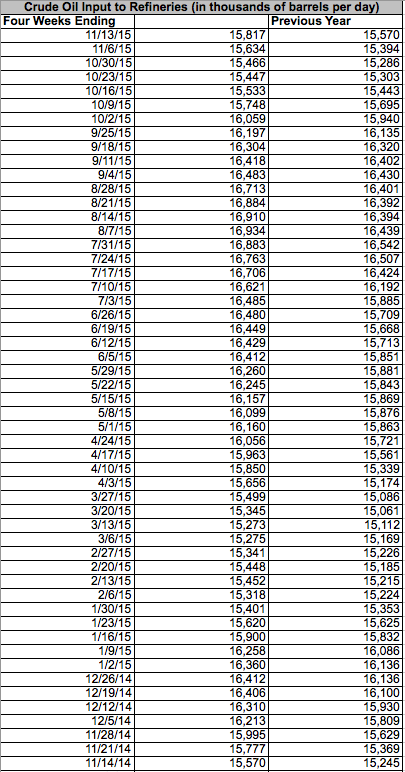
One of the reasons why the amount of gasoline being produced is declining appears to be refineries adjusting their product mix for the winter season. During the four-week period ended November 13, 2015, the nation’s oil refineries processed an average of 15.817 million barrels of crude oil per day in aggregate. This is a marked increase from the 15.634 million average that these same refineries processed in aggregate per day during the four-week period ended November 6, 2015. As has been the case throughout much of this year, the nation’s refineries processed more crude in aggregate than during the corresponding period of last year. During the four-week period ended November 14, 2014, the nation’s oil refineries processed an average of 15.570 million barrels of crude oil per day in aggregate.
Thus, in conclusion, the United States continues to appear greatly oversupplied with oil and this is likely to continue to apply downward pressure on prices.



Comments
Log in or sign up to join the conversation.