


The August jobs data came in somewhat stronger than expected, with the economy adding 162,000 jobs. The unemployment rate was unchanged, but perhaps more importantly, the dip in the employment-to-population ratio (EPOP) and labor force participation in July was completely reversed in August. The EPOP rose to 59.1 percent in August, although that is still 0.5 percentage points (p.p.) below its year-ago level.
Prime-Age and White Workers Have Largest Drops in Employment
In 2025, the deterioration in the labor market seemed to be almost entirely focused on disadvantaged groups, as Black workers and young people (ages 20-24) saw sharp rises in their unemployment rate and drops in EPOPs. That is no longer the case. The unemployment rate for Black workers in August was 6.0 percent, 1.6 p.p. below its year-ago level. That is still 1.2 p.p. above its all-time low hit in April of 2023, but the same as its year-round average in 2024.
The employment side of the story does not look quite as good, especially for Black women. The EPOP for Black men was 64.5 percent in August, down 0.4 p.p. from its year-ago level, and 0.5 p.p. from its 2024 average. The EPOP for Black women last month was 57.2 percent; that’s down 0.1 p.p. from the year-ago level, but 2.3 p.p. from its 2024 average.
For young people, the unemployment rate stood at 7.1 percent in August, down from 9.2 percent a year ago, and even below its 7.4 percent average for 2024. The EPOP for young workers was 65.9 percent in August, up 2.1 p.p. from its year-ago level and just 0.4 p.p. below its year-round average in 2024.
By contrast, while the unemployment rates are little changed, the EPOP for white workers was 58.7 percent, down 0.8 p.p. from its year-ago level and 1.3 p.p. from its 2024 average. The falloff was sharper for white men, dropping 1.2 p.p. year-over-year and 1.6 p.p. from the 2024 average. For white women, the declines were 0.7 p.p. and 1.1 p.p.
The fall in EPOP is also largely a prime-age (25 to 54) worker story, especially for men. The EPOP for prime-age workers overall stood at 80.4 percent, down 0.3 p.p. from its year-ago level and year-round average in 2024. However, for men the EPOP was down 0.7 p.p. from its year-ago level and 0.5 p.p. from its 2024 average. For women, there was a rise of 0.2 p.p. from a year ago and the August level is the same as the 2024 average.
Unemployment Due to Quits Rise, Involuntary Part-Time Falls
The other data in the household survey was mostly positive. The share of unemployment due to voluntary quits jumped 1.8 p.p. to 13.1 percent. This is roughly what we should expect with a 4.1 percent unemployment rate, although it goes against the JOLTS data showing very low quit rates. The number of people involuntarily working part-time fell by 414K in August, hitting its lowest level since December 2024.
On the other side, the EPOP for native-born workers was 58.1 percent in August, 0.7 p.p. below its year-ago level. The EPOP for immigrants was unchanged at 63.5 percent. All the duration measures of unemployment rose in August, but this was mostly reversing a July drop and may just be noise in the data.
Job Gains Widely Spread Across Sectors
Job growth was far less concentrated in the health and social services sector in August than in prior months. It accounted for just 28.4K of the 162K increase. It had accounted for all of the job growth over the prior year. The biggest single contributor was restaurants, which added 59.2K jobs in August. This was somewhat surprising since the sector actually showed job losses in both June and July, even with the World Cup taking place. Local government education was also a big gainer, with a jump of 41.9K that mostly reversed a drop of 57.5K reported for July. As noted before, this is almost certainly a seasonal adjustment issue.
Construction showed healthy growth, adding 22K jobs, somewhat above its average of 10K over the last year. This gain comes despite the fact that both residential and non-residential construction have been falling. Manufacturing added 16K jobs, putting employment 23K above its year-ago level, although 134K below its level in August 2024.
The federal government was again among the job losers, shedding 5K jobs, putting it 242K below its year-ago level. The insurance sector lost another 6.3K jobs. It is now down 75K (2.5 percent) from its year-ago level. This has been identified as a possible result of AI; if so, it doesn’t seem like quite the job disaster many have envisioned. Computing infrastructure and web hosting lost 7.7K jobs in August, putting employment 26.1K (5.4 percent) below the year-ago level.
Wage Growth Continues to Slow
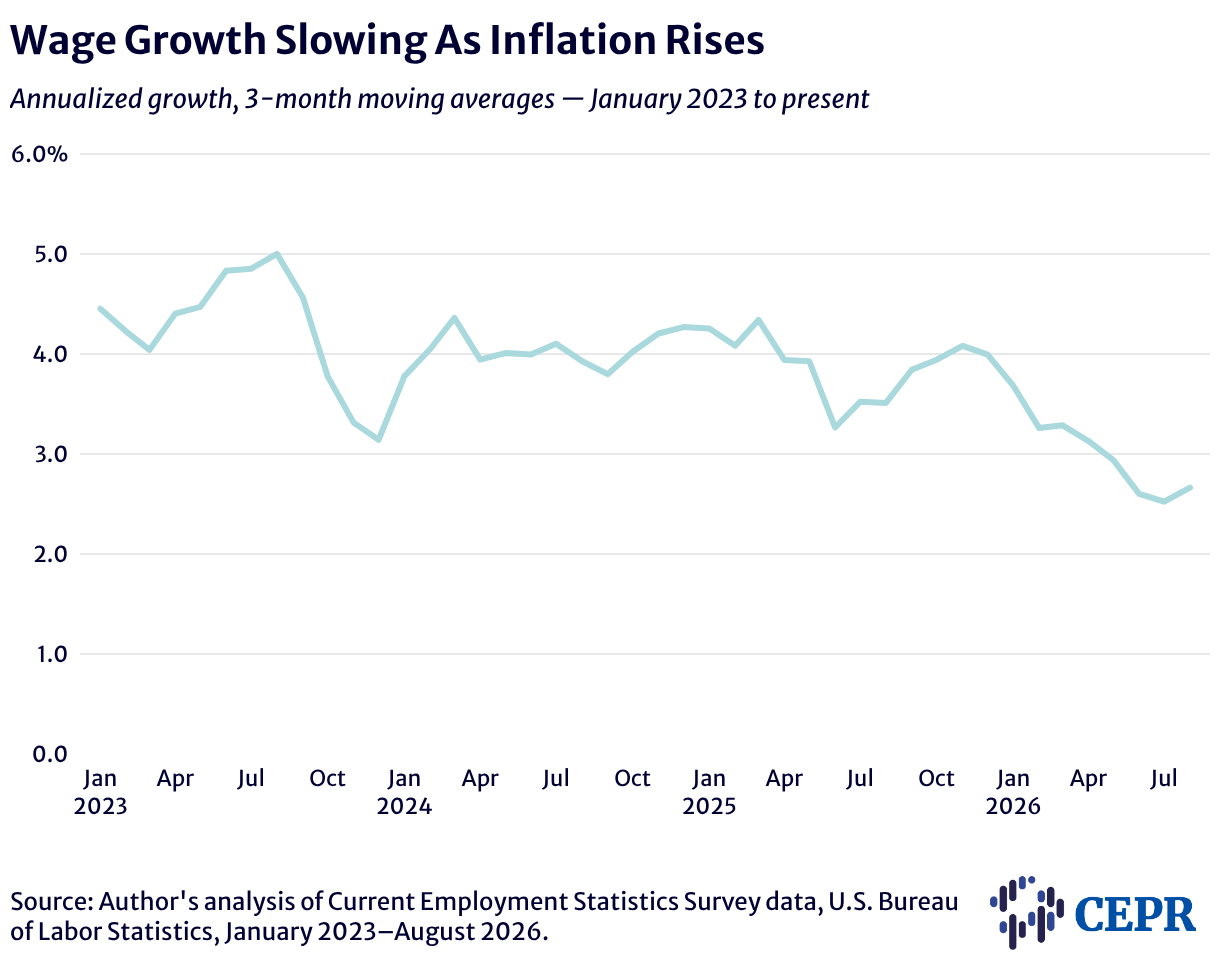
The average hourly wage rose by 3.1 percent over the last year. That is down from an average of more than 4.0 percent in 2023 and 2024. It is below the 3.5 percent rate of inflation, which means that real wages are falling. The story looks even worse comparing the average for the last three months (June-August) with the prior three (March-May). Over this period, wages have grown at just a 2.7 percent annual rate.
Overall Picture: Good Jobs Growth, but Wages Continue to Lag
There is a lot of good news in this report. The job decline reported for July was obviously a fluke of seasonal adjustment, but we had seen weak job growth for three consecutive months. With this month’s report and upward revisions to the prior two months, the average for the last three months is 72K. This is certainly enough to keep pace with the growth of a labor force with near zero immigration.
On the other hand, wage growth continues to slow, even as inflation has accelerated above 3.0 percent. This does not suggest a strong labor market. The increase in unemployment due to quits may indicate workers are starting to feel more confident about their job market prospects, but this goes against a lot of data pointing the other way. This is hugely important for wage growth, since job changers get larger wage gains than workers who stay with their employer.
We also are not seeing any real evidence to support the AI job disaster story. At most, some narrow sectors seem to be affected. Productivity growth was weak the last three quarters and with a big jump in hours in August it doesn’t seem likely to pick up much in the current quarter, maybe next quarter.
It is worth noting that women again accounted for the bulk of the job growth in August, 158K of the 162K jobs.



Comments
Log in or sign up to join the conversation.