

Understanding the consensus in investing is important. During the middle of when an investment idea is succeeding or failing, typically the consensus is correct. At the turning points, the consensus is typically wrong. That is why it is important to try to understand what the consensus is.
Often we listen to or read the news to learn what current opinion is. In the quotation in the picture above, King was a major molder of the consensus on race relations in America. He knew the situation, and took action to try to change people’s minds, and thus move the consensus to a better place — closer to a colorblind society. We haven’t arrived on that yet; maybe in the generation of my children we will get there. We owe a debt of gratitude to King politically. (Religion was a different matter for King. If you want to read about that, there is an appendix at the bottom.)
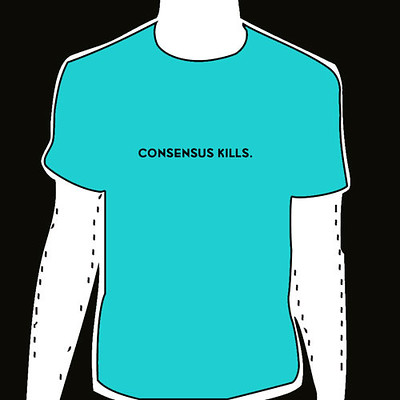
Picture credit: tara hunt || Active managers must avoid being consensus thinkers, lest they be expensive indexers
But for investors, reading or listening to the news will not give you the consensus. It will give you opinions, and sometimes the agreeing chatter of opinions may give you the illusion that you know the consensus.
In an election, the consensus is whoever manages to win a majority of votes, whether of people, or their electoral representatives. This is can take place in a simple district, or in the more messy situation of who prime minister will be in a parliamentary system, or even the election of a US President.
But in the markets consensus does not stem from what is said, but rather where money is invested. This is once again the concept of Ben Graham’s voting machine. Thus to understand the consensus, we don’t read the news. Rather, we look at prices, and then try to do some sort of analysis, usually fundamental, to see whether the consensus is right or wrong.
Indexing is the ultimate statement of an investor saying he will just go with the consensus. That’s not a bad idea for many people. Active investing is a statement that you think the consensus is wrong, and that over a reasonable period of time, the consensus will be proven wrong, and you will make good money in the process. But part of that question is whether your investors will hang around long enough for you to be proven right. The other part is that you could be wrong — non-consensus does not mean right. (In my time, I have known more than my share of cranks who held extreme minority positions for a long period, and would rarely admit they were wrong. When they would admit failure, typically, they would blame someone else.)
Now let me give you two large present examples of how the “consensus” in the investment news is not the market consensus:
One frequent thing that I run into both on the web and radio is the argument from many advisors as to how pessimistic investors are today. The correct way to understand this is that because the market is high, many investors are skittish about future commitments. So what is the consensus here? The big investors of the world have and are investing money in the stock market such that prices are high — they discount a low expected future return.
The second example is people who kvetch about low interest rates and say they have nowhere to go but up. I’ve been hearing this off and on since 1987, when my boss said, “Interest rates will never go below 10%.” These arguments are a little dented today, because of the shell-shock stemming from negative interest rates in much of the developed world, but I still read commentators on the web and on the radio saying that interest rates must rise.
But what does the behavior of market participants tell you? It tells you that investors at present are yield-hungry, and that there has been money looking for a home than entities willing to borrow. No promises about the future, but the consensus has been that yields have been attractive to lenders, and that may continue for a while.
Now a hybrid regarding investment consensus and activists and short sellers who publish their opinions to the market in an effort to profit. In the long run, the cash flows will dictate the market movements, but in the short run their words, purchases/sales, and expected purchases/sales implied by their writing will drive prices in the short run.
Articles
Now, I’ve written a series of articles dealing with this topic over the years:
- “Different from the Consensus” — An overview of what “consensus” means with its limitations.
- On Contrarianism — ” With markets, it doesn’t matter what people say. What matters is what they rely upon.” I give several examples for how to possibly generate a correct contrarian (or, non-consensus) opinion.
- My 9/11 Experience — A brief telling of what happened to me on 9/11/2001, but focusing on the very non-consensus investment decisions we made immediately after that.
- The Ecology of Investment Strategies — ‘ Any investment strategy can be overused. Part of the job of a portfolio manager is to ask the question “To what degree am I in or out of the consensus? Where am I in the cycle for my strategy?” ‘ (I wish I had applied that to my deep value investing when the FOMC dropped rates to zero.)
- Book Review: The Most Important Thing — Howard Marks as an investor is probably the best explainer of non-consensus investing, which he entitles “second level thinking.” I’m currently reading the book Non-Consensus Investing by Rupal Bhansali. This also seems to be a good book on the topic, and I will likely review it.
- But then if you want to hear the same thing from someone who is out of favor right now it would be: Book Review: The Only Three Questions That Count by Ken Fisher. It’s his second question: ” What can you fathom that others find unfathomable?”
Summary
In general, talk is cheap. Money talks louder than human chattering when it comes to the markets. The consensus derives from the investment actions that market players make, not the words they utter.

Comments
Log in or sign up to join the conversation.