

United Parcel Service, Inc. (UPS) was founded in 1907 as a private messenger and delivery service in Seattle, Washington. Today, they are the world’s largest package delivery company, a leader in the U.S. less-than-truckload industry and a premier provider of global supply chain management solutions. The global market for these services includes transportation, distribution, contract logistics, ground freight, ocean freight, air freight, customs brokerage, insurance and financing.
MARKET LEADER
In 1907, 19-year-old Jim Casey borrowed $100 from a friend to launch the American Messenger Company in Seattle, Washington. Jim’s slogan for the business was “best service and lowest rates.” In 1919, the growing company made its first expansion beyond Seattle and adopted the United ParcelService name. Jim Casey’s strict policies of customer courtesy, reliability, round-the-clock service and low rates are the principles which continue today to
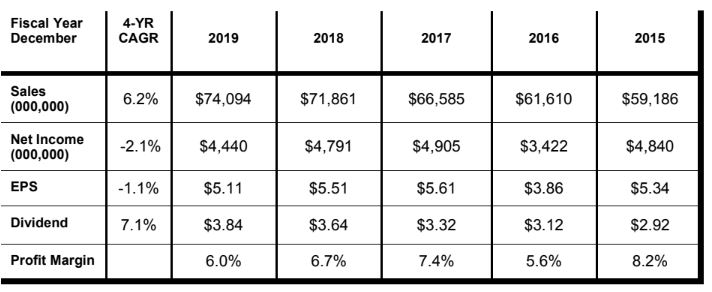
guide UPS, a market leader with more than $74 billion in sales.
UPS’s first international operations started in 1975 when the company expanded its operations to Canada. Today, UPS runs an international network serving more than 220 countries and territories, with international sales accounting for 19% of total 2019 revenues. Global package and freight shipments are expected to continue to grow as global ecommerce accelerates in the retail, healthcare, manufacturing and aerospace sectors. As one of the largest transportation companies in the world, UPS is uniquely positioned to assist companies as they “go global.”
UPS has constructed a massive internationaltransportation network interconnected with one of the largest technological infrastructures in commercial history, unlikely to be replicated by many. Economies of scale, excellent customer service and operating efficiencies translate into high profitability for the firm.
STRONG CASH FLOWS
UPS has a flexible capital allocation strategy which allows the company to reinvest in its business, make dividends a priority and take a balanced approach to share repurchases. Since going public in 1999, UPS has delivered parcel loads of free cash flow to shareholders via dividends and share buybacks.
During the first quarter of 2020, the company generated free cash flow of $1.6 billion. Given the challenging economic environment, UPS suspended share buybacks for 2020 and reduced capital expenditures by $1 billion. The company remains committed to paying its dividend, which currently yields an attractive 4.1%.
FIRST QUARTER RESULTS
UPS delivered 5% growth in first quarter revenues to $18.0 billion,driven by growth in business-to- consumer shipments as online shopping increased substantially during the pandemic along with gains in healthcare services. Average daily volume in the U.S. domestic market increased 8.5% with growth across all products. Next Day Air average daily volume increased 20.5%.
The product mix shifted dramatically during the quarter as commercial deliveries declined while residential deliveries were elevated. Net income and EPS each declined 13% during the quarter to $965 million and $1.11, respectively. The company’s results were adversely affected by the disruption to business customers that were locked down due to the coronavirus.
The firm maintains ample liquidity and a solid financial condition. UPS remains confident that the company is well prepared for the economic recovery regardless of the shape it takes. Long-term investors should package up UPS for their portfolio. UPS is a high-quality market leader with strong cash flows, an attractive dividend and on track for future long- term growth. Buy.



Comments
Log in or sign up to join the conversation.