

Oracle (ORCL) provides products and services for all aspects of corporate IT environments—applications, platform and infrastructure. Oracle offers database software and tools, cloud engineered systems and enterprise software including database development tools, middleware software products, enterprise resource planning software, Human Capital Management software, customer relationship management software and supply chain management software.
TECHNOLOGY LEADER
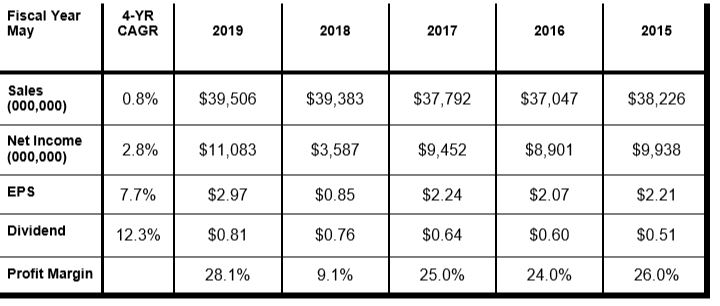
Larry Ellison, who owns 30.6% of Oracle’s stock and continues to serve as Chairman and Chief Technology Officer, founded the company in 1977. Since introducing its first database software in 1979, Oracle has grown to become a global technology market leader with sales topping $39 billion. In fiscal 2019, Oracle’s cloud services & license support, cloud license & on premise license, hardware and services businesses represented 68%, 15%, 9% and 8% of total sales, respectively. To transition its business into the cloud,management plans to leverage its large operating scale, which includes a 50% share of the global database management market; its technology breadth, which stems, in part, from key acquisitions; and its large installed base of more than 430,000 worldwide customers. To support its cloud transition and drive growth during the past five years, Oracle has invested nearly $30 billion, or 15% of its revenues, in research and development.
FINANCIAL STRENGTH
For fiscal 2019, revenues increased 3% on a constant currency basis with reported revenues relatively flat at $39.5 billion. Net income and EPS each more than tripled. On an adjusted basis, EPS increased 16%. Return on shareholders’ equity in fiscal 2019 was an outstanding 50%. These solid results were driven by the company’s high margin Fusion and NetSuite cloud applications businesses which continue to grow rapidly while Oracle downsizes their low-margin legacy hardware business. The shift from commodity hardware to cloud applications resulted in an adjusted operating margin of 47%, the highest the company has generated in five years.
Oracle is gaining market share in the cloud applications business. During the fourth quarter, the company added over 5,000 new Autonomous Database trials. This new Gen2 Cloud Infrastructure offers a self-driving database that automatically encrypts all data, backs itself up, tunes itself, upgrades itself and patches itself when a security threat is detected all without the need of human intervention or downtime.
Oracle’s profitable operations generate strong cash flows. With minimal capital expenditure needs, Oracle’s free cash flow has significantly exceeded net income over the years, a sign of high-quality earnings. Over the last decade, free cash flow has grown from $7.7 billion to $13 billion at the end of fiscal 2019. As of 5/31/19, Oracle’s balance sheet boasted nearly $38 billion in cash and marketable securities and $52 billion in debt. This $14 billion of net debt comes despite several large, fast-growing acquisitions, including Fusion and NetSuite, and a 25% reduction in Oracle’s outstanding shares during the past five years, with nearly 60% of the total reduction in fiscal 2019. During the year, Oracle repurchased a whopping 734 million shares for a total of $36 billion. Between the share buyback and dividend, Oracle returned $39 billion to shareholders in fiscal 2019.
ATTRACTIVE VALUATION
Oracle’s dividend currently yields 1.7%. With a relatively low 27% dividend payout, the company has ample room to increase the dividend steadily even while it transitions its business to the cloud. Based on Oracle’s current market capitalization, the stock is attractively valued with a free cash flow yield of 7%. Long-term investors should add Oracle to their database, a high-quality technology market leader with financial strength and an attractive valuation. Buy.



Comments
Log in or sign up to join the conversation.