


On October 1, 2025, Tim Plaehn noted that “ETF evolution over the past few years has come at a frenetic pace.” Income ETFs had moved from monthly payments to weekly distributions. Defiance was taking the next step with a fund designed to pay twice a week.
That fund is the Defiance Nasdaq 100 LightningSpread Income ETF (QLDY). It had launched only a few weeks prior.
A little more than a year after Plaehn’s initial review, QLDY deserves another look. For income investors, the question is straightforward: Can the strategy support those frequent payments while preserving the value of the investment?
How QLDY Generates Income
QLDY’s primary objective is current income, with capital appreciation as a secondary goal. Its LightningSpread strategy combines two options positions.
First, the fund buys deep in-the-money call options to gain exposure to the Nasdaq-100 Index. These positions allow QLDY to participate in movements in the index without directly owning its stocks.
Second, the fund sells short-term put spreads, primarily using options that expire the same day. A put spread pairs a sold put with a purchased put at a lower strike price. The fund collects a net premium while the purchased put limits the potential loss on that spread. The strategy can also establish part of a spread the day before expiration.
The goal is to turn frequent premium collection into twice-weekly cash distributions.
The Appeal of Frequent Payments
Two payments a week would work out to approximately 104 distributions a year. For investors who use portfolio income to cover expenses, that frequency is easy to appreciate.
However, the payment schedule is a target. Neither the distributions nor their amounts are guaranteed. Defiance cautions that payments can vary significantly.
A high distribution rate also needs context. It measures the cash being paid relative to the fund’s value. It does not tell investors whether their investment is earning a positive total return.
The Risks Behind the Income
QLDY’s strategy introduces several risks that deserve attention.
Execution matters. In his original review, Plaehn pointed out that earlier Defiance funds had used put spreads before switching to daily call selling following disappointing results. That history does not determine QLDY’s outcome, but it supports his decision to give the fund time to prove itself.
Market declines can hit both positions. When the Nasdaq-100 falls, the fund’s call options can lose value while its sold put spreads also generate losses. If the index finishes at or below the spread’s lower strike, the spread reaches its maximum loss. The purchased put limits that portion of the damage, but it does not protect the separate call position.
Distributions can outpace investment results. Every distribution reduces net asset value, or NAV, by the amount paid, all else equal. If investment gains do not replenish those payments, NAV can decline over time.
Distributions may also include return of capital. That tax classification alone does not establish that a payout is unsustainable. Investors should examine NAV and total return alongside the cash received.
Frequent options trading also creates transaction costs and can affect the tax character of distributions.
Watch the Size of the Payments
There is another risk for investors counting on dependable cash flow: distributions can gradually shrink.
A small reduction may be difficult to notice when payments arrive twice a week. Over several months, however, those reductions can add up to a meaningful decline in income. The chart below makes this clear.
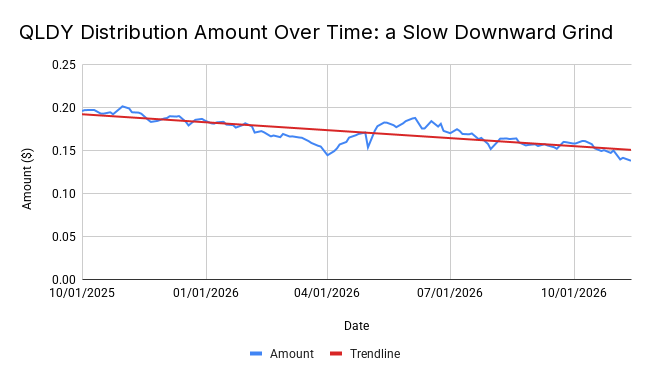
Investors should compare monthly distribution totals alongside NAV and total return. Frequent payments provide limited comfort if both the investment value and the income it produces are falling.
QLDY offers an unusual payment schedule and an aggressive income strategy. For conservative income investors, the deciding factor should be whether the fund can sustain useful cash flow while delivering acceptable total returns.



Comments
Log in or sign up to join the conversation.