

The U.S. stock market is nothing if not the most incredible information absorption tool ever developed, continually responding almost instantaneously to the random onset of new information.
But which new information are investors weighing the most in setting their expectations for the future?
That question arises because we've developed two different scenarios based simply on how investors are factoring in the prospects for the Fed's expected rate hikes in 2022. In the first scenario, we're presenting in this article, we're assuming that the Fed's recent 26 January 2022 meeting played an outsized role influencing the future expectations of investors, where we find the level of the S&P 500 (Index: SPX) is elevated above where we would expect it to be for investors focusing in on how the Fed will act during the current quarter of 2022-Q1:

In our second scenario, we're treating the Fed's 26 January 2022 meeting as if it were just a noisy outlier temporarily affecting a well-established trend, with investors continuing to treat the S&P 500 as they have since 16 June 2021:
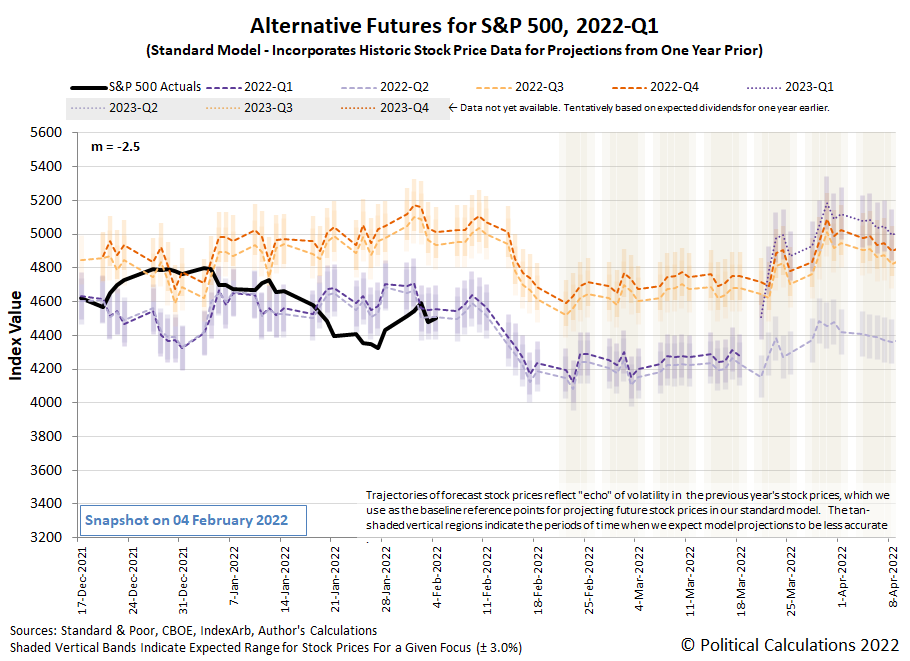
In this past week, this second scenario would appear to be the stronger one in terms of explaining the evolution of U.S. stock prices.
Regardless, we expect the S&P 500 to eventually settle according to the assumptions investors are developing for the future, which means we get to keep paying close attention to the one thing that's affecting those assumptions more any other factor right now. The random onset of new information.
Speaking of which, here's a sampling of what investors had to digest during the first week of February 2022.
Monday, 31 January 2022
- Signs and portents for the U.S. economy:
- Fed minion floats half-point rate hike, then tries to walk it back; other minions try being noncommital:
- Bigger trouble developing in China, Japan, Eurozone:
- Nasdaq narrowly misses worst January ever as Wall Street gains
Tuesday, 1 February 2022
- Signs and portents for the U.S. economy:
- Fed minions try to dial back expectations of more than four rate hikes or a half-point rate hike in 2022:
- Bigger trouble developing in Japan:
- Mixed economic signs in the Eurozone:
- Central banks looking to avoid rate hikes:
- Wall St flat in choppy trading after two-day surge
Wednesday, 2 February 2022
- Signs and portents for the U.S. economy:
- Prospective Fed minions not well matched to appointed tasks?
- ECB minions surprised to find higher inflation than expected in the Eurozone:
- Stocks extend gains on strong U.S. earnings, weak economic reports
Thursday, 3 February 2022
- Signs and portents for the U.S. economy:
- U.S. job market faces reshuffling as workers quit at near record rates
- U.S. worker productivity rebounds in fourth quarter; labor costs tepid
- U.S. service sector slows in January; input prices remain elevated - ISM survey
- Oil prices take a breather, OPEC+ sticks to output plans
- U.S. factory orders fall in December; shipments rise further
- Biden's prospective Fed minions say they fear inflation, current Fed minions wants higher rates:
- Bigger trouble developing in Japan, positive growth signs in S. Korea:
- ECB minions thinking about doing something about inflation; BOJ minion thinking about passing on doing something about inflation; Bank of England acts to deal with inflation:
- Wall St snaps winning run as Facebook forecast disrupts tech-led recovery
Friday, 4 February 2022
- Signs and portents for the U.S. economy:
- Fed minions will hike rates by quarter-point in March (no half-point rate hike):
- Recovery signs in Japan and the Eurozone:
- BOJ minion determined to keep stimulus going; ECB minions starting to notice inflation, are expected to raise rates to 0%:
- Nasdaq ends choppy week higher, as Amazon earnings stall tech rout
As of the close of trading on 4 February 2022, the CME Group's FedWatch Tool projects rate hikes in March 2022 (2022-Q1), May 2022 (2022-Q2), July (2022-Q3), and December (2022-Q4). Although we should point out the tool's results look a little haywire right now, in that it forecasts a quarter-point rate cut in September, followed by a half-point rate hike in December 2022. Based on Reuters' reporting on Friday, 4 February 2022, the Fed is seeking to set expectations for quarter-point rate hikes, of which there will be four hikes in 2022 with no cuts if all goes according to plan. (Unless, of course, something really goes wrong with the economy.)
Finally, checking on the Atlanta Fed’s GDPNow tool, it is still forecasting a 0.1% real GDP growth rate for the U.S. economy in the first quarter of 2022.
Comments
Log in or sign up to join the conversation.