
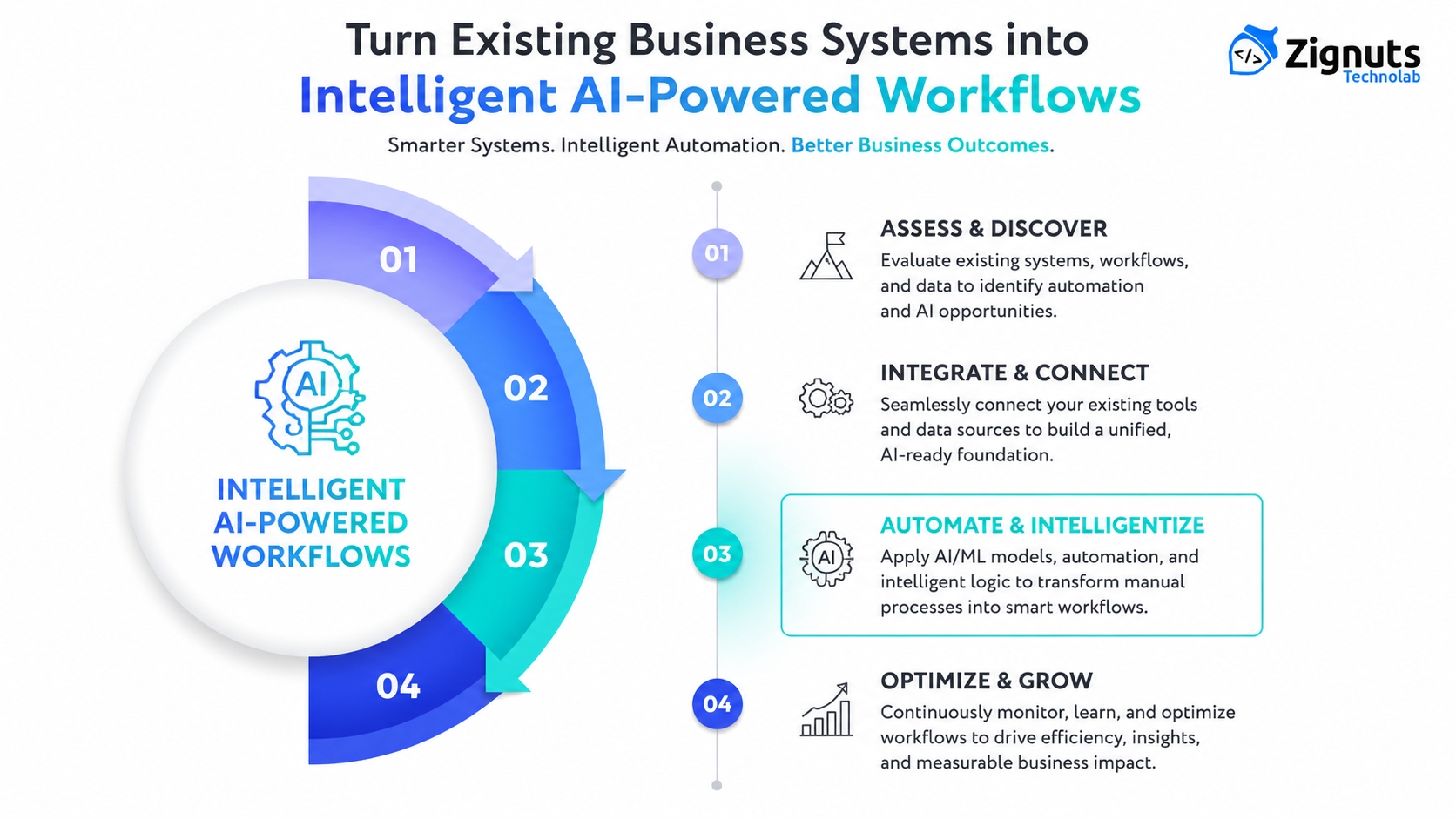
The most expensive mistake an enterprise leader can make is assuming that modernizing a business requires ripping out legacy systems. For decades, corporate IT budgets have been dominated by the multi-year, multi-million-dollar cycle of replacing core infrastructure. Yet, the promised land of agility rarely arrives. Instead, enterprises trade one rigid system for a slightly shinier, equally inflexible alternative.
True digital transformation does not require abandoning the transactional systems that run your operations. The real breakthrough lies in upgrading their cognitive capacity. By layering intelligence directly onto your established databases and applications, you can transform rigid infrastructure into intelligent AI workflows that actively reason, adapt, and drive business outcomes.
The market has shifted past simple data collection and basic robotic process automation. In an environment defined by margin pressure and rapidly evolving customer demands, static software is a liability. Leaders who learn to inject reasoning into their existing technology stacks will build an unassailable operational advantage, while those stuck in endless replacement cycles will continue to bleed capital.
The New Corporate Reality: The Shift from Automation to Augmentation
Enterprise technology has entered a new era. The previous decade focused heavily on basic automation, specifically utilizing rules-based systems to handle repetitive, structured tasks. While this approach effectively reduced manual data entry, it proved brittle when faced with exceptions, unstructured data, or shifting business conditions.
Today, market leaders are facing unprecedented pressures. Customers expect instantaneous, highly personalized service. Regulatory frameworks require granular compliance monitoring. Concurrently, macroeconomic factors demand higher productivity without a linear increase in headcount.
To survive in this climate, organizations must transition from simple automation to cognitive augmentation. This means building workflows that do not just move data from point A to point B, but actually analyze the data, determine the next best action, and execute it within the context of complex business rules.
Why Traditional System Replacement Strategies Fail
The standard playbook for technology modernization has long been the platform migration. When an ERP, CRM, or core administrative system becomes too slow or restrictive, the default response is to issue an RFP for a replacement. This approach relies on outdated business assumptions and introduces systemic risk.
First, legacy software is rarely just software. It is a digital reflection of an organization’s institutional knowledge, custom business rules, and historical exceptions. When you rip out a thirty-year-old core ledger or claims processing engine, you are discarding decades of refined operational logic.
Second, the cost of migration extends far beyond software licensing. It includes data mapping errors, productivity drops during transition, and extensive employee retraining. Most importantly, by the time a massive multi-year migration project is completed, the technology landscape and market conditions have shifted, leaving the organization right back where it started.
The Modern Strategy: Systems of Record vs. Systems of Intelligence
The alternative to the rip-and-replace trap is a decoupled architecture that separates your transactional foundation from your cognitive layer.
Systems of Record: These are your core databases, ERPs, and legacy applications. They are designed for accuracy, compliance, and stable transaction processing. They do not need to be fast or flexible; they need to be secure and reliable.
Systems of Intelligence: This is the cognitive overlay. It communicates with your systems of record via APIs, database connectors, or secure virtualization layers. It reads unstructured text, interprets user intent, coordinates multi-step actions, and updates the core systems automatically.
By maintaining this separation, you protect the stability of your foundational software while gaining the ability to deploy rapid, iterative intelligent AI workflows on top of them.
The AI Value Stack Framework
To successfully orchestrate this cognitive overlay, enterprises should view their architecture through a structured layer model. Each tier builds upon the last to convert raw enterprise assets into definitive bottom-line outcomes.
             ┌─────────────────────┐
             │   Business Impact   │
             └──────────▲──────────┘
                        │
             ┌─────────────────────┐
             │ Intelligent Actions │
             └──────────▲──────────┘
                        │
             ┌─────────────────────┐
             │ AI Reasoning Layer  │
             └──────────▲──────────┘
                        │
             ┌─────────────────────┐
             │  Data & Knowledge   │
             └──────────▲──────────┘
                        │
             ┌─────────────────────┐
             │ Business Processes  │
             └─────────────────────┘
Business Processes
This is the foundational layer representing your current operational workflows, legacy systems, and standard operating procedures. It defines what your business does on a day-to-day basis, regardless of the software used.
Data & Knowledge
This layer gathers and synthesizes data from across your enterprise. It normalizes unstructured documents, connects isolated databases, and establishes a secure, unified data layer that provides the necessary context for intelligent operations.
AI Reasoning Layer
The reasoning layer is where cognitive processing occurs. Using large language models, machine learning algorithms, and semantic routers, this layer interprets data, handles exceptions, evaluates complex choices, and makes contextual decisions based on corporate policies.
Intelligent Actions
Once a decision is reached, this layer executes it. It triggers API calls, updates records within your legacy applications, generates personalized communications, and coordinates tasks across diverse software platforms without requiring manual human intervention.
Business Impact
The peak of the stack represents the measurable outcomes realized by the organization. This includes reduced cycle times, lower operational expenses, mitigated risks, and enhanced revenue retention driven by smarter, faster operations.
Strategic Decision Matrices for Enterprise Leaders
To assist leadership teams in prioritizing their modernization efforts, the following matrices offer clear, actionable frameworks for evaluation.
Business Value Matrix
Business Capability | AI Readiness | Expected Business Value | Implementation Difficulty | Priority |
Customer Support Triage | High (Abundant historical logs) | High (Reduced resolution times) | Low (Uses standard API connectors) | Immediate |
Supply Chain Forecasting | Medium (Fragmented vendor data) | High (Reduced inventory holding costs) | High (Requires complex data cleaning) | Strategic Target |
Regulatory Compliance Auditing | High (Clear, well-defined legal rules) | Very High (Avoidance of severe penalties) | Medium (Requires strict access controls) | High Priority |
Core Financial Reconciliation | Low (Highly sensitive data silos) | Medium (Incremental speed gains) | Very High (Zero error tolerance required) | Defer |
Executive Decision Matrix
Decision Area | Questions Leaders Should Ask | Risk if Ignored | Success Indicator |
Architecture Approach | Can we expose this legacy system's data through secure APIs rather than replacing the core platform? | Multi-million dollar write-offs and years of operational disruption. | API endpoints successfully deliver core data in under 200 milliseconds. |
Vendor Selection | Does the vendor offer open integrations, or are they locking us into an isolated ecosystem? | Inability to adapt to future AI advancements without another system overhaul. | Smooth data orchestration across three or more disconnected internal software tools. |
Talent Allocation | Do we have the internal expertise to manage AI orchestrations, or do we need external system integrators? | Project delays, security vulnerabilities, and poor workflow design. | Delivery of an initial production-ready workflow within a strict 90-day window. |
Real-World Industry Implementations
Healthcare: Medical Claims Pre-Authorization
Business Problem: A major healthcare provider suffered from severe delays in patient care because processing medical claims and pre-authorization requests required manual verification across three separate legacy mainframes.
Technology Approach: The organization built an intelligent overlay that extracts clinical text from electronic health records, matches it against insurance policy rules using an AI reasoning layer, and automatically updates the legacy authorization platform.
Implementation Challenge: Navigating complex data schemas within thirty-year-old databases without violating patient privacy regulations.
Measurable Business Outcome: Processing time dropped from an average of five days down to less than four minutes, while maintaining a compliance accuracy rate of 99.8 percent.
Finance: Commercial Loan Underwriting
Business Problem: A commercial bank struggled with slow loan processing times because analysts had to manually collect, compare, and verify financial statements scattered across legacy core banking software and external credit databases.
Technology Approach: The bank implemented intelligent AI workflows that automatically ingest multi-page financial documents, extract relevant financial ratios, and pass structured data directly into the legacy risk valuation system.
Implementation Challenge: Normalizing highly inconsistent document formats and balance sheet layouts from diverse business applicants.
Measurable Business Outcome: Underwriting throughput increased by 45 percent, allowing the bank to capture higher loan volume without adding administrative headcount.
Manufacturing: Predictive Maintenance and Parts Procurement
Business Problem: An industrial manufacturer experienced unexpected production line downtime because their legacy enterprise asset management system could not anticipate equipment failures or automate parts ordering.
Technology Approach: Sensor data streams were linked to an analytics engine that monitors equipment degradation and automatically triggers purchase orders within a legacy ERP when specific wear thresholds are crossed.
Implementation Challenge: Connecting real-time internet-of-things data with a rigid, batch-processed procurement database.
Measurable Business Outcome: A 30 percent drop in unscheduled factory downtime and a 15 percent reduction in emergency shipping fees for replacement parts.
Retail: Omni-Channel Inventory Optimization
Business Problem: A national retailer suffered from frequent stockouts and regional overstock situations due to isolated inventory systems across e-commerce platforms and physical retail outlets.
Technology Approach: An intelligent coordination system was deployed to continually evaluate local demand shifts, weather forecasts, and historical trends, automatically executing stock transfers within the old inventory ledger.
Implementation Challenge: Reconciling conflicting data updates sent simultaneously from thousands of point-of-sale terminals.
Measurable Business Outcome: Inventory holding costs decreased by 18 percent, while overall product availability rates rose to 98.5 percent.
Quantifiable Benefits of Intelligent Workflows
Deploying intelligent overlays instead of replacing foundational systems delivers significant operational benefits:
Improved Operational Efficiency: By eliminating the manual steps required to move data between disconnected applications, organizations compress transaction cycle times from days to seconds.
Accelerated Decision-Making: AI reasoning layers process vast amounts of data instantly, giving frontline employees clear, context-aware operational recommendations at the moment of interaction.
Enhanced Customer Experience: Customers receive immediate answers, rapid resolutions, and highly personalized interactions because support teams are no longer toggling through slow, disconnected application screens.
Greater Scalability: Intelligent workflows operate continuously, allowing businesses to absorb major spikes in transaction volume without needing to quickly hire and train temporary operational staff.
Strengthened Compliance: Digital logic consistently applies regulatory and internal policy rules to every single transaction, automatically creating an immutable audit trail within existing databases.
Navigating Implementation Obstacles and Risks
While the benefits are clear, building cognitive workflows introduces specific enterprise challenges that require careful mitigation strategies.
Poor Data Quality
AI systems depend entirely on the quality of the data they ingest. Siloed, corrupted, or duplicate historical records will inevitably lead to flawed reasoning and poor automated actions.
Mitigation Strategy: Implement automated validation filters at the integration boundaries to sanitize and format data before it enters the cognitive reasoning layer.
Integration Complexity
Legacy applications frequently lack standard modern APIs, making direct integration difficult and technically demanding.
Mitigation Strategy: Use secure data virtualization solutions or lightweight microservice wrappers to interact with older systems without altering their core programming code.
Security and Governance Concerns
Exposing sensitive operational data to external AI models introduces data leaks and compliance risks.
Mitigation Strategy: Deploy local, open-source models within your private cloud environment or establish strict data-masking protocols to strip out personally identifiable information before transmission.
Employee Resistance and Change Management
Employees often worry that increased intelligent automation threatens their job security, leading to passive resistance and low adoption rates.
Mitigation Strategy: Position the initiative as a tool for administrative relief. Actively involve end-users in the initial design phase to ensure the new system solves their actual daily operational frustrations.
Actionable Best Practices for Execution
To ensure long-term success, enterprise technology leaders should adopt a disciplined, value-first approach to deployment.
Start with Tangible Business Problems
Do not launch a project simply to use new technology. Identify specific, measurable operational bottlenecks, such as high order error rates or long customer onboarding cycles, and design the workflow to resolve that issue.
Prioritize High-Impact, Low-Complexity Opportunities
Target early wins to build organizational momentum. Use the Business Value Matrix to locate processes that feature highly structured data and clear business logic, as these can be automated quickly with minimal engineering risk.
Clean and Standardize Data Formats First
Allocate adequate time to establish clean data inputs. The accuracy of your intelligent reasoning layer is directly tied to the consistency of the underlying context it receives.
Build Cross-Functional Implementation Teams
Avoid building systems in an isolated IT department. Create balanced project teams that bring together legacy system experts, data engineers, compliance officers, and everyday operational users.
Define and Track Clear KPIs
Establish baseline operational metrics before writing a single line of code. Monitor processing speed, error rates, and user adoption daily to prove clear financial return on investment to executive stakeholders.
Frequently Asked Questions
What exactly are intelligent AI workflows?
Intelligent AI workflows are operational processes that combine traditional software applications with advanced reasoning capabilities. Unlike standard automation tools that follow rigid, pre-programmed paths, these workflows can analyze unstructured data, adapt to unexpected exceptions, and make contextual choices aligned with organizational guidelines.
Why does this approach matter more than standard platform modernization?
Ripping out and replacing core enterprise software requires massive capital investments, carries high failure rates, and disrupts ongoing business operations. Layering intelligent workflows on top of your existing systems allows you to modernize operational speed and agility at a fraction of the cost, while preserving your proven transaction engines.
How much does it cost to implement these intelligent layers?
The total investment depends on the scale and complexity of the workflow, but it is typically significantly less than a system migration. Because you are utilizing existing infrastructure and connecting via APIs or data layers, initial pilot projects can often be delivered using existing engineering teams and standard cloud infrastructure budgets.
How do we measure the direct ROI of these initiatives?
Return on investment is measured by looking at clear operational metrics, such as reduced employee hours spent on manual data entries, decreased transaction processing times, lower compliance fines, and increased customer retention rates driven by faster service delivery.
How long does a typical implementation take?
While a full core system replacement often drags on for years, a targeted intelligent workflow pilot can typically be designed, integrated, and deployed to production within ninety days by focusing on a specific business process.
What critical mistakes must our business avoid during development?
The most damaging mistakes are choosing overly complex processes for an initial pilot, neglecting to sanitize historical data inputs, failing to include compliance teams early in the design cycle, and buying proprietary vendor solutions that lock your data into a closed ecosystem.
Conclusion
The future of enterprise technology belongs to organizations that maximize the value of their existing software investments by turning them into intelligent AI workflows. True operational agility is not achieved by chasing endless, expensive system replacement cycles. It is achieved by building a high-performing cognitive layer over the reliable, stable transaction engines you already own.
As you look at your current technology strategy, consider this question: Are your legacy systems a true technical bottleneck, or are you simply missing the cognitive layer required to unlock their full potential?
Enterprise modernization is no longer about changing your databases; it is about changing how those databases think, reason, and act to drive value.
Comments
Log in or sign up to join the conversation.