

Turkey’s economy grew by 2.3% in 2Q26, slowing from the previous quarter. Despite a clear loss of momentum, domestic demand was the main driver of economic activity, while positive net exports also added to the headline number.
In the second quarter, Turkey's GDP grew 2.3% year-on-year, below both the market consensus of 2.5% and our forecast of 2.7%. The latest figures point to a further moderation in economic activity compared with previous quarters.
GDP growth (%, YoY)
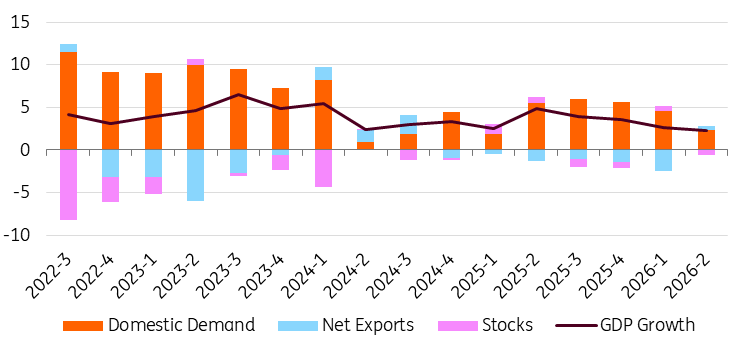
On a seasonally-adjusted basis, GDP expanded by 1.1% quarter-on-quarter, rebounding from the weak 0.3% growth recorded in the previous three months. This recovery was driven mainly by net exports, which contributed 1.5ppt to the headline figure. Capital formation remained broadly unchanged after contracting in the first quarter of 2026, while inventory accumulation also made a positive contribution of 0.8ppt, although at a slower pace than in the previous quarter. By contrast, household consumption weakened further, reducing headline growth by 0.9ppt, while government consumption also turned negative and weighed on sequential growth performance during the quarter.
A year‑on‑year breakdown of expenditure components shows the following:
Private consumption increased by 3.5%, contributing 2.3ppt to GDP growth. Nevertheless, this represents a further slowdown from the previous quarter, reflecting tighter financial conditions with additional reductions in lending limits, and ongoing geopolitical risks.
Investment spending rose by 0.6%, adding 0.2ppt to growth. Notably, construction investment contracted for the first time since mid-2023, while machinery and equipment investment posted a modest increase of 1.6%, although this was weaker than in recent quarters.
Public consumption declined by 1.8%, subtracting 0.2ppt from overall GDP growth. This suggests intensified efforts to contain fiscal spending despite certain policy measures aimed at mitigating the adverse effects of geopolitical developments.
Inventories reduced headline growth by 0.5ppt.
After exerting the largest drag on growth since late 2023, net exports returned to positive territory, ending the negative trend that had persisted since the beginning of 2025. Supported by declining imports, net exports added 0.6ppt to GDP growth.
From a sectoral perspective, agriculture and industry provided the strongest support to economic growth, each contributing 0.5ppt. The public sector and communications followed, contributing 0.4 and 0.3ppt, respectively.
Drivers of growth (ppt contribution)
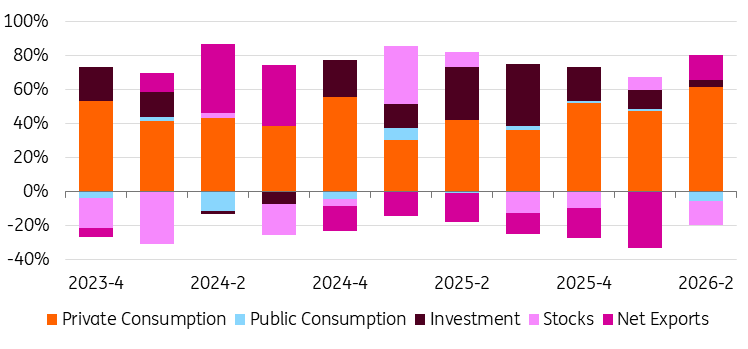
Overall, elevated borrowing costs and the recent tightening of macroprudential measures appear to be translating into a more pronounced slowdown in 2Q26 GDP growth. Despite a clear loss of momentum and the lowest contribution since 2024, domestic demand, particularly private consumption, continued to be the main driver of economic activity in the quarter. At the same time, the contribution from net exports has shifted back into positive territory.
We expect the economy to maintain a moderate growth performance in the second half of the year, increasing the risks surrounding our full-year GDP growth forecast of 3.0%. A potential resolution of the Gulf conflict could ease current downside pressures on the economic outlook and provide some support to growth prospects, while any further escalation would add to downside risks. The weaker-than-expected 2Q data is also likely to reinforce expectations of policy rate cuts by the central bank. We see the policy rate at 35% by the end of 2026.


Comments
Log in or sign up to join the conversation.