


I’m very pleased to share with you that our Holmes Macro Trends Fund (MEGAX) beat its benchmark, the S&P 1500 Composite Index, for the 12-month period as of March 31. Whereas the benchmark returned 13.73 percent for the period, MEGAX returned an impressive 17.15 percent. We also have very favorable expectations for the fund for the remainder of this year and beyond because of its model that emphasizes returns on invested capital (ROIC) and growing revenues.

MEGAX seeks to identify strong sectors, and within those sectors, to identify companies that have the greatest potential for growth. We like to lean toward the “growthier” small- and mid-cap components of the broader S&P 1500, which covers about 90 percent of total market capitalization of the U.S. stock market.
An Appetite for Well Managed Companies
Specifically, we focus on companies that have a high ROIC as well as revenues that appear to be growing faster than their peers. We overweight companies whose shares are currently being accumulated by institutional investors and underweight names that, according to our technical overlay, show investor appetite is waning.
Finally, we omit companies that have low margins and low revenue per employee.

As an example of how we put our strategy into practice, we added Energizer Holdings last quarter after the company reported strong net earnings in fiscal year 2017. After taxes, the Energizer bunny reported $201.5 million in sales, or an incredible $3.27 per share. That’s up 58 percent from $127.7 million in 2016 and after a net loss of $4 million the previous year. In 2017, gross margin as a percent of net sales was 46.2 percent, an improvement over the 43.6 percent margin in 2016.
The position was well made, as Energizer charged up nearly 25 percent in the first quarter, making it one of the top performing stocks in the mid-cap S&P 400 Index. Can the Energizer rally “keep going and going”? We’ll continue to study the bunny very closely.
Small Business “On Fire”
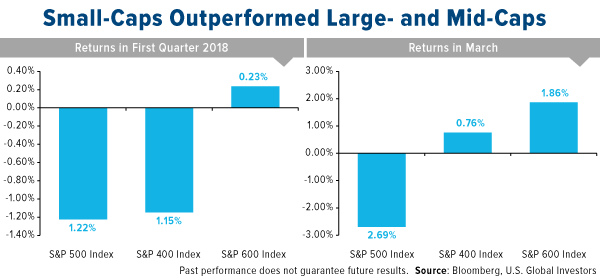
Our emphasis on smaller-cap, domestic-focused names has worked especially well as concerns over tariffs and global trade have lately hurt a number of shares of large multinationals with high exposure to foreign markets. As I shared with you just this week, small-cap stocks, as measured by the S&P 600 Index, finished positive for both the first quarter of 2018 and the turbulent month of March. They outperformed large-cap S&P 500 Index names as well as mid-cap stocks, represented by the S&P 400 Index. Please note, though, that small-caps, while they have higher returns here, also have a history of higher volatility than large- and mid-caps.
Consider what small business owners themselves are saying. The most recent monthly Index of Small Business Optimism, conducted by the National Federation of Independent Business (NFIB), came in at 107.6, the second-highest reading in the survey’s 45-year history. And 32 percent of small business owners say now is a good time to expand, the highest percentage ever. This optimistic comes in response to corporate tax cuts and the Trump administration’s pledge to roll back regulations.



Comments
Log in or sign up to join the conversation.