

The undeniable truth is easy to see in pictures.
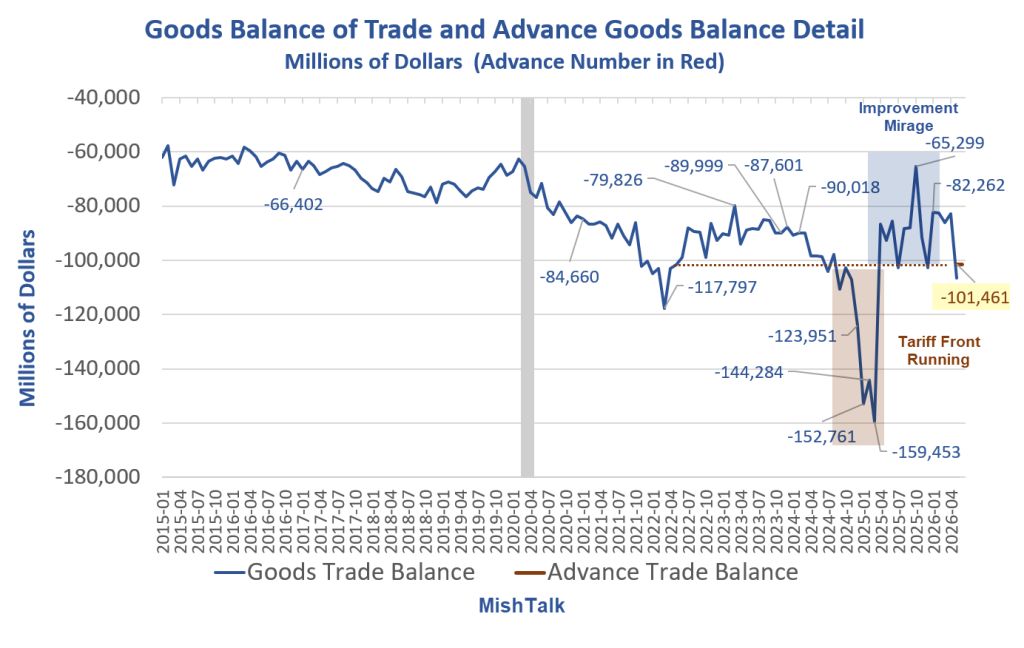
Advance International Trade in Goods
The international trade deficit was $101.5 billion in June, down $4.4 billion from $105.9 billion in May.
Exports of goods for June were $204.7 billion, $3.8 billion less than May exports.
Imports of goods for June were $306.2 billion, $8.2 billion less than May imports.
Tariff Front-Running and Rebound
In late 2024 and early 2025 corporations rushed to beat Trump’s reciprocal tariffs. Imports surged. Red Highlights
In mid-to-late 2025 and early 2026 imports fell because stock inventories were high.
The current goods trade deficit is worse than every month but one between June 2022 and March 2025.
Tariffs did nothing to improve trade deficits. We are now right back where we started from, if not a bit worse.
Goods Exports and Imports
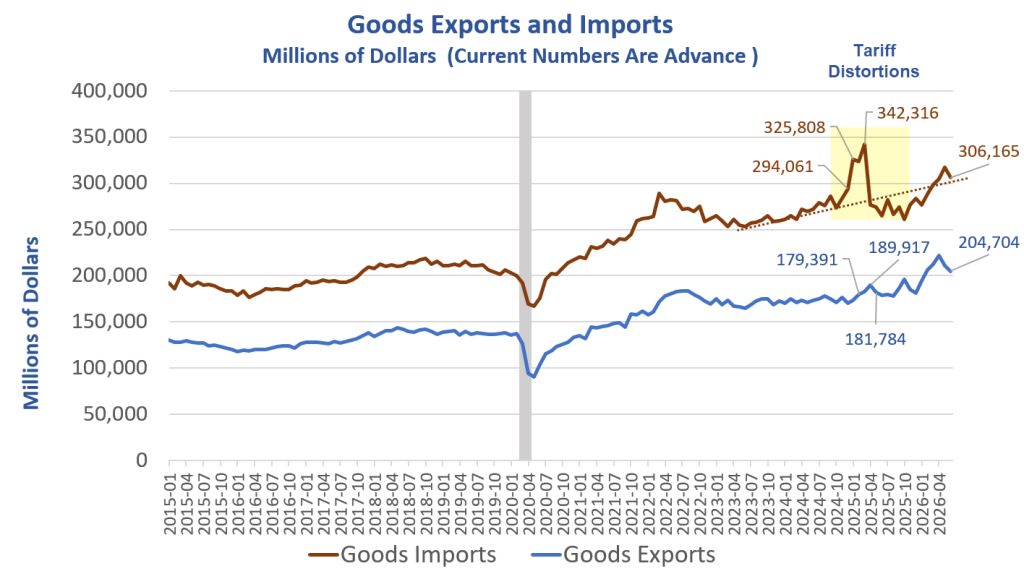
The increase in exports and imports is largely a measure of inflation. But there is no improvement in the net balance.
Balance of Trade Goods and Services
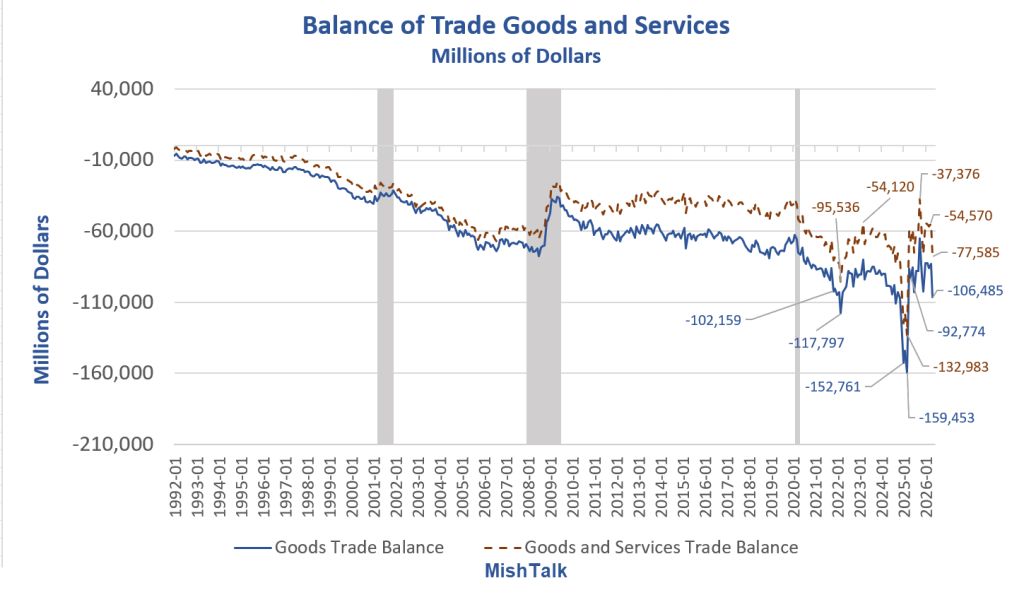
The advance numbers are goods only. Goods and Services are as of May 2026.
Balance of Trade Goods and Services Detail
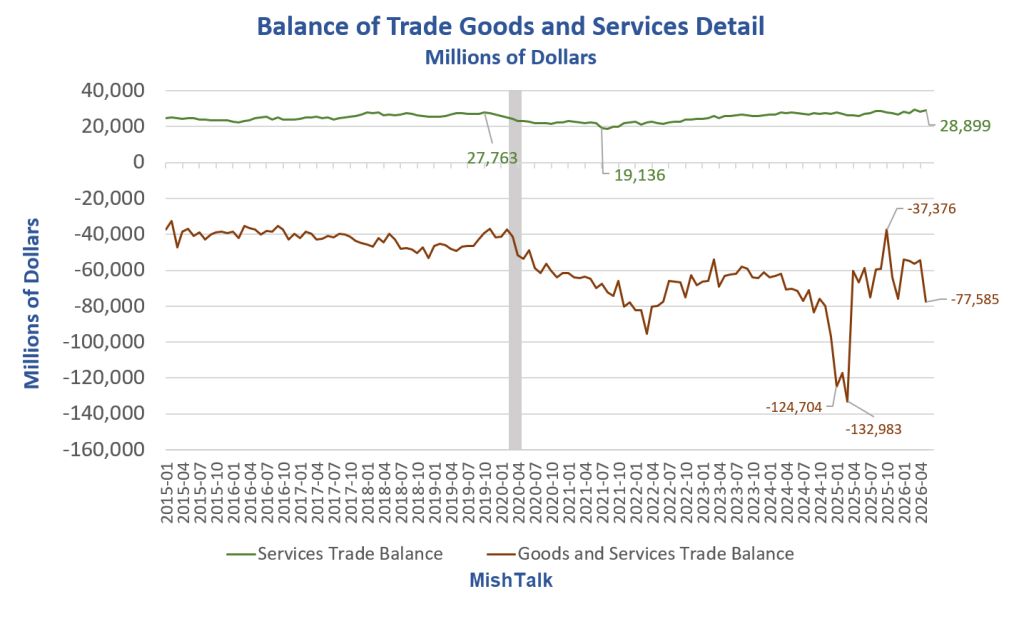
Between July 2021 and May 2026, the US trade services surplus increased from 19,136 and 28,899.
That’s an improvement of $9.8 billion or the goods and services deficit would now be 87.348 billion instead of 77.585 billion.
Tariffs have done nothing to improve trade deficits but they sure have increased costs.
Tariffs Will Not and Cannot Fix Trade Deficits
Tariffs will not and cannot fix trade deficits short of causing a recession reducing demand.
Note the balance of trade goods and services full chart with three recession bars.
The only improvements in the trade deficits were in periods of recession.
Trade Deficits a Symptom of a Problem
Trade deficits are not a problem, they are a symptom of a problem.
The real problem is there is no constraint on fiscal spending in congress.
This happened on August 15, 1971, when Nixon ended gold redeemability.
Coupled with the reserve currency, US consumers became the global consumers of last resort and there were no bakes on deficit spending by Congress.
Credit soared, and so did deficit spending.
Total Credit Market Debt Owed vs GDP
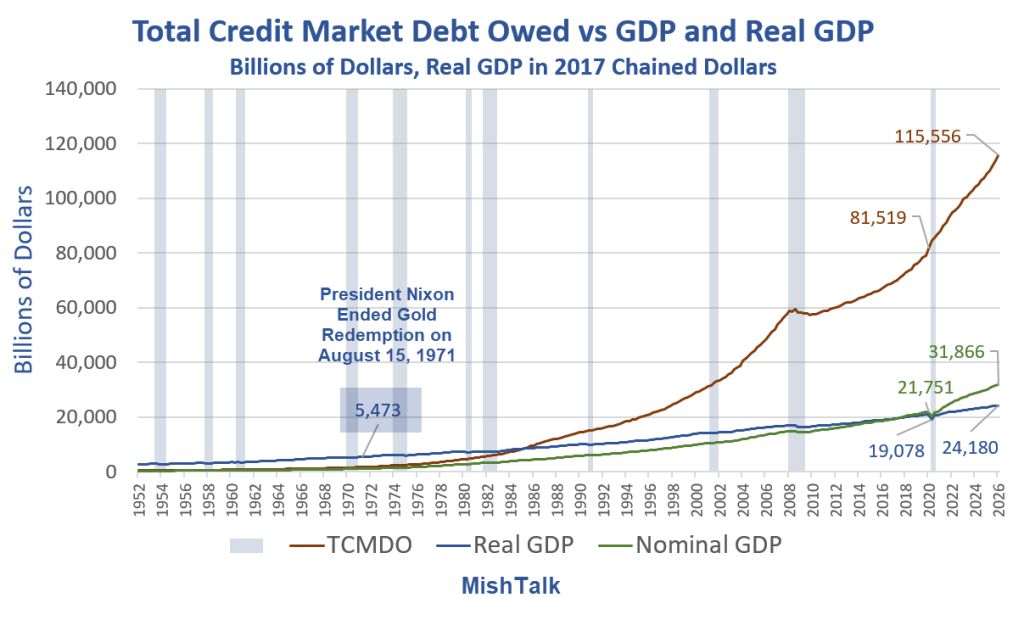
TCMDO vs GDP 2026 Q1
TCMDO: 115.556 Trillion
Nominal GDP: 31.866 Trillion
Real GDP: 24.180 Trillion
On August 15, 1971 president Nixon temporarily suspended redeemability of gold for dollars.
It turned out to be permanent. Since then, there has been no constraints on the expansion of money, national debt, or trade deficits.
Nixon Shock
I have been writing about the fundamental problem for nearly two decades. Here’s a synopsis from September 2019.
Please consider Nixon Shock, the Reserve Currency Curse, and a Pending Currency Crisis
In 1971 President Nixon appointed the then Democrat John Connally as Treasury Secretary. That’s when things started rolling.
Our Currency But Your Problem
Shortly after taking the Treasury post, Connally famously told a group of European finance ministers worried about the export of American inflation that the dollar “is our currency, but your problem.”
By 1971, US money supply had increased by 10%. In May 1971, West Germany left the Bretton Woods system, unwilling to revalue the Deutsche Mark. Switzerland also started redeeming dollars for gold.
On August 5, 1971, the United States Congress released a report recommending devaluation of the dollar to protect the dollar against “foreign price-gougers“.
On August 9, 1971, as the dollar dropped in value against European currencies, Switzerland left the Bretton Woods system.
On August 15, 1971 Nixon directed Connally to suspend, with certain exceptions, the convertibility of the dollar into gold or other reserve assets, ordering the gold window to be closed such that foreign governments could no longer exchange their dollars for gold. He also issued Executive Order 11615, imposing a 90-day freeze on wages and prices in order to counter inflation. This was the first time the U.S. government had enacted wage and price controls since World War II.
The American public believed the government was rescuing them from price gougers and from a foreign-caused exchange crisis. Politically, Nixon’s actions were a great success. The Dow rose 33 points the next day, its biggest daily gain ever at that point, and the New York Times editorial read, “We unhesitatingly applaud the boldness with which the President has moved.”
So Much for Temporary
The move was not temporary. There have not been any restraints on deficit spending since.
Wars became easy to finance. Deficits? No problem.
In 2011, Paul Volcker, who replaced William Miller as Fed Chair in 1979, expressed regret over the abandonment of Bretton Woods.
“Nobody’s in charge,” said Paul Volcker.
As long as the US is the global reserve currency, US consumers are the global consumers of last resort, and Congress ignores big deficits and massive building debt, nothing is going to reduce trade deficits short of a big recession.
And that is precisely what the charts show.
Amusingly Trump has threatened nations if they try to end US reserve currency dominance. The irony is despite all their talk, China does not want it because it would be the end of their export mercantilism.
Credit Growth vs Real GDP
For further discussion please see How Much Credit Growth Does It Take to Expand Real GDP?
It is shocking how much exponential credit growth it now takes to prevent recession.
Click above for more charts and details.
Also see What Would It Take to End US Dollar Dominance Over Global Transactions?
Those two posts are the key to understanding the total futility of tariffs as a means to fix anything.



Comments
Log in or sign up to join the conversation.