

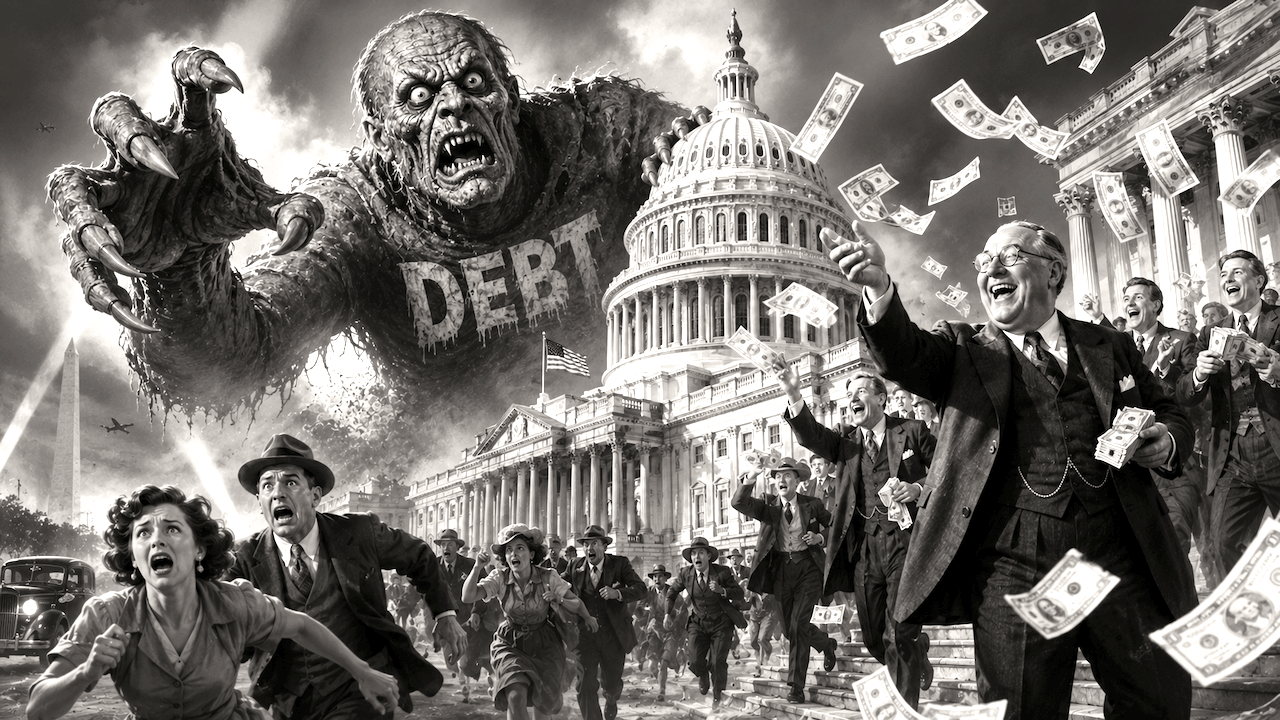
The federal government kicked off fiscal 2027 with a record October deficit.
After running the third-largest budget deficit in history in 2026, the Trump administration spent $404.06 billion more than it took in last month.
Granted, November 1 fell on a weekend, and the government pushed some November benefit spending back into October. But even accounting for calendar adjustments, the October deficit was still $285 billion, 49 percent higher than October 2025.
Net customs receipts fell by 39 percent to $19.2 billion. This helped drive government receipts down 9 percent year-on-year to $368.94 billion.
October revenue also took a hit as individual non-withheld tax receipts fell 36 percent to $51 billion year-on-year. Tax receipts swelled last October when Californians with extensions due to the 2025 wildfires filed their taxes.
While government receipts dipped last month, revenue has trended upward over the last few years. Government receipts grew by 3.2 percent in 2026. Revenue in 2025 was 6 percent higher than 2024, which was 11 percent higher than 2023.
Meanwhile, the federal government can’t stop spending money.
The Trump administration blew through $773 billion in October. That was a 12 percent increase over last October. (November 1 also fell on a weekend last year, meaning last year's October deficit also reflected November benefit spending.)
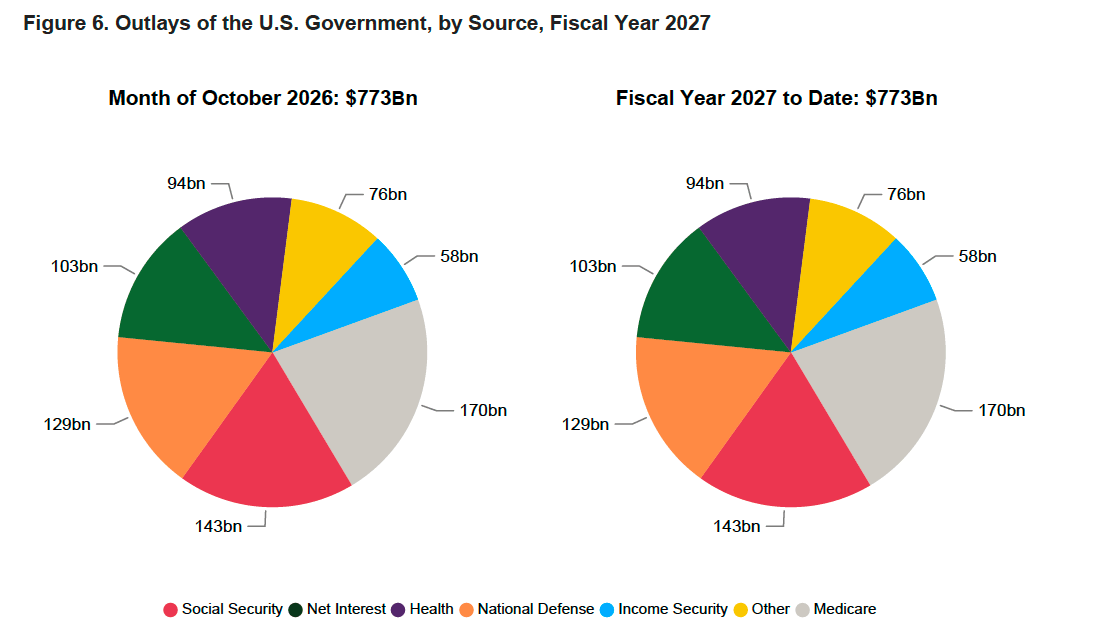
U.S. Department of Agriculture spending rose 80 percent due to $28 billion in farm relief payments. The Department of War reported a 30 percent year-on-year increase in spending.
This goes to show that the federal government always finds new ways to spend money.
And nobody seems interested in addressing the spending problem.
Despite some non-specific talk about “spending cuts,” there seems to be little to no commitment to tackle runaway spending. In fact, the powers-that-be constantly find new reasons to spend money, whether it is a crisis at home or a war overseas.
Treasury Secretary Scott Bessent set a goal to reduce the deficit to 3 percent of GDP. The 2026 budget shortfall was 6.2 percent of GDP, so he’s not off to a very good start.
As the government borrows more and more to cover the budget shortfall, the cost of servicing the ever-growing debt continues to climb in this higher-interest-rate environment.
In fiscal 2026, interest expense was the second-largest spending category in the federal budget behind only Social Security.
The Treasury forked out $115.46 billion in interest payments last month. That was an 11 percent increase from the same period last year.
Net interest (interest expense – interest receipts) was $103 billion.
In fiscal 2026, the Treasury spent $1.36 trillion in interest payments. That was an 11.5 percent increase over fiscal ‘25.
Much of the debt currently on the books was financed at very low rates before the Federal Reserve started its hiking cycle. Every month, some of that super-low-yielding paper matures and must be replaced with bonds yielding much higher rates. Meanwhile, Treasury yields are spiking as more countries spurn the dollar.
This is one reason the Federal Reserve finds itself in a Catch-22. It needs to hike rates to battle inflation, but the government can't handle even higher borrowing costs.
When people say the spending is unsustainable, it feels like an understatement. In fact, it’s fair to call the federal government insolvent.
However, very few people in the political class seem the least bit interested in tackling the problem. The bad news is that at some point, the problem will tackle them.

Comments
Log in or sign up to join the conversation.