

Headline data for truck shipments were again mixed in April - but our analysis believes trucking growth rate is modestly improving.

Analyst Opinion of Truck Transport
I tend to put heavier weight on the CASS index which again showed a moderate improvement year-over-year. The ATA data continues to wander all over the map - and is likely a result of seasonal adjustment issues and a smaller share of shipping now going to ATA members.
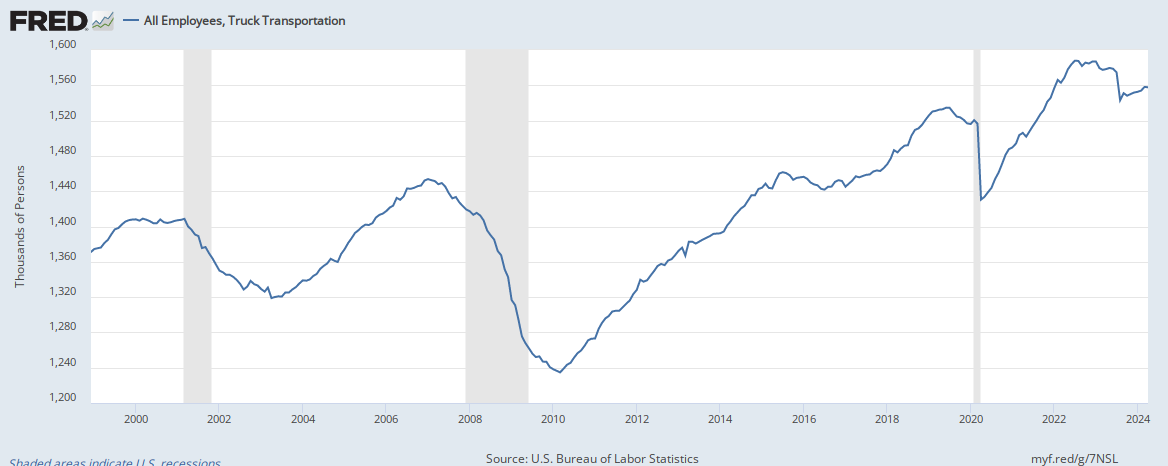
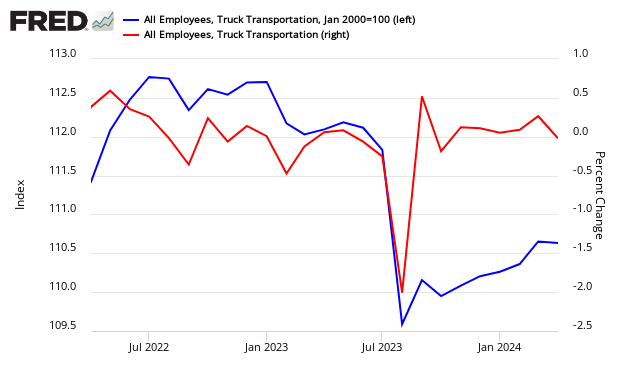
It is also interesting that the current trucking employment pattern is now showing a short-term improvement trend which supports the CASS index.
ATA Trucking
American Trucking Associations' advanced seasonally adjusted (SA) For-Hire Truck Tonnage Index slipped 2.5 % in April, following a 1.1% decline during March. Said ATA Chief Economist Bob Costello:
I have to admit that April's contraction is a bit surprising, especially considering the anecdotal reports I've been hearing from fleets regarding freight levels. It's not necessarily that tonnage levels fell in April that is surprising, but the size of the decrease. One explanation is that housing starts fell substantially in April as well, and residential construction generates heavier truck freight.
Despite the fact that tonnage is down a total of 3.6% over the last three months, I still expect moderate growth going forward as key sectors of the economy continue to improve slowly.
ATA Truck tonnage this month

z truck.jpg
Compared with April 2016, the SA index fell 1.8% year-over-year.
Econintersect tries to validate ATA truck data across data sources. It appears this month that jobs growth says the trucking industry employment levels were up month-over-month. Please note using BLS employment data in real time is risky, as their data is normally backward adjusted (sometimes significantly).
This data series is not transparent and therefore cannot be relied on. Please note that the ATA does not release an unadjusted data series (although they report the unadjusted value each month - but do not report revisions to this data) where Econintersect can make an independent evaluation. The data is apparently subject to significant backward revision. Not all trucking companies are members of the ATA, and therefore it is unknown if this data is a representative sampling of the trucking industry.
source: ATA
FTR's Trucking Conditions Index for February Moves Up in Expectation of Tightened Market
FTR's Trucking Conditions Index (TCI) for March fell back to a reading of 2.97 after an upturn in February. However, as detailed in the May issue of the Trucking Update, FTR sees the recent steady improvement in spot rates as an indication that a market-wide move to capacity tightness is on the way with a correlating upswing in the index throughout 2017 and into 2018. FTR remains confident in the freight market for 2017, as we started the year off with strong growth in Q1. Their forecast has moderated somewhat for the regulatory headwinds affecting trucking, but still expect them to have significant effect toward the end of 2017 and for most of 2018.
CASS FREIGHT INDEX REPORT
Both the Shipments and Expenditures Indexes have now been positive for four months in a row. Throughout the U.S. economy, there is a growing number of data points suggesting that the economy continues to get slightly better. Some data points are simply less bad, but an increasing number of them are better, and even a few are becoming outright strong. The 4.0% year-over-year (YoY) increase in the April Cass Shipments Index is yet another data point which suggests that the first positive indication in October may have indeed been a change in trend. In fact, it now looks as if the October Cass Shipments Index, which broke a string of 20 months in negative territory, was one of the first indications that a recovery in freight—or at least a change in trend—had begun.
The 4.0% April YoY change looks very promising, but we should point out that April 2016 was down 4.9%, and that was on top of April 2015 which was down 2.5% ,and hence serves as an easy comparison.


Comments
Log in or sign up to join the conversation.