

Business travel puts payroll teams in a tricky spot. Two separate rulebooks apply at once: the Fair Labor Standards Act (FLSA) governs how much of an employee's travel counts as compensable work time, while IRS rules decide whether the money reimbursed for that travel gets taxed as income. Mixing these two frameworks up is one of the most common — and costly — payroll mistakes.
Getting travel time pay right isn't just about calculating hours. It's about understanding when reimbursed travel expenses cross the line from a tax-free business expense into taxable wages.
Travel Time Pay vs. Travel Expense Reimbursement
Before diving into taxability, it helps to separate two concepts that often get lumped together:
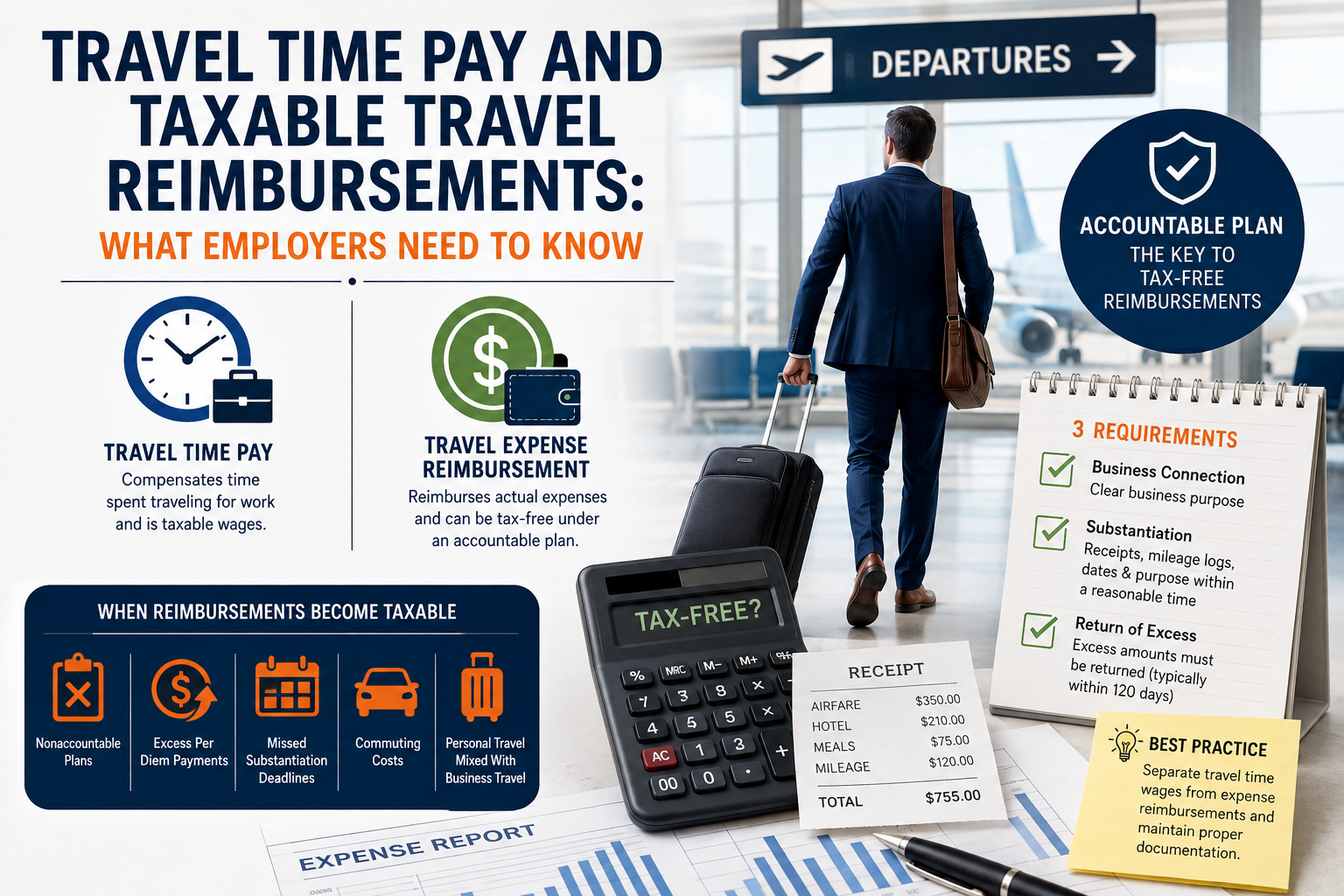
Travel time pay refers to wages owed for the hours an employee spends traveling for work — think overnight trips, same-day travel to another city, or travel between job sites during the workday. Whether this time is compensable depends on FLSA rules and whether the employee is exempt or non-exempt.
Travel expense reimbursement covers the actual out-of-pocket costs of travel — airfare, mileage, lodging, meals, and incidentals. This is where IRS accountable plan rules come into play.
Both pieces matter for compliance, but they're taxed under different logic. Travel time pay is wages, full stop, and it's subject to standard payroll tax withholding when it's compensable under wage and hour law. Travel expense reimbursements, on the other hand, can be entirely tax-free — if the employer follows the right process.
The Accountable Plan: The Key to Tax-Free Reimbursements
The IRS allows employers to reimburse travel expenses without treating the payments as taxable income, but only if the reimbursement arrangement qualifies as an "accountable plan." To meet this standard, three conditions must be satisfied:
Business connection – The expense must have a clear business purpose, such as a client visit, conference, or job-related travel.
Substantiation – The employee must provide adequate documentation (receipts, mileage logs, dates, and business purpose) within a reasonable time, generally 60 days.
Return of excess amounts – Any reimbursement that exceeds actual substantiated expenses must be returned to the employer, typically within 120 days.
When all three boxes are checked, the reimbursement is excluded from the employee's wages, isn't subject to federal income tax withholding, and doesn't count toward Social Security, Medicare, or FUTA taxes.
When Reimbursements Become Taxable
Travel reimbursements lose their tax-free status — and must be run through payroll like ordinary wages — in several common situations:
Nonaccountable plans: If an employer simply hands employees a flat travel allowance with no requirement to substantiate expenses or return unused funds, the entire amount is taxable wages, even if the employee spent it all on legitimate business costs.
Excess per diem payments: Employers often use per diem rates (such as GSA rates) instead of requiring itemized receipts. This is allowed, but if the per diem paid exceeds the federal rate for that location, the excess is taxable.
Missed substantiation deadlines: If an employee doesn't submit documentation within the required window, the reimbursement can become taxable by default, even under an otherwise accountable plan.
Commuting costs: Ordinary commuting between home and a regular worksite is never a deductible or reimbursable business expense — reimbursing it creates taxable income.
Personal travel mixed with business travel: When a trip combines business and personal purposes, only the business-related portion can be reimbursed tax-free. Costs tied to extending a trip for vacation, or bringing a spouse along, are taxable if reimbursed.
How This Intersects With Travel Time Pay
Payroll and HR teams often assume that if travel time is compensable under the FLSA, the related expense reimbursement must also be taxable — or vice versa. That's not accurate. A non-exempt employee's travel time pay is wages and is taxed accordingly, regardless of how their mileage or hotel costs are reimbursed. Meanwhile, an accountable-plan reimbursement for that same trip's actual costs can remain untaxed. Treating both categories with the same tax logic is a frequent source of W-2 errors and IRS notices.
This is also where state law can complicate things further. Some states have their own rules on what travel time must be paid, and multistate employers may face conflicting requirements when employees travel across jurisdictions.
Best Practices for Payroll Compliance
Maintain a written accountable plan policy and require timely, itemized substantiation.
Reconcile per diem payments against current federal rates before processing.
Separate travel time wages from expense reimbursements on pay statements and in payroll coding.
Train managers not to approve flat "travel stipends" without documentation, since these default to taxable.
Review multistate travel pay obligations regularly, since federal and state rules don't always align.
The Bottom Line
Whether a travel reimbursement is taxable comes down to one question: does the payment follow an accountable plan with proper substantiation and no excess retained by the employee? If yes, it stays off the W-2. If no, it's wages. Layer that on top of correctly calculating travel time pay under the FLSA, and payroll teams have a complete, audit-ready approach to one of the most misunderstood areas of compensation.
FAQs
Q1: Is travel time pay the same as a travel reimbursement?
No. Travel time pay compensates an employee's hours spent traveling and is always taxable wages. A travel reimbursement covers actual expenses like mileage or lodging and can be tax-free if paid under an accountable plan.
Q2: Are per diem payments always tax-free?
Only up to the applicable federal per diem rate for the travel location. Any amount paid above that rate is treated as taxable income and must go through payroll.
Q3: Does commuting to a regular worksite count as compensable travel?
No. Ordinary home-to-work commuting isn't compensable travel time, and reimbursing those costs creates taxable income for the employee.
Q4: What happens if an employee doesn't submit receipts on time?
Under an accountable plan, late or missing substantiation can turn an otherwise tax-free reimbursement into taxable wages, since the IRS requires documentation within a reasonable period, generally 60 days.
Comments
Log in or sign up to join the conversation.