
The traditional one-size-fits-all model of education is rapidly fading into the background. For decades, classrooms—both physical and digital—have operated on a standardized schedule and pace, often leaving struggling students behind while failing to challenge advanced learners. Today, artificial intelligence is tearing down those rigid boundaries.
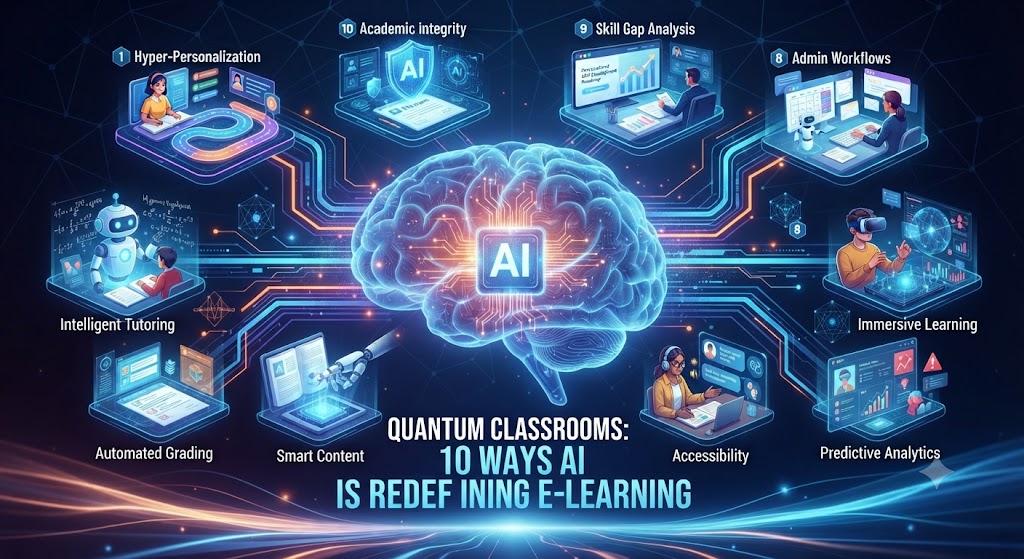
By integrating intelligent algorithms, machine learning, and natural language processing, e-learning platforms are no longer just static digital textbooks. They are evolving into dynamic, responsive, and deeply intuitive learning environments.
If you want to understand how the future of education is being written right now, here are 10 ways AI is completely transforming e-learning.
1. Hyper-Personalized Learning Paths
Every student absorbs information differently, yet traditional courses force everyone down the exact same path. AI analyzes a learner's strengths, weaknesses, pace, and engagement levels in real-time. If a student breezes through algebra but stumbles on fractions, the AI automatically adjusts the curriculum, slowing down to provide extra practice or serving up advanced material to keep things challenging.
2. Intelligent Tutoring Systems Available 24/7
Imagine having a patient, highly knowledgeable personal tutor sitting next to you around the clock. AI-powered tutoring bots can answer complex questions, explain difficult concepts in simpler terms, and guide students through problem-solving steps without making them wait for office hours or instructor email replies.
3. Automated Grading and Instant Feedback
Waiting weeks for an exam to be graded kills momentum. AI can now instantly evaluate not just multiple-choice tests, but complex essays, short answers, and even basic coding assignments. This gives students immediate feedback, allowing them to correct misunderstandings while the material is still fresh in their minds.
4. Smart Content Creation and Digital Textbooks
Creating educational content used to take months of manual research and drafting. Educators now leverage AI tools to generate customized quizzes, summarize dense academic papers, translate text into dozens of languages, and transform standard text into interactive modules or flashcards in seconds.
5. Enhanced Accessibility for All Learners
Inclusion is a massive win for AI in education. Advanced machine learning models power real-time speech-to-text transcription for deaf students, instant language translation for international learners, and text-to-speech tools for the visually impaired. Furthermore, AI can adapt visual layouts and reading levels for students with neurodivergent needs like dyslexia.
6. Predictive Analytics for Student Success
Schools and online platforms no longer have to wait until final exams to realize a student is failing. AI-driven predictive analytics track metrics like login frequencies, assignment submission patterns, and quiz scores to flag students who are at risk of dropping out or falling behind. This allows educators to step in with early interventions before it's too late.
7. Immersive Learning with AI and VR/AR
When combined with Virtual and Augmented Reality, AI creates hyper-realistic simulations. Medical students can practice complex surgeries on virtual patients whose responses adapt in real-time to the student's actions, and engineering students can troubleshoot virtual machinery, all powered by adaptive AI logic.
8. Streamlined Administrative Workflows
Teachers spend an astonishing amount of time on non-teaching tasks like scheduling, attendance tracking, responding to routine student queries, and compiling reports. AI automates these tedious administrative burdens, freeing up educators to focus on what they do best: mentoring, teaching, and human connection.
9. Dynamic Skill Gap Analysis for Corporate Training
In the corporate world, e-learning is vital for upskilling employees. AI scans an employee's current skill set, evaluates the company’s future goals, and automatically designs a targeted micro-learning roadmap. This ensures workers stay ahead of industry shifts without sitting through redundant training sessions.
10. Intelligent Proctoring and Academic Integrity
As online education expands, ensuring fairness in testing is critical. AI-powered proctoring tools monitor exams by analyzing behavioral cues—such as unusual eye movements, background audio, or typing patterns—to flag potential cheating. This maintains the credibility of digital certifications and degrees.
The Human Element in an AI-Driven Classroom
Artificial intelligence is not here to replace teachers; it is here to replace the friction in education. By automating the repetitive, data-heavy aspects of teaching, AI empowers educators to focus on empathy, critical thinking, and inspiration.
The revolution is already underway. Whether you are a student looking for a smarter way to study, an educator modernizing your curriculum, or a professional upskilling for the future, embracing AI in e-learning is the key to unlocking true human potential.
Comments
Log in or sign up to join the conversation.