

Today, we want to focus on a bullish seasonal pattern in Silver. Fundamentally, as market participants expect the Fed to keep on flooding markets with liquidity in order to avoid a funding crisis (particularly in the repo market), the general outlook for Silver stays positive. The Fed Watch Tool now also indicates expectations that of rate cuts by 50 basis points by December 2020 with a likelihood of nearly 50%, despite the latest Fed dot plot showing no interest-rate changes for 2020. With that in mind, the seasonal bullish window in Silver comes on February 5 and runs through February 21, and has developed over the last 16 years. It puts the advantage in the precious metal on the long side, and delivers a potential trading setup.
Seasonal Pattern in Silver
The key parameter of this seasonal bullish pattern is as follows: between February 5 - 21, Silver saw an average gain of 1.17 USD for 12 of the past 16 years. In the remaining four years, it dropped on average only 0.53 USD, while the maximum loss and the maximum drawdown were 0.96 USD.
Trade the Seasonal Pattern: Silver
And now the key question: how could we trade this? Here's the plan:
- After identifying the profitable seasonal window, we buy Silver on the closing price of the starting date on February 05 (22:59 CET).
- We identify the maximum loss within the seasonal period. Then, have a look at the daily chart and the ATR(14) indicator.
- If the maximum loss is above the ATR(14) reading, round it up to the next round number and use it as worst-case-stop.
- If the maximum loss is below the ATR(14) reading, use the ATR(14) as your stop-width (rounded up to the next round number).
- We Look at the average gain of the seasonal pattern, and place the take profit at this distance from your entry point.
- If the trade is not stopped out or it does not reach its take profit within the seasonal period, end the trade market on the closing price on February 21.
Looking at current market data, since the ATR(14) in Silver on a daily time frame is currently trading around 0.31 USD, while the maximum loss of the window was 0.96 USD, our worst-case stop will be placed based on a maximum loss 0.90 USD away from our entry price.
Meanwhile, the average gain of the seasonal pattern is 1.16 USD within this period. So, after entering the trade on the closing price of February 5, we would add 1.20 USD to get our take profit level.
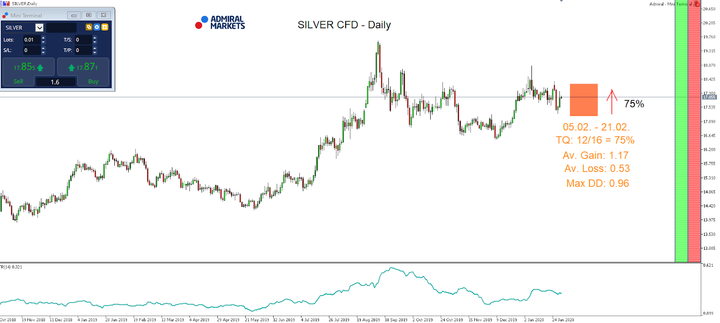
Source: Admiral Markets MT5 with MT5-SE Add-on Silver Daily chart (between October 26, 2018, to January 31, 2020). Accessed: January 31, 2020, at 12:00 GMT - Please note: Past performance is not a reliable indicator of future results, or future performance. In 2015, the value of Silver fell by 12.8%, in 2016, it increased by 13.0%, in 2017, it increased by 6.4%, in 2018, it fell by 10.0%, in 2019 it increased by 12.6%, meaning that after five years, it was up by 4.9%.

Comments
Log in or sign up to join the conversation.