


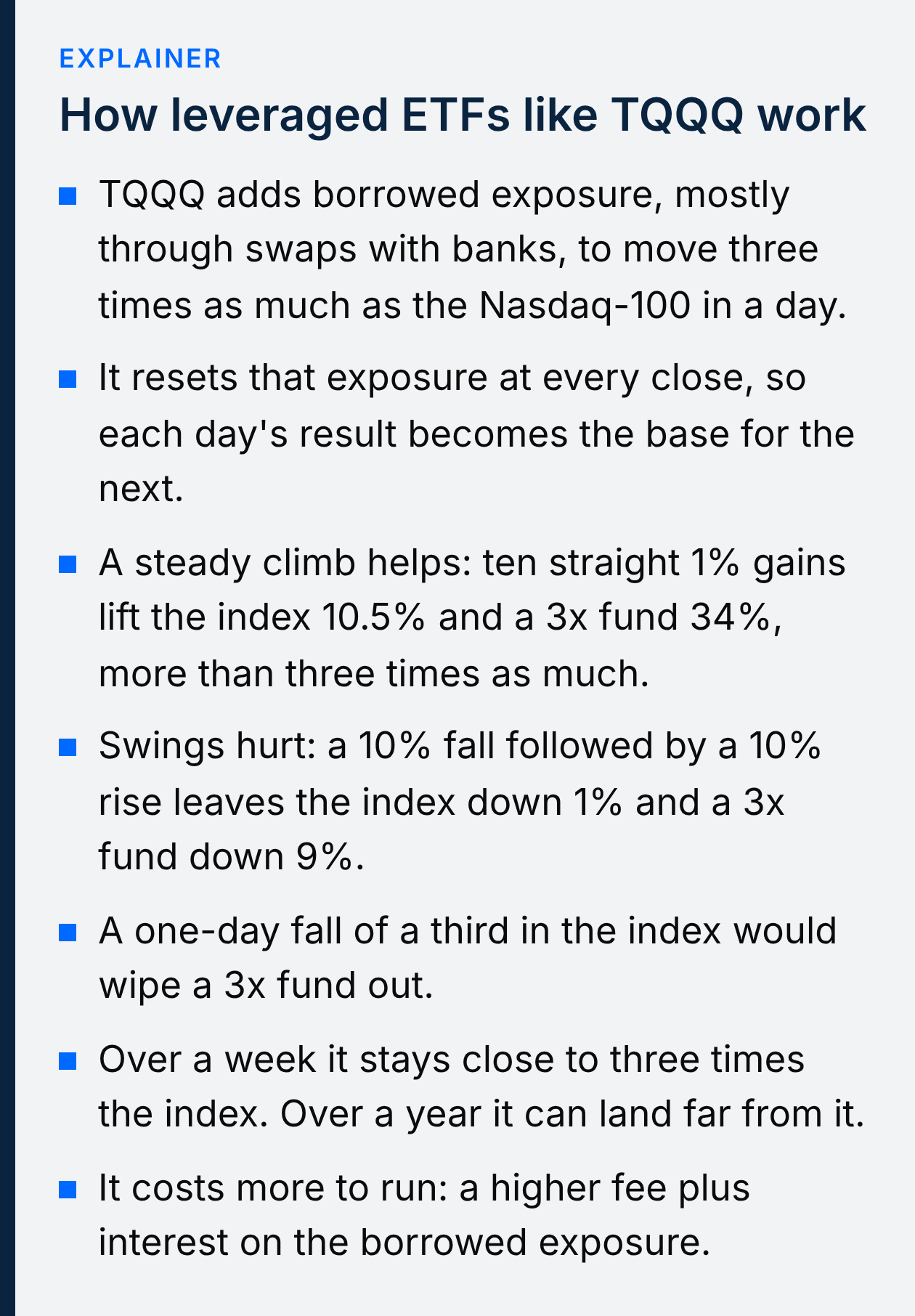
ProShares is upfront about what its UltraPro QQQ (NASDAQ: TQQQ), the biggest leveraged Nasdaq ETF, does. It aims for three times the Nasdaq-100’s return for a single day, before fees and expenses. Over any longer stretch, its own fund page warns, “your return may be higher or lower than the Daily Target.”
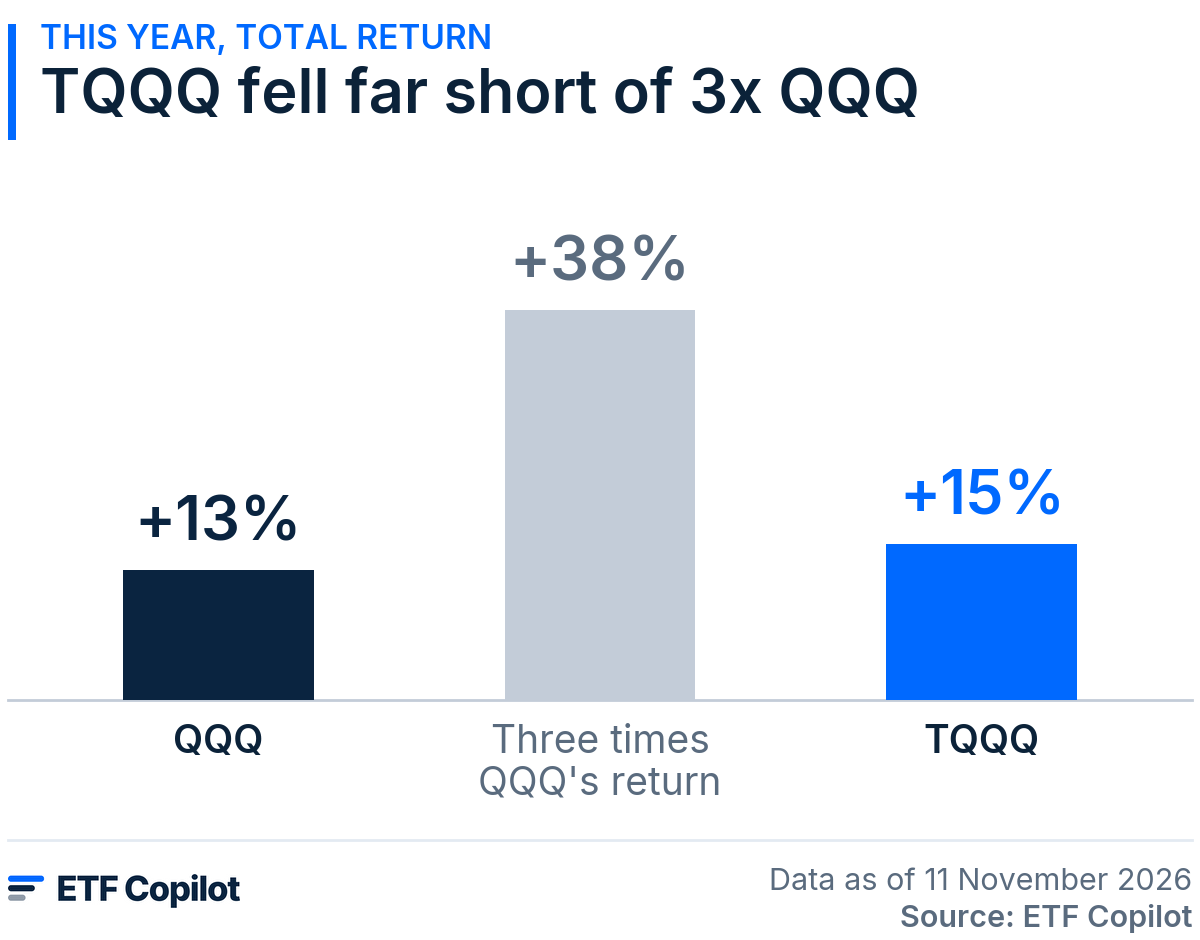
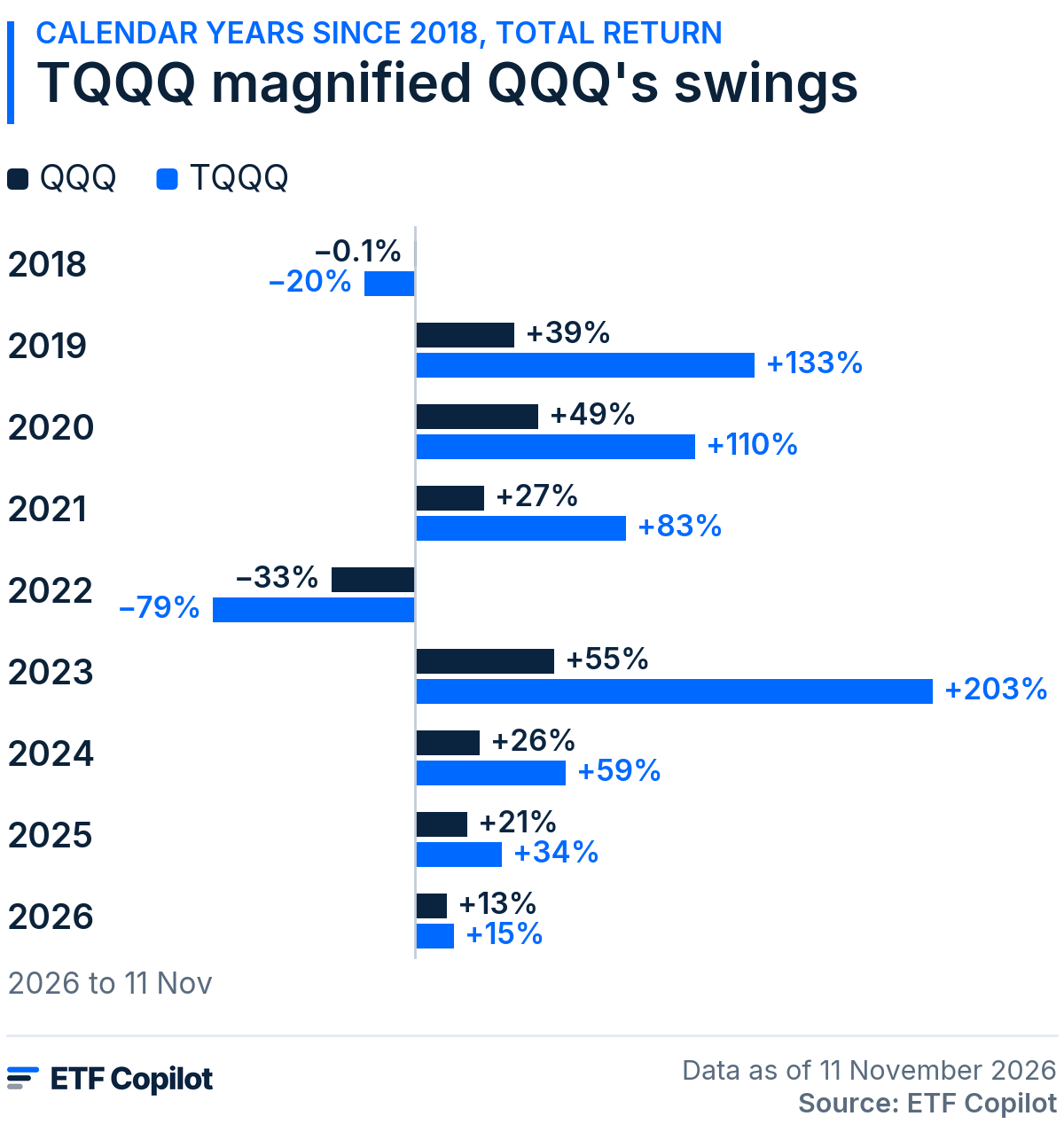
This year shows how far apart the two can drift. According to our calculations, the Invesco QQQ Trust (NASDAQ: QQQ), which tracks the Nasdaq-100, has returned approximately 13% this year to the 11 November close, dividends included. Our comparison puts three times QQQ’s return at approximately 38% and TQQQ’s return at 15%, only a little ahead of QQQ. QQQ is used here as a comparison; TQQQ’s daily target is tied to the Nasdaq-100 itself.
A choppy year worked against it
2026 has swung hard, and the swings did much of the damage in our comparison. By 30 March, QQQ was down 9% for the year and TQQQ 28%. The spring rally then carried TQQQ to a record on 2 June, up 66% on the year. QQQ kept climbing until its own record on 6 October, and TQQQ never got back to its June high.
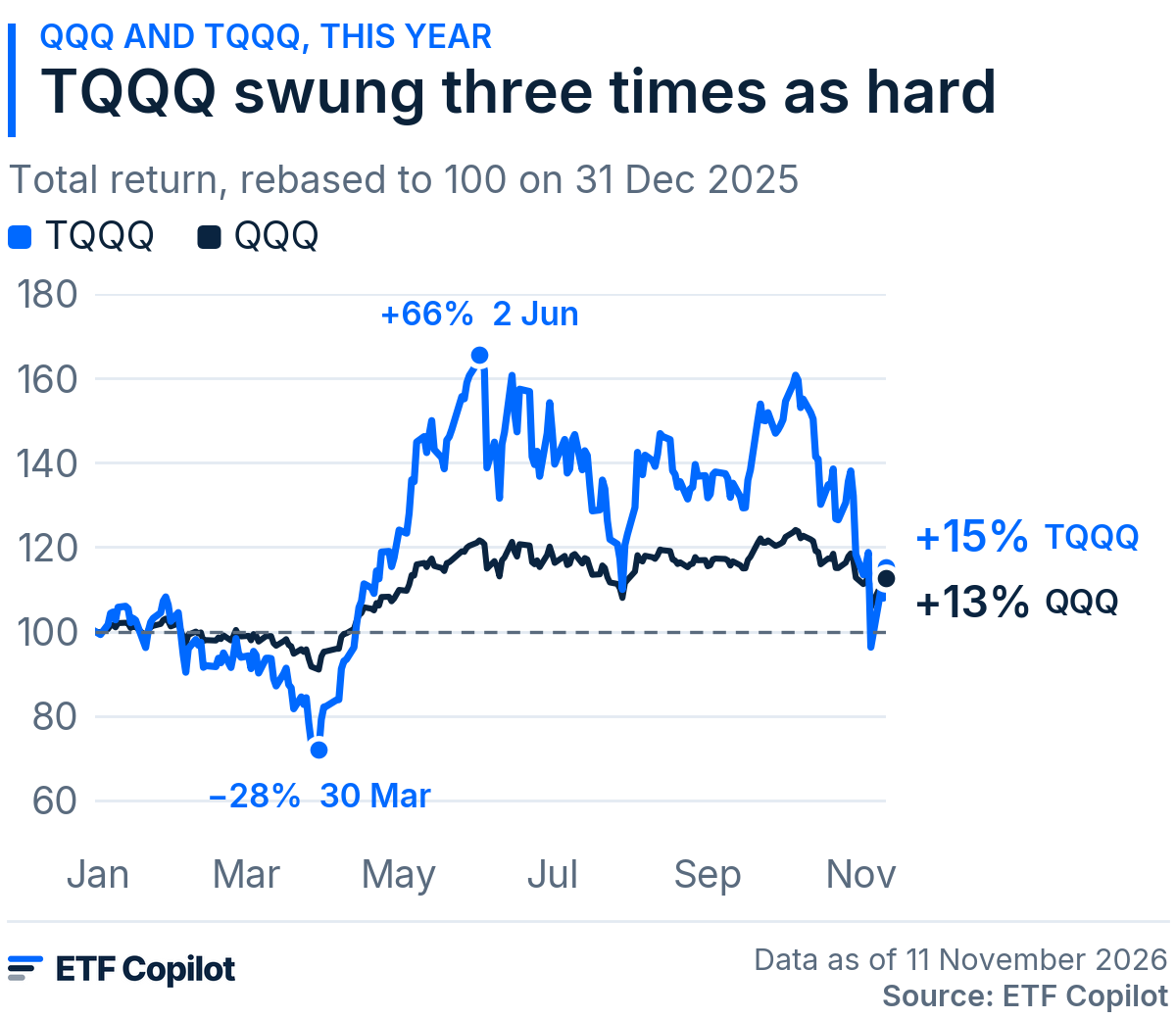
Then came the slide. On 5 November, the AI trade sold off after the midterms. TQQQ fell 19% that day, its worst day since March 2020. Since 6 October, it has lost 28%, about three times QQQ’s drop.
By our calculations, a hypothetical portfolio that tripled QQQ’s return every single day this year, with no additional fees or financing costs, would be up about 26%. The effect of daily compounding accounts for approximately 12 percentage points of the gap from three times QQQ’s cumulative return.
Then the costs
TQQQ’s gross expense ratio is 0.94%, against QQQ’s 0.18%. The fee is the smaller part of the bill. To move three times as much as its own assets, TQQQ in effect borrows twice its assets through its swaps, and pays short-term interest on that money.
With short-term rates near 4%, financing costs can dwarf the management fee. By our measure, estimated annualized drag from fees, financing and other tracking differences is about 10% in 2026, against about 2% in 2021, when rates sat near zero.
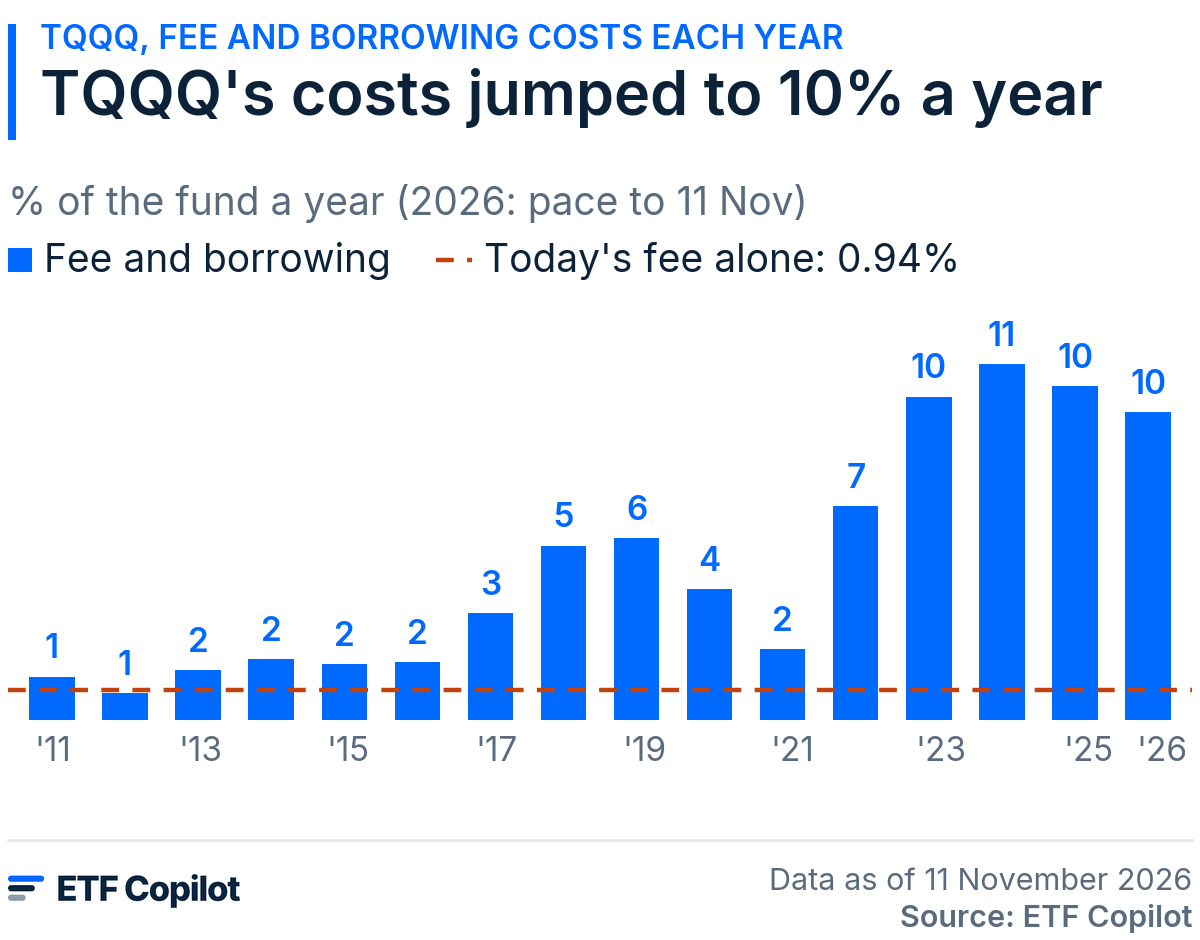
These costs reduce returns. This year, our hypothetical daily-leveraged portfolio and TQQQ differ by roughly 11 percentage points, using the rounded returns above. Financing costs, fund expenses and other tracking differences help explain that remaining gap. In 2024, our hypothetical portfolio tripling QQQ’s daily returns would have returned about 80%, while TQQQ returned 59%.
Great in steady years, harsh in flat ones
The same reset that hurt this year pays off when the Nasdaq climbs in a fairly straight line. In 2023, QQQ returned 55% and TQQQ 203%, more than three times as much. 2019 went the same way.
A flat or falling year can run the other way. In 2018, QQQ ended about where it started and TQQQ lost 20%. In 2022, QQQ lost 33% and TQQQ 79%.
Can you hold it for a few months?
How long you hold TQQQ changes what you get. In our analysis of periods since 2010, over a week it landed within 2 percentage points of three times QQQ’s return 99% of the time. Over a year, only 9% of the time.
A common plan is to buy TQQQ, hold it for a few months and sell after a strong run. We looked at every six-month stretch since 2010. TQQQ beat QQQ in about seven out of ten of them. The ones it lost followed a pattern.
When QQQ ended a six-month stretch within 5% of where it started, TQQQ lost money three times out of four. A sideways market can be enough to shrink it. Even when QQQ rose, TQQQ trailed it 13% of the time in our analysis.
Crashes can arrive inside the window too. TQQQ fell 70% in a month in early 2020 and was back to its high by July. The 2022 bear market went differently: TQQQ lost 82% from November 2021, and holders waited until July 2024 to get back to even.
Buyers kept coming
None of this has cooled demand. According to our data, investors put $4.3 billion into TQQQ in the month to 10 November, about a tenth of its assets. More than half of it, $2.3 billion, arrived in the week of the 5 November drop.
TQQQ targets three times the Nasdaq-100’s daily return before fees and expenses. Over longer periods, even weeks, compounding can cause its return to differ from three times the index’s cumulative move. Held for months or years, it turns into a bet on the path. A steady climb can reward it richly. A choppy or sideways market can leave it with a loss even as QQQ edges higher, and its costs keep running either way. That is why ProShares sets its target one day at a time and suggests holders consider monitoring their positions periodically.
TQQQ pays for a straight line and charges for every zigzag.
Comments
Log in or sign up to join the conversation.