
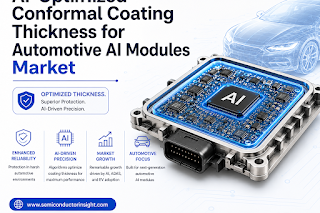
AI‑Optimized Conformal Coating Thickness for Automotive AI Modules Market is positioned on a trajectory of remarkable growth, as detailed in a comprehensive new report published by Semiconductor Insight. The study highlights the critical role of ultra‑thin, AI‑tuned polymer films in ensuring precision and efficiency within advanced automotive electronics, particularly for high‑density AI modules that power driver‑assist and autonomous systems.
Conformal coatings, essential for protecting and insulating electronic components in automotive modules, are becoming indispensable in minimizing downtime and optimizing operational efficiency. Their precision deposition allows for rapid servicing of critical components such as sensors, processors, and power electronics, making them a cornerstone of modern automotive manufacturing.
Download FREE Sample Report:
AI‑Optimized Conformal Coating Thickness for Automotive AI Modules Market - View in Detailed Research Report
Competitive Landscape: Key Industry Players
List of Key AI‑Optimized Conformal Coating Thickness for Automotive AI Modules Companies Profiled
Henkel
Henkel AG & Co. KGaA
BASF
BASF AG
Dow
Dow Inc.
3M
Covestro
Shin‑Etsu Chemical
Nippon Shokubai
Electrolube
HEXPOL
Sika
NanoCoat Technologies
QuantumFilm Labs
Master Bond
Segment Analysis:
The report provides a detailed segmentation analysis, offering a clear view of the market structure and key growth segments:
Segment Analysis:
By Type
Thermal‑Optimized Coatings
Dielectric‑Strength Focused Coatings
By Application
ADAS Sensor Modules
Autonomous Driving Compute Units
Vehicle‑to‑Everything (V2X) Communication
Others
By End User
OEMs for Premium Vehicles
Tier‑1 Suppliers
Aftermarket Retrofit Providers
By Coating Technology
Nano‑Particle Enhanced Polyurethanes
Siloxane‑Based Ultra‑Thin Layers
Hybrid Organic‑Inorganic Composites
By Vehicle Architecture
Electric Powertrain Platforms
Hybrid Powertrain Platforms
Traditional Internal Combustion Platforms
Key Insights within Each Segment
Thermal‑Optimized Coatings
Prioritize heat dissipation to sustain high‑performance compute in confined automotive spaces.
Leverage AI‑driven formulation adjustments that balance viscosity and cure speed for thin yet robust layers.
Enhance overall vehicle reliability by reducing thermal stress on electronic components.
ADAS Sensor Modules
Require ultra‑thin protection to maintain sensor signal integrity while withstanding vibration.
AI‑tuned thickness ensures minimal signal attenuation and consistent environmental shielding.
Supports rapid iteration cycles in smart‑manufacturing environments.
OEMs for Premium Vehicles
Emphasize cutting‑edge reliability standards that demand AI‑optimized coating precision.
Integrate coating development directly into vehicle platform design cycles.
Leverage partnerships with coating innovators to uphold brand reputation for safety.
Nano‑Particle Enhanced Polyurethanes
Offer superior dielectric performance while remaining lightweight.
AI feedback loops refine nanoparticle distribution for uniform protection.
Facilitate seamless integration with existing automotive coating lines.
Electric Powertrain Platforms
Demand rigorous thermal management due to high‑current drive electronics.
AI‑controlled coating thickness helps maintain battery safety envelopes.
Supports the push toward lighter vehicle architectures without compromising protection.
Regional Analysis: AI‑Optimized Conformal Coating Thickness for Automotive AI Modules Market
Europe
Europe continues to lead the adoption of AI‑Optimized Conformal Coating Thickness for Automotive AI Modules, driven by stringent emissions legislation and a mature automotive supply chain. OEMs such as Volkswagen, BMW, and Stellantis are integrating AI‑driven coating processes to improve module reliability while reducing material waste. The region benefits from strong R&D ecosystems in Germany, France, and the UK, where collaborations between semiconductor manufacturers and coating specialists accelerate innovation cycles. Customer demand for higher‑performance autonomous driving systems pushes suppliers to fine‑tune coating thickness at the micron level, ensuring thermal stability and electrical insulation. Moreover, the European Union’s focus on circular economy principles encourages the use of predictive AI models to optimize coating applications, minimizing rework and extending component lifespans. As manufacturers shift toward low‑volume, high‑mix production, the need for flexible, AI‑enabled coating solutions becomes a competitive differentiator, reinforcing Europe’s position as the market’s technological benchmark. This dynamic environment fuels continuous investment in digital twins and machine‑learning algorithms that predict optimal coating parameters under varying production scenarios, solidifying the region’s leadership in the coming decade.
Regulatory Landscape
The EU’s REACH and ELV directives compel manufacturers to adopt environmentally responsible coating processes. AI‑driven thickness control aligns with these policies by reducing excess material and ensuring compliance, while also supporting the bloc’s goal of zero‑defect automotive components.
Key Automotive OEMs
Leading OEMs are piloting AI‑optimized coating platforms to shorten time‑to‑market for advanced driver‑assist systems. Partnerships with coating specialists enable rapid iteration, delivering modules that meet stringent thermal‑management requirements.
Supply Chain Innovation
The region’s dense supplier network facilitates real‑time data sharing, allowing AI models to adjust coating parameters on the fly. This collaborative ecosystem reduces lead times and enhances overall product quality.
Market Growth Drivers
Consumer demand for higher‑performance autonomous vehicles and stricter safety standards push manufacturers toward AI‑optimised solutions, creating a robust pipeline of investments in coating technology across the continent.
North America
North America exhibits strong interest in AI‑Optimized Conformal Coating Thickness for Automotive AI Modules, particularly among Tier‑1 suppliers serving the U.S. and Canadian markets. The emphasis on electric‑vehicle adoption and advanced driver‑assist systems fuels demand for precise coating processes that ensure reliability under harsh operating conditions. Industry players are leveraging cloud‑based AI platforms to synchronize coating parameters with real‑time sensor data, improving yield and reducing warranty costs. While regulatory pressure is less stringent than in Europe, market dynamics are shaped by fast‑track innovation cycles and substantial capital investment in automation. The region’s focus on scalability and cost efficiency positions it as a significant growth engine for the technology.
Asia‑Pacific
Asia‑Pacific’s automotive manufacturing scale provides a fertile ground for AI‑driven coating technologies. Nations such as China, Japan, and South Korea are accelerating the integration of AI‑optimized thickness control to support high‑volume production of AI‑enabled modules. The competitive landscape encourages rapid adoption of machine‑learning tools that predict optimal coating deposition, thereby minimizing material usage and enhancing thermal performance. Government incentives for smart manufacturing and the rise of connected vehicle initiatives further amplify market momentum. Although the region faces variability in quality standards, the sheer volume of production offsets these challenges, making it a pivotal market for future expansion.
South America
South America’s automotive sector, while smaller, is increasingly exploring AI‑based coating solutions to improve the durability of modules in diverse climatic conditions. Brazil and Argentina lead regional efforts by collaborating with global coating firms to pilot AI‑enhanced thickness monitoring. The focus is on extending component lifespan in high‑temperature and humidity environments, where traditional coating methods often underperform. Market growth is moderated by economic fluctuations, yet emerging partnerships and localized R&D initiatives signal a steady trajectory toward broader adoption of intelligent coating technologies.
Middle East & Africa
In the Middle East and Africa, the market remains nascent but shows promising signs as automotive manufacturers target rugged operating environments. AI‑Optimized Conformal Coating Thickness for Automotive AI Modules offers a strategic advantage by delivering consistent protection against dust, heat, and corrosion. Pilot projects in the United Arab Emirates and South Africa demonstrate the technology’s potential to enhance reliability in both luxury and off‑road vehicles. While investment levels are currently modest, increasing focus on smart manufacturing and regional automotive hubs suggest a gradual but meaningful uptake in the coming years.
Get Full Report Here:
https://semiconductorinsight.com/report/ai-optimized-conformal-coating-thickness-for-automotive-ai-modules-market/
Click Here to Explore More-
https://semiconductorinsight.com/report/gallium-oxide-substrates-market/
https://semiconductorinsight.com/report/microdisplay-plane-market/
https://semiconductorinsight.com/report/global-silicon-based-capacitor-market/
https://semiconductorinsight.com/report/black-light-vision-chip-market/
https://semiconductorinsight.com/report/fpc-market/
About Semiconductor Insight
Semiconductor Insight is a leading provider of market intelligence and strategic consulting for the global semiconductor and high-technology industries. Our in‑depth reports and analysis offer actionable insights to help businesses navigate complex market dynamics, identify growth opportunities, and make informed decisions. We are committed to delivering high‑quality, data‑driven research to our clients worldwide.
🌐 Website: https://semiconductorinsight.com/
📞 International: +91 8087 99 2013
🔗 LinkedIn: Follow Us
Comments
Log in or sign up to join the conversation.