

Soup season has arrived! With fall now in full swing, complete with leaves changing color and cooler temperatures, Americans are increasingly turning to warmer foods as the warmth of summer fades. Foods like Campbell's Tomato Soup, which is second only to Campbell's Chicken Noodle Soup in its annual number of sales.
It's no wonder because the iconic Number 1-size can of Campbell's condensed Tomato Soup been one of the Campbell company's most popular products since it first rolled out to grocery stores in January 1898. It ranked as the company's most popular soup until Chicken Noodle was introduced in 1934.
But in October 2026, Americans may be buying less of Campbell's Tomato Soup because its price has spiked upward, reversing a year-long trend toward lower prices.
Here are the prices we observed for a 10.75 ounce can of Campbell's Condensed Tomato Soup at ten major national and regional grocery-selling retailers, along with howe they've changed since our Summer 2026 snapshot:
Walmart: Increase of $0.53 to $1.53 (+53.0%).
Amazon: Increase of $0.50 to $1.50 (+50.0%).
Kroger: Increase of $0.50 to $1.50 (+50.0%).
Walgreens: Unchanged at $1.99 (0.0%).
Target: Increase of $0.30 to $1.59 (+23.3%).
CVS: Unchanged at $2.49 (0.0%).
Albertsons: Increase of $0.01 to $1.50 (+0.7%).
Ingles: Initial price at $1.39 (0.0%).
H-E-B: Increase of $0.04 to $1.28 (+3.2%).
Meijer: Increase of $0.20 to $1.49 (+15.5%).
We've replaced Food Lion with Ingles in our sampling of prices since Food Lion's web site was experiencing technical problems when we sampled them.
Five of the retailers have really cranked up their shelf prices for Campbell's condensed tomato soup, with Walmart, Amazon, and Kroger raising their prices by 50-53%. Target boosted the price it charges its customers by over 23%, and Meijer increased its price by over 15%. The remaining retailers either held prices steady or increased them by a small, single digit percentage.
Our trailing twelve month average of the price for a single can of Campbell's Tomato Soup bottomed at $1.10 per can in August-September 2026, before increasing to $1.15 per can in October 2026 with the month's price hikes.
The following chart presents the price history of Campbell's Condensed Tomato Soup in the 21st century, from January 2000 through September 2026:
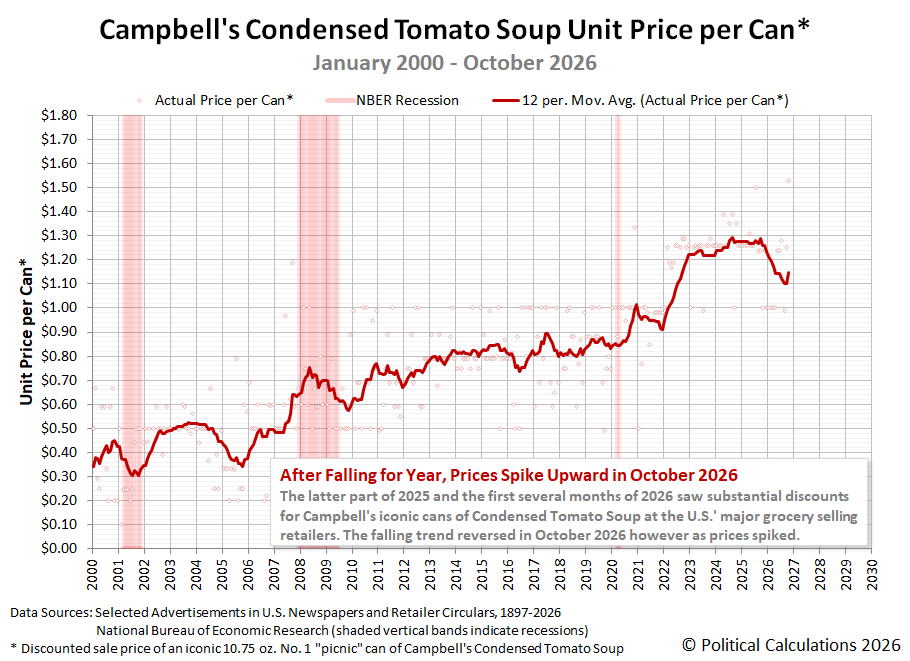
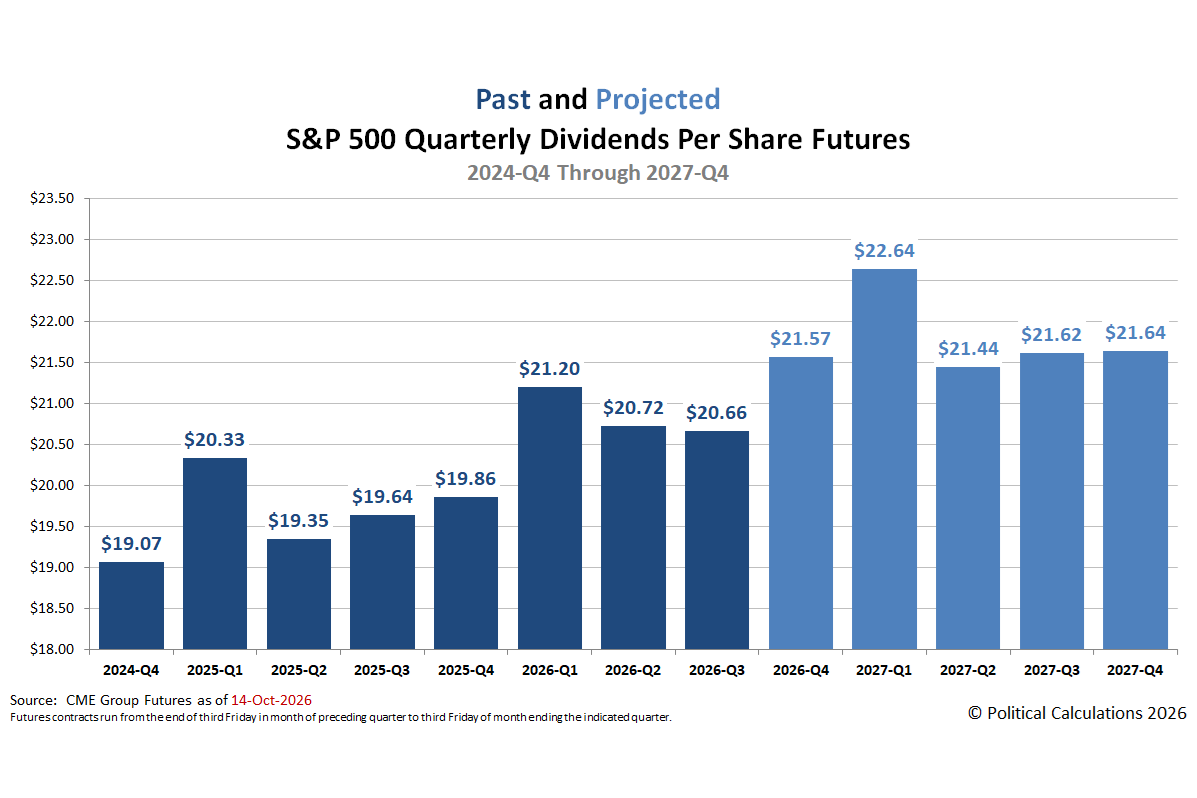
Prices have risen for Campbell's Tomato Soup because the costs of the things it takes to make and distribute it to grocery stores around the nation have increased in recent months. Those higher costs have put additional strain on the business of The Campbell's Company (NYSE: CPB) at a time when it is still carrying an unusually high debt load because of its acquisition of Rao's. In September 2026, the Campbell's Company acted to compensate for its increased costs and its high debt burden by cutting its costs, which includes slashing its dividend. Campbell's is also increasing prices as part of its turnaround strategy, which is why the prices of many of its products rose sharply in October 2026.
The company's business situation is such that we think it's unlikely we'll see prices return to the $1.00 per can level, which had become the floor for consumers to buy an iconic can Campbell's Tomato Soup since 2022. Since 2022, we would still periodically see discounts lowering its price to the $1.00 per can level, but given the company's change in its pricing strategy, we think that floor will rise to around $1.25-$1.30 per can in the next year.
It's a far cry from the 12 cents a can price consumers could buy the identical size can of Campbell's condensed tomato soup a century ago. Speaking of which, for more history, you can find our collected price data extending back to January 1898 here.
Comments
Log in or sign up to join the conversation.