


TMX Group reported its third quarter on October 30th. Revenue up 17%. Adjusted earnings per share up 21%. The dividend paid this quarter is 18% higher than a year ago.
Most investors still think of TMX as the company that runs the Toronto Stock Exchange. That is true, and it is now a small part of the business.
TMX is a lot more than a stock exchange. It is a growth story.
Here is the full breakdown on video if you would rather watch it than read it.
Video Length: 00:11:12
What Does TMX Group Actually Do?
TMX gets paid four ways. Global Insights (data, indices and analytics) brings in 44.5% of revenue. Derivatives trading and clearing brings 24%, capital formation 16%, and stock and bond trading 15%.
Global Insights is the big driver. It sells financial data, market analytics and indices. Revenue in that segment grew 26% this quarter, the fastest of the four. A big piece of it is TMX VettaFi, a US platform that supplies data, analytics and indices to ETF providers.
Derivatives trading and clearing is the options and futures traded on the Montreal Exchange. We don’t talk about it often. It grew 13%.
Capital formation is the listings business: IPOs and new companies coming to market. It grew 12%.
Equities and fixed income trading and clearing is the stocks and bonds trading on the TSX. It grew 8%, mostly driven by CDRs. If you think CDRs are amazing, they are certainly amazing for TMX.
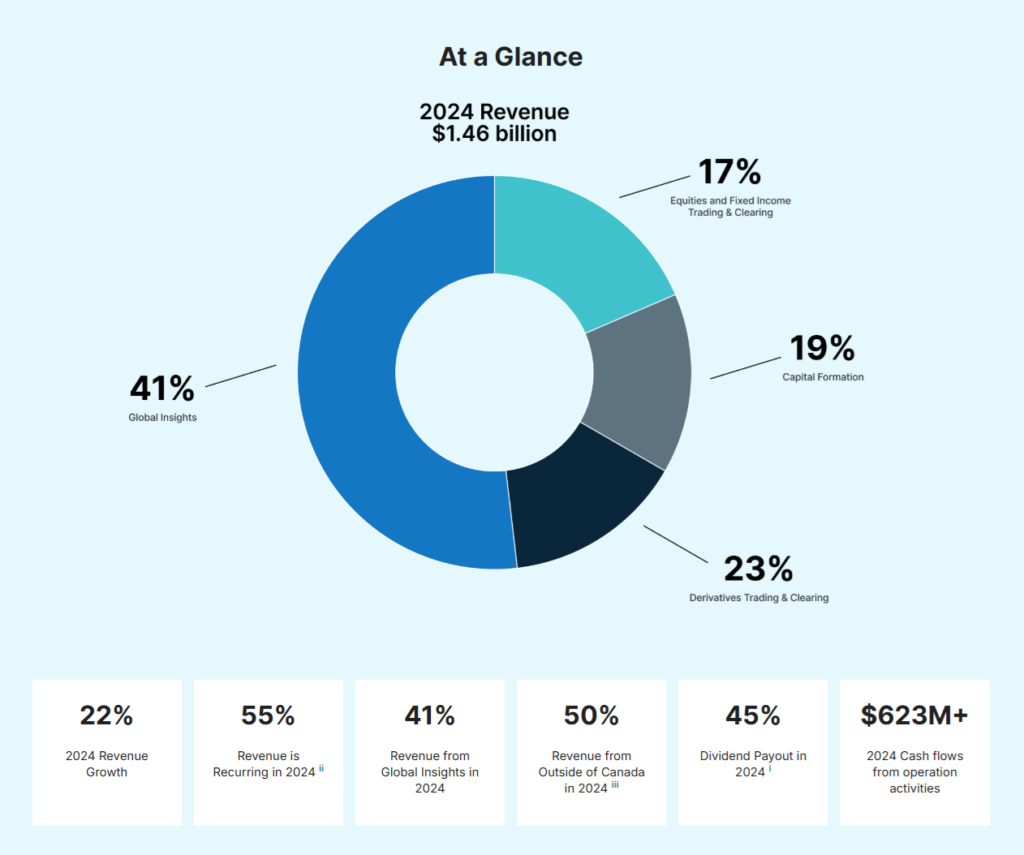
TMX Group 2024 revenue at a glance. Source: Investors relations website
How Did TMX Do in Q3 2026?
All three sides of the dividend triangle moved up. Revenue grew 17%, with 11% organic growth. Adjusted EPS rose 21%. The dividend is up 18% from the same quarter last year.
The number I like most is the 11% organic growth. Strip out the acquisitions and TMX still grew revenue by double digits. I love when a company can grow both ways, through acquisitions and on its own. It shows strong demand for its products.
Earnings need one explanation. GAAP EPS came in at $0.38, down 12% from last year. Most of that came from acquisition deal costs and losses on foreign exchange hedges. Not the end of the world. Stick with the adjusted EPS, up 21%, and you keep smiling.
The dividend did not move this quarter. It did not need to. TMX raised it twice in 2026 already, by 9% and then 8%. A year ago the quarterly dividend was $0.22 per share. The first raise took it to $0.24, the second to $0.26.
Is it covered? This one is easy. TMX is a low-yield, high-growth stock. The payout ratio sits at 41%, and operating cash flow rose 29% from last year to $202 million. You don’t have to worry much.
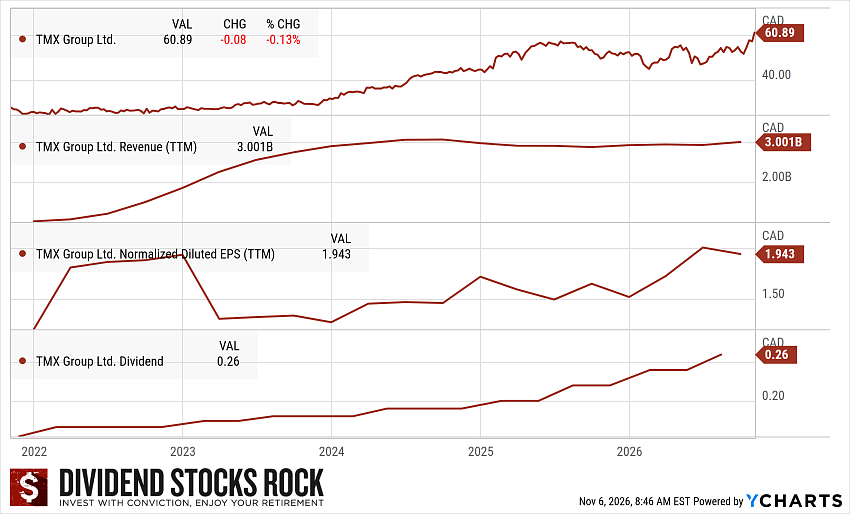
TMX Group (X.TO) 5-year Dividend Triangle Chart
Where Is the Growth Coming From?
Data and analytics. Inside Global Insights, TMX Datalinx grew 31% and TMX VettaFi grew 46%.
TMX Datalinx is the group’s long-standing real-time market data service. There are several growth engines inside that one segment. Again, it is a mix of recent acquisitions and organic growth.
TMX closed two major acquisitions during the quarter. The first is Cboe Australia, now TMX Australia Exchange, a regulated alternative stock market that gives TMX a direct presence in Asia Pacific. The second is RAFI Indices, a pioneer of indices weighted by company fundamentals instead of market cap. It joins TMX VettaFi and expands its exposure to the US market.
If you wonder what VettaFi does, it gives ETF providers the information they need. TMX is not creating its own ETFs to battle the Vanguards and BlackRocks of this world. It supplies the support and infrastructure instead, and every ETF provider relies on those services.
Another deal should close in 2027, probably in the second half. TMX plans to bring MEMX and BOX together, with a target of about 10% of the options cleared in the US. It is another major step and another ambitious part of the growth by acquisition strategy. It will be important to follow.
The ecosystem looks like this. The stock exchange is why TMX exists. Clearing sits next to it, because every transaction has to be cleared. The two major growth vectors are market data (TMX Datalinx, TMX VettaFi, and TMX Trayport, the platform energy and commodity traders use worldwide) and indices and solutions (TMX VettaFi and RAFI Indices).
What Is the Cost of This Growth?
Expenses and debt. Operating expenses rose 35% while revenue rose 17%. Total debt stands near $2.76 billion after the recent acquisitions and refinancing.
The growth isn’t free. Operating expenses rising twice as fast as revenue is not what you want to see.
The weighted average cost of debt is still reasonable at 4.29%. Going forward, I want revenue to grow faster than expenses, not the other way around. And I want debt to come down once the acquisitions are done.
TMX is in growth mode right now, and that’s great. Eventually it has to stop. The company will need to gather more cash flow and pay down its debt.
Why Do I Own TMX Group?
The economic moat. TMX is heavily regulated, hard to replicate, and its data clients rarely leave.
You cannot wake up tomorrow morning and create another stock exchange. It takes a lot of technology and a lot of investment.
The business is heavily regulated. Yes, regulators sometimes slow things down. They also protect TMX from competitors, which is great.
Then there are the sticky relationships. When you buy market analytics, you get used to the way you receive the data and the way you use it. It becomes recurring revenue, and clients don’t want to get out of it. That makes TMX an important data provider.
My investment thesis rests on three things. A strong economic moat. A very strong dividend triangle. And the move toward data analytics, which should produce more recurring revenue.
What I will be watching:
Expenses versus revenue. Up 35% against up 17%, I would like to see those numbers switch.
The level of debt.
The integration of the recent acquisitions.
How TMX handles the MEMX transaction in 2027.
Whether all those acquisitions bring more cash in.
TMX is a very interesting company that should be on your radar. Do your due diligence. As for me, I own it and I am happy about it.



Comments
Log in or sign up to join the conversation.