


Welcome to the first real trading week of 2020. It is my sincere hope that everyone enjoyed their holiday break that spanned the majority of the past two weeks (isn't it great when Christmas and New Year's fall mid-week!). But with the calendar having flipped to January, it's time to get back to work.
Looking at the stock market action, I've learned over the years that what the news cycle giveth (i.e. Thursday's joyride to the upside based on China's latest stimulus plans), the news cycle can also taketh away (i.e. Friday's news that a U.S. drone strike had killed an Iranian general and the weekend back and forth). So it goes in the stock market game, right?
The good news is that so far at least, the latest geopolitical instability created by the White House didn't do much in the way of damage to the U.S. stock market. Sure, the Dow dropped -234 points on Friday and started lower again this morning. However, with the DJIA closing at 28,634 on Friday, the "scary" decline pushed prices back to, well, Tuesday's close.
In a market where prices were clearly overbought and sentiment had become more than a little too rosy, a pause, a pullback, a correction, or at the very least, a sloppy phase is most certainly to be expected. So forgive me if I don't start screaming "fire" in what looks like a very crowded theater here.
From my seat, the bottom line as it relates to the near-term action is that some backing and filling is the most likely order of the day. Where would I worry, you ask? First, a break below S&P 3180 would get my attention as this would indicate the bears had taken control of the near-term trend. And then a sustained move with multiple closes below 3160 would also cause me to sit up and take notice. Until then though, I think we have to continue to give the bulls the benefit of any/all doubt.
From a trading perspective, the point is that if you have cash on the sidelines that you've been hoping to put to work, this is perhaps the start of the "dip" you've been waiting for. And if it were me, I'd probably take a three step approach to my dip buying. I.E. don't spend all of your money at the same level. Finally, let's remember that the new year has just begun and from my perch, I'll bet that there will better buying opportunities at some point in the next month or so.
On that note, next time we'll take peek at what the historical cycles project for this year. Here's a brief synopsis/spoiler... Using history as our guide, we shouldn't expect stocks to move straight up from here!
But since it's the start of a new week, it's now time to put aside my subjective view of the action and to review the "state" of our indicator boards.
Weekly Market Model Review
Each week we do a disciplined, deep dive into our key market indicators and models. The overall goal of this exercise is to (a) remove emotion from the investment process, (b) stay "in tune" with the primary market cycles, and (c) remain cognizant of the risk/reward environment.
The Major Market Models
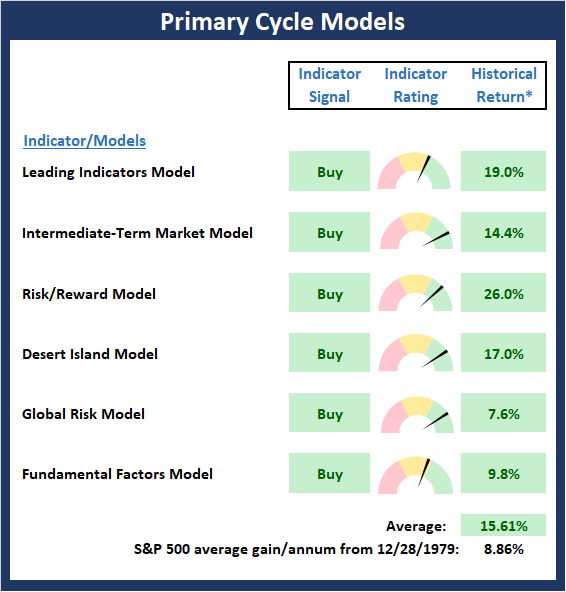
We start with six of our favorite long-term market models. These models are designed to help determine the "state" of the overall market.
The are no changes to the Primary Cycle board this week. And given that have been any number of geopolitical skirmishes with the Middle East over the year that usually don't have a lasting impact on stocks, I'll continue to support a bullish stance at this stage of the game from a macro point of view.
This week's mean percentage score of my 6 favorite market models held rose to 74.3% from 71.8% while the median upticked to 75.0% from 72.5%.
* Source: Ned Davis Research (NDR) as of the date of publication. Historical returns are hypothetical average annual performances calculated by NDR. Past performances do not guarantee future results or profitability - NOT INDIVIDUAL INVESTMENT ADVICE.
The State of the Fundamental Backdrop
Next, we review the market's fundamental factors in the areas of interest rates, the economy, inflation, and valuations.
Despite the recent uptick in market volatility, there have been no changes to the Fundamental Factors board this week. With the economic model in good shape and the monetary conditions holding steady, the two most important big-picture drivers (economic expansion vs. recession and the state of Fed policy) suggest investors should keep their offensive lineups in the game and use any dips to add to positions.

* Source: Ned Davis Research (NDR) as of the date of publication. Historical returns are hypothetical average annual performances calculated by NDR. Past performances do not guarantee future results or profitability - NOT INDIVIDUAL INVESTMENT ADVICE.
The State of the Trend
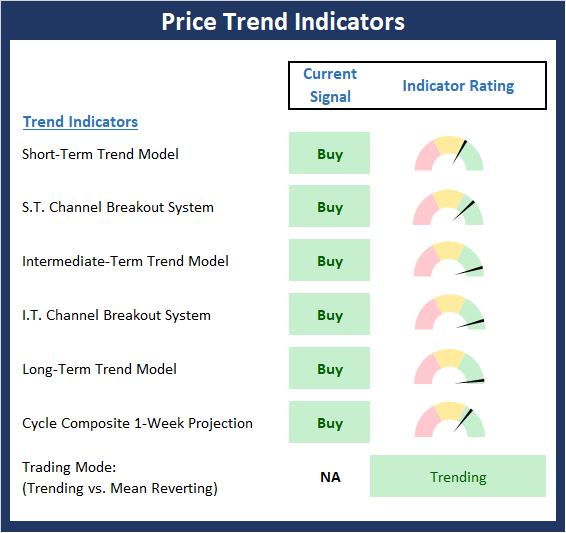
After looking at the big-picture models and the fundamental backdrop, I like to look at the state of the trend. This board of indicators is designed to tell us about the overall technical health of the current trend.
After a strong, virtually uninterrupted rally, it should surprise no one that something came out of the woodwork to create some selling. As should be expected, the Trend board took a small hit last week. However, the the intermediate and long-term trends remain in great shape, which tells me continue to buy-the-dips until/unless a lower-low were to occur on the charts.
NOT INDIVIDUAL INVESTMENT ADVICE.
The State of Internal Momentum
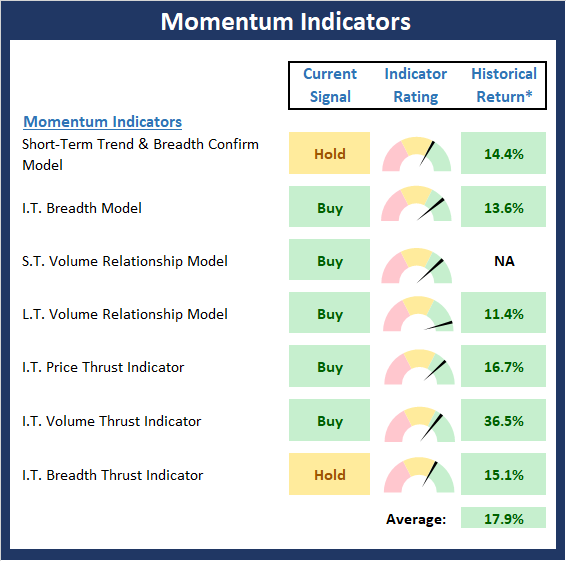
Next, we analyze the "oomph" behind the current trend via our group of market momentum indicators/models.
The Momentum board remains in pretty good shape. The "wobble" we started to see on the board last week suggested that a pause in the upside move was to be expected. But as long as we don't see any major breakdowns in the key momentum indicators, the current state of the board suggests, yep, you guessed it; giving the bulls the benefit of the doubt here.
* Source: Ned Davis Research (NDR) as of the date of publication. Historical returns are hypothetical average annual performances calculated by NDR. Past performances do not guarantee future results or profitability - NOT INDIVIDUAL INVESTMENT ADVICE.
Early Warning Signals
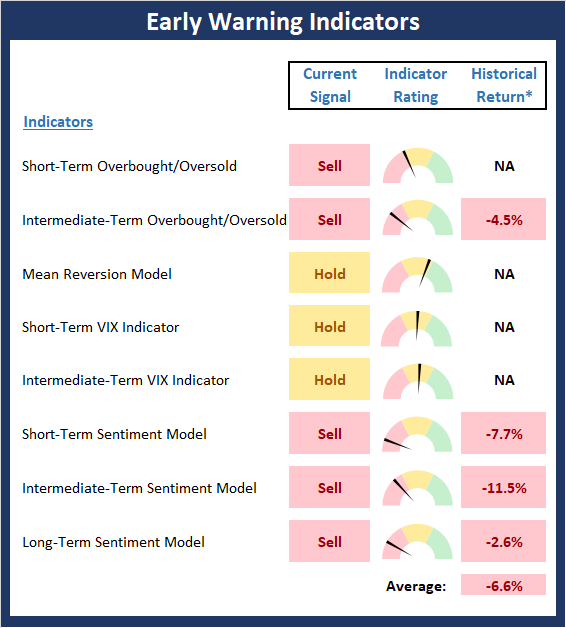
Once we have identified the current environment, the state of the trend, and the degree of momentum behind the move, we then review the potential for a counter-trend move to begin. This batch of indicators is designed to suggest when the table is set for the trend to "go the other way."
The message from the Early Warning board is now quite clear as the table has been set nicely for a counter-trend move. The question of the day is if the bear camp will be able to do anything with their opportunity. So far at least, the pullback has been very constructive and the selling hasn't been intense. However, in order to clear the table and see a favorable setup for our heroes in horns, we will likely have to endure a few scary down days.
* Source: Ned Davis Research (NDR) as of the date of publication. Historical returns are hypothetical average annual performances calculated by NDR. Past performances do not guarantee future results or profitability - NOT INDIVIDUAL INVESTMENT ADVICE.
Thought For The Day:
It is not only what we do, but also what we do not do, for which we are accountable. -Moliere
Wishing you green screens and all the best for a great day,



Comments
Log in or sign up to join the conversation.