

In March 1968, the US began an experiment in pure growth rate targeting. The value of the dollar was no longer fixed by any “level” type variable. Prior to March 1968, the dollar had been at least loosely linked to gold (at $35/ounce during 1934-68, and $20.67/ounce during 1879-1933.) It’s time to bring this 52-year experiment in growth rate targeting to an end.
The experiment can be divided into three phases:
1. 1968 – 81
2. 1981 – 2008
3. 2009 – present
During the first period, the failure to set a price level target path resulted in excessively high inflation. This reflected a myriad of errors, including misjudging the stance of monetary policy, the politicization of monetary policy, and the misapplication of the Phillips Curve model. It was not caused by “supply shocks”, as the excessive growth of NGDP was just as appalling as the performance of inflation. RGDP growth during 1968-81 was just fine.
During the second period, monetary policy was relatively successful.
During the third period, the failure to set a price level path resulted in excessively low inflation. This reflected a myriad of errors, including misjudging the stance of monetary policy, anxiety about a large balance sheet at the Fed, and over-reliance on predicting inflation with Phillips curve models (and under-reliance on market forecasts.)
In retrospect, level targeting would have greatly improved the performance of policy during the first and third periods and would have left the policy performance roughly the same during the middle period.
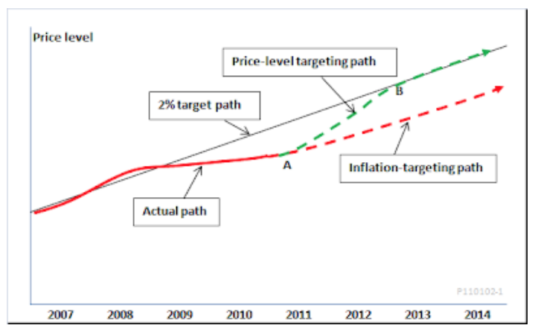
Right now, a switch to level targeting is a sort of “no-brainer” for the Fed. They’ve been discussing this idea for quite some time, so it wouldn’t be coming out of the blue. It would greatly improve policy during this crisis period, allowing a more rapid recovery from the recession. It would improve credibility, giving the markets more confidence that they would achieve their inflation target over time. It would eliminate the need for fiscal stimulus.
There’s no significant downside in committing to raise the PCE by 10.4% over the next 5 years (2% per year), and lots of downside for not setting this target.
I know that the Fed is a conservative institution that doesn’t like radical change, but that’s precisely why it’s the right time for level targeting. If they don’t do level targeting, the Fed will have to do far more of the sort of highly controversial “concrete steps” that Fed officials prefer not to do. Level targeting is a pragmatic solution, a solution that makes their job easier, not harder. It’s a failure to level target that would be risky and radical, opening the door to demands that the Fed get far more involved in bailing out the economy than is desirable.
So my message to the FOMC is, “Please, take the easy way out. Level target.”
My conspiratorial commenters will tell me that Fed officials view heavy involvement in running the economy as a feature, not a bug. I don’t believe that. I believe the FOMC wants to do the right thing.
Every expert from Michael Woodford to Ben Bernanke to Christina Romer will tell you that at the zero bound you need to level target.
So do it. Please.
PS. Ed Dolan has a post that explains level targeting, and provides this nice graph:
(Click on image to enlarge)
Update:Even in this crisis period, there’s always room for some comic relief:
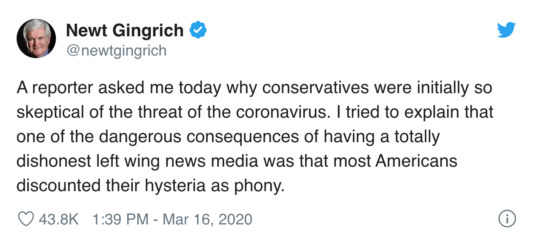
Let me add that the left wing news media is also responsible for conservatives being wrong about global warming, evolution, and a host of other issues.


Comments
Log in or sign up to join the conversation.